




 BOM
BOM Cart
Cart Product Catalog
6N137 is a high-speed optocoupler widely used in modern electronic systems for reliable electrical isolation and fast digital signal transmission. It helps protect sensitive circuits from voltage spikes, electrical noise, and ground loop interference while allowing communication between isolated sections of a circuit without direct electrical contact. Because its excellent speed and noise immunity, the component commonly use in industrial automation, communication interfaces, and switching applications.
The optocoupler specifically design for high-speed signal isolation. It combines an AlGaAs infrared LED with a high-speed photodetector to achieve fast switching performance and excellent noise immunity. With support for data rates up to 10MBd and common mode transient immunity of 10kV/μs, the device is suitable for applications such as microcontroller interfaces, switching power supplies, motor drives, and digital communication systems.
This article provides a detailed overview of the 6N137 opto coupler, including its pinout, features, specifications, applications, alternatives, and comparison with the 6N138 optocoupler. Whether you are designing an industrial automation system or building an isolated communication interface, understanding the capabilities of the component can help improve circuit reliability and performance.
1. What is a 6N137 Optocoupler?
3. Key Features and Specifications
7. Where and How to Use 6N137 Optocoupler?
8. Frequently Asked Questions [FAQ]
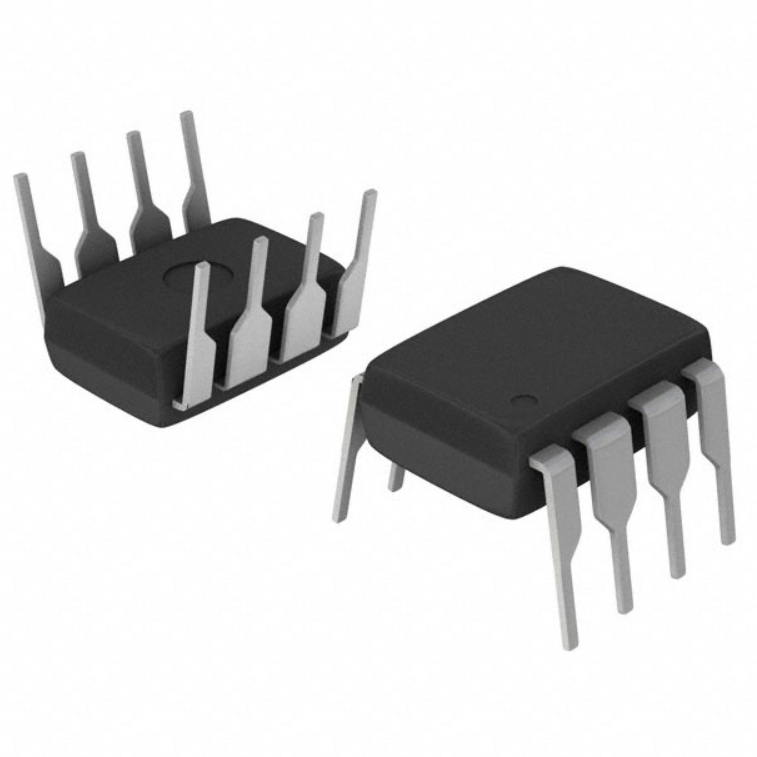
What is a 6N137 Optocoupler?
The 6N137 is a high-speed optocoupler designed for signal isolation and fast digital communication applications. It consists of an AlGaAs infrared LED optically coupled to a high-speed photodetector. The output stage features an open collector transistor, making the device suitable for interfacing with TTL, CMOS, and microcontroller circuits.
The 6N137 provides excellent electrical isolation between input and output circuits while allowing high-speed data transmission up to 10MBd. Commonly use in industrial automation, motor control systems, switching power supplies, communication interfaces, and digital isolation circuits.
One of the major advantages of the circuit is its high Common Mode Transient Immunity (CMTI), typically rated at 10kV/μs. This allows the device to operate reliably in noisy electrical environments with large voltage transients.
The operating temperature range is from -40°C to +85°C, making it suitable for industrial and commercial applications.
6N137 Pinout
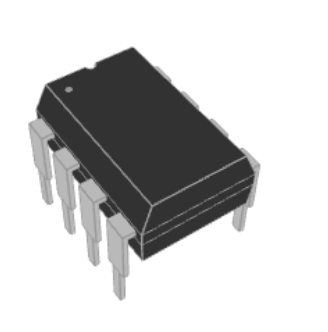
The optocoupler comes in an 8-pin DIP or SMD package and design for high-speed digital isolation applications. Each pin has a specific function for powering the device, controlling the internal infrared LED, and providing isolated output signals.
Pin Configuration
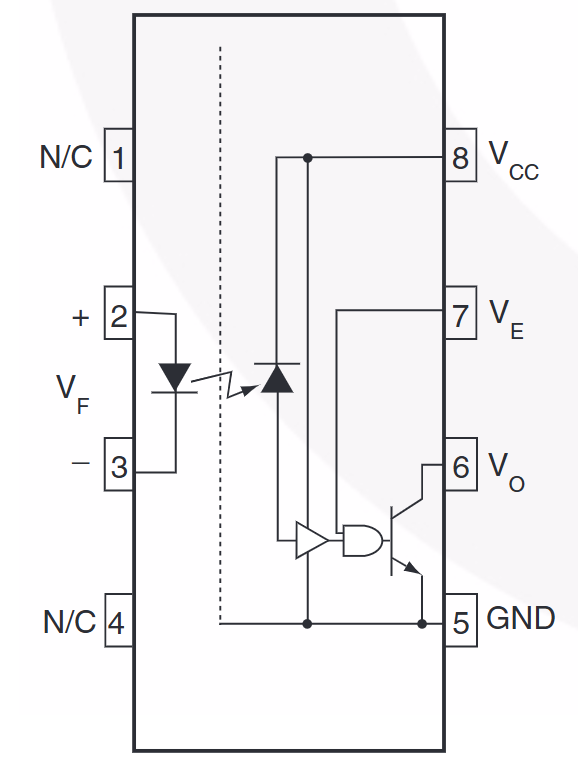
Pin No | Pin Name | Description |
1 | NC | No internal connection and should remain unused in the circuit. |
2 | Anode (A) | Anode terminal of the internal infrared LED connected to the input signal through a current-limiting resistor. |
3 | Cathode (C) | Cathode terminal of the internal LED, usually connected to ground on the input side. |
4 | NC | No internal connection and should not use. |
5 | Ground | Ground reference pin for the output side circuitry of the optocoupler. |
6 | Output (VO) | Open collector isolated output pin that delivers the digital output signal. |
7 | Enable (VE) | Used to enable or disable the output stage and commonly connected with a pull-up resistor for normal operation. |
8 | VCC | Positive power supply pin for the output side of the device. |
6N137 CAD Model
Available in several package styles including DIP-8 and SMD packages.
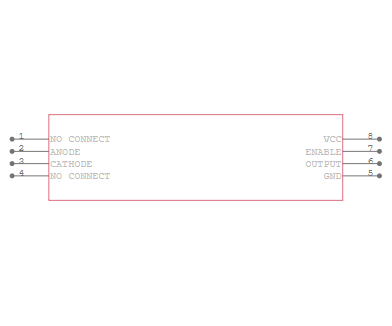
Symbol
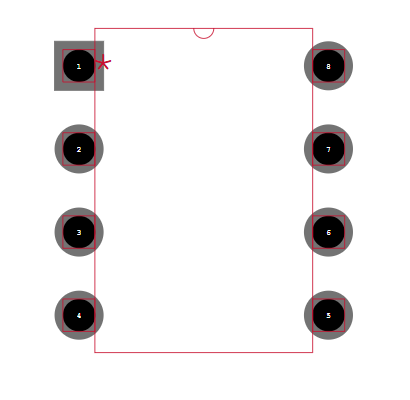
Footprint
3D Model
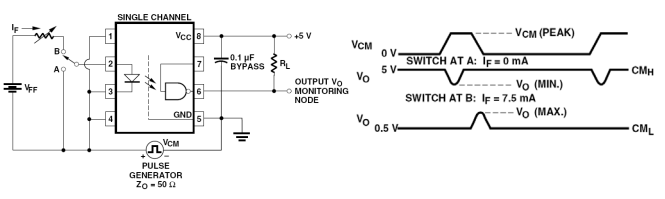
6N137 Application Circuit
6N137 Key Features and Specifications
Main Feature
High-Speed Operation:
The component supports data transmission speeds up to 10MBd, making it suitable for high-speed digital communication and signal isolation applications.
High Common Mode Rejection:
It provides excellent common mode transient immunity of up to 10kV/μs, allowing stable operation in electrically noisy environments.
Open Collector Output:
The device features an open collector output configuration, making it compatible with various digital logic circuits and external pull-up resistor configurations.
Excellent Noise Immunity:
The internal shielding design helps reduce interference and improves signal reliability in industrial and high-voltage applications.
Wide Operating Temperature Range:
The circuit operates reliably across a temperature range of -40°C to +85°C, making it suitable for industrial and commercial systems.
High Isolation Voltage:
It offers electrical isolation up to 5000Vrms between the input and output sides for improved circuit protection and safety.
TTL and CMOS Compatibility:
The optocoupler can interface directly with TTL and CMOS logic families, simplifying digital circuit integration.
Available Package Types
6N137 – Dual In-Line Package
6N137M – Wide Lead Spacing Package
6N137S – Surface Mount Package
6N137S-TA / TA1 – Tape and Reel Packaging
6N137 Specifications
Table
Parameter | Specification |
Data Rate | 10MBd |
Manufacturer | Lite-On Inc. |
Propagation Delay tpLH / tpHL (Max) | 75ns / 75ns |
Rise / Fall Time (Typ) | 22ns / 6.9ns |
Forward Voltage Vf (Typ) | 1.38V |
Number of Channels | 1 |
Maximum Forward Current | 20mA |
Input Configuration | 1/0 |
Supply Voltage | 7V |
Isolation Voltage | 5000Vrms |
Operating Temperature | -40°C to +85°C |
Common Mode Transient Immunity | 10kV/μs |
Mounting Type | Through Hole, Surface Mount |
Input Type | DC |
Output Type | Open Collector |
Output Current | 50mA |
Package Type | 8-DIP, 8-SMD |
6N137 Package Information
Available in the following packages:
· 8-DIP
· 8-SMD
These packages provide flexibility for both through-hole and surface mount PCB designs.
About 6N137 Manufacturers
The 6N137 optocoupler manufacture by several semiconductor companies including:
Avago Technologies, Lite-On Inc. and onsemi.
These manufacturers provide different package variants and reliability grades suitable for industrial, communication, and automation applications.
6N137 Application
High Voltage Isolation
Used to electrically isolate low-voltage control circuits from high-voltage systems.
Line Receivers
Suitable for high-speed digital communication interfaces and signal reception.
Switching Mode Power Supplies
Commonly used as feedback elements in SMPS circuits to maintain isolation between primary and secondary sides.
Logic Ground Isolation
Provides isolation between TTL, CMOS, and LSTTL logic systems.
Pulse Transformer Replacement
Can replace bulky pulse transformers in digital signal transmission applications.
Motor Drive Isolation
Protects low-voltage control electronics from high-power motor drive circuits.
Microprocessor Interfaces
Used for safe communication between microcontrollers and external equipment.
Ground Loop Elimination
Prevents noise and interference caused by ground loops in communication systems.
6N137 Alternative and Equivalent
Can use several optocouplers as alternatives depending on speed and application requirements.
HCPL4503M
The HCPL4503M is a transistor-output optoisolator with 5kV isolation voltage in an 8-DIP package. Commonly use in digital isolation and industrial control applications.
MOC3021
The MOC3021 is a zero-crossing TRIAC optoisolator designed for AC load switching and isolation in lighting controls, motor controls, and power switching circuits.
MCT2E
The MCT2E is a non-zero crossing transistor-output optocoupler with 5.3kV isolation. Suitable for signal isolation and low-speed switching applications.
MOC3041
The MOC3041 is a non-zero cross TRIAC optoisolator available in a 6-SMD package. It is widely used in AC power control and solid-state relay circuits.
FOD3180
The FOD3180 is a high-speed MOSFET gate driver optocoupler designed for motor drives, inverter systems, and power transistor isolation applications.
PC817
The PC817 is a popular general-purpose optoisolator with transistor output and 5kV isolation. It is commonly used in switching power supplies and microcontroller isolation circuits.
4N25
The 4N25 is a standard transistor-output optocoupler in a 6-DIP package widely used for signal isolation, interfacing, and low-speed switching applications.
Comparing 6N137 and 6N138
Table
Parameter | 6N137 | 6N138 |
Manufacturer | Lite-On Inc. | Lite-On Inc. |
Data Rate | 10MBd | Lower Speed |
Output Type | Open Collector | Darlington with Base |
Propagation Delay tpLH / tpHL (Max) | 75ns / 75ns | — |
Turn On / Turn Off Time (Typ) | — | 1.6µs / 10µs |
Rise / Fall Time (Typ) | 22ns / 6.9ns | Slower |
Forward Voltage Vf (Typ) | 1.38V | 1.1V |
Maximum Forward Current | 20mA | 20mA |
Number of Channels | 1 | 1 |
Input Configuration | 1/0 | — |
Supply Voltage | 7V | 7V Output Max |
Isolation Voltage | 5000Vrms | 5000Vrms |
Operating Temperature | -40°C to +85°C | -20°C to +85°C |
Common Mode Transient Immunity | 10kV/µs | — |
Current Transfer Ratio (Min) | — | 300% @ 1.6mA |
Current Transfer Ratio (Max) | — | 2600% @ 1.6mA |
Output Current | 50mA | 50mA |
Input Type | DC | DC |
Key Difference
The 6N137 is optimized for high-speed digital communication and logic isolation with fast switching performance. In contrast, the 6N138 offers a much higher current transfer ratio using a Darlington output configuration, making it more suitable for low-speed isolation and signal amplification applications.
Where and How to Use 6N137 Optocoupler?
The 6N137 is ideal for applications requiring fast signal transmission with electrical isolation. Commonly used in:
Industrial Automation Systems:
Used for isolating PLC signals, sensors, and control lines in industrial environments where electrical noise and voltage spikes are common.
Microcontroller Interfaces:
Ideal for isolating communication lines such as UART, SPI, and I2C between microcontrollers and external modules.
Switching Power Supplies (SMPS):
Used as feedback and control signal isolation components to ensure safe operation between primary and secondary sides.
Motor Control Circuits:
Protects control electronics from high-voltage switching noise in motor driver and inverter systems.
Communication Systems:
Commonly used in RS-232, RS-485, and other serial communication interfaces requiring signal isolation.
Ground Loop Protection:
Eliminates ground loop noise by isolating different ground domains in a circuit.
How to Use the 6N137
1. Connect the input LED through a current-limiting resistor.
2. Supply VCC to pin 8 and ground pin 5.
3. Connect a pull-up resistor to the output pin.
4. Tie the enable pin appropriately.
5. Add a bypass capacitor between VCC and GND for stable operation.
Proper PCB layout and short signal paths help achieve maximum switching speed and noise immunity.
6N137 Datasheet PDF
The datasheet provides detailed information. Users should always consult the data sheet before designing circuits with the 6N137 optocoupler.
Frequently Asked Questions [FAQ]
What is the difference between 6N139 and 6N137?
The 6N 137 is a high-speed optocoupler designed for fast digital communication, while the 6N139 provides higher current transfer ratio but slower switching speed. The 6N139 is better for low-speed isolation applications.
What is the maximum data rate of a 6N137?
Supports data transmission speeds up to 10MBd, making it suitable for high-speed digital communication and logic isolation applications.
What are common uses for the 6N137 optocoupler?
Common applications include switching power supplies, motor drives, digital communication interfaces, logic isolation, microcontroller protection, and industrial automation systems.
How does the 6N137 function?
The internal infrared LED emits light when driven by an input signal. The photodetector receives the light and switches the output transistor, transferring the signal across an electrically isolated barrier.
What is the difference between the TLP521 and the 6N137?
The TLP521 is a general-purpose optocoupler with slower switching speed, while the 6N 137 design specifically for high-speed digital isolation applications with much faster response time and higher noise immunity.
Conclusion
The 6N137 is a reliable high-speed optocoupler widely used for digital signal isolation in industrial, communication, and power electronics applications. Its fast switching performance, excellent common mode transient immunity, and strong electrical isolation make it suitable for demanding environments.
With support for data rates up to 10MBd and compatibility with TTL and CMOS logic systems, the 6N 137 remains a popular choice for engineers designing isolated digital interfaces and high-speed communication circuits.
Read More:
1. MT3608 Boost Converter - An In-Depth Guide
2. 4N35 Optocoupler – Complete Guide, Pinout and Datasheet
3. Mini MP1584 DC-DC 3A Buck Converter Module: Complete Guide
HOT NEWS
TP4056 Charging Module Pinout, Working, and Applications
TP4056 Charging Module Pinout, Working, and Applications
2026-01-23
LR41 Battery Guide: Specifications, Equivalents, and Uses
LR41 Battery Specifications, Equivalents, and Uses
2025-12-14
Understanding A 0603 Resistor
0603 resistor,dimensions,marking code, values
2025-05-29
Understanding The CD4051 Analog Multiplexer
CD4051 analog multiplexer
2025-06-30
MT3608 Boost Converter - An In-Depth Guide
MT3608 Boost Converter
2025-09-04
Complete Guide to the 220 Ohm Resistor
220 Ohm Resistor
2025-07-28
The 0402 Resistor: A Comprehensive Guide
0402 Resistor
2025-05-06
Guide To The XL6009 Boost Converter
XL6009 Boost Converter
2025-09-05
Mini MP1584 DC-DC 3A Buck Converter Module: Complete Guide
Mini MP1584 DC-DC 3A Buck Converter Module: Complete Guide
2026-03-26
What Is A 1206 Resistor?
1206 resistor dimensions,footprint,value
2025-06-05