




 BOM
BOM Cart
Cart Product Catalog
ADS1220 is a high-precision 24-bit analog-to-digital converter (ADC) designed for accurately measuring small analog sensor signals. As a sigma-delta ADC from Texas Instruments, it combines a programmable gain amplifier, flexible input multiplexer, excitation current sources, voltage reference, temperature sensor, and SPI interface in a compact package. With up to 128× programmable gain and data rates up to 2kSPS, ADS 1220 is widely suited for RTDs, thermocouples, thermistors, resistive bridge sensors, industrial automation, and precision measurement systems.
7. ADS1220 ADC I2C 24 Bit A/D Converter Sensor Module
8. Frequently Asked Questions [FAQ]
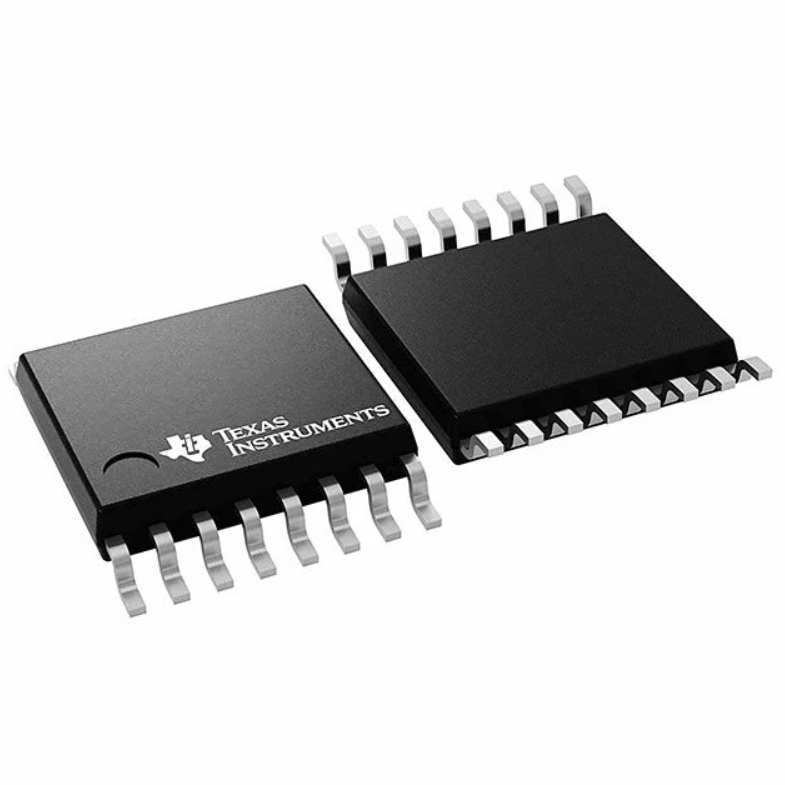
What is ADS1220?
ADS1220 is a precision 24-bit sigma-delta analog-to-digital converter (ADC) from Texas Instruments, designed for accurately measuring small analog sensor signals. It integrates a flexible input multiplexer, low-noise programmable gain amplifier (PGA), programmable excitation current sources, voltage reference, oscillator, low-side switch, and temperature sensor into a compact device.
ADS 1220 supports two differential inputs or four single-ended inputs through its flexible MUX configuration. Its internal PGA provides programmable gains from 1 to 128, making the ADC suitable for low-level signals from RTDs, thermocouples, thermistors, and resistive bridge sensors.
The ADS1220 ADC supports data rates up to 2000 samples per second (SPS) with single-cycle settling. At 20 SPS, its digital filter provides simultaneous 50Hz and 60Hz rejection, which helps improve measurement stability in industrial environments affected by power-line noise.
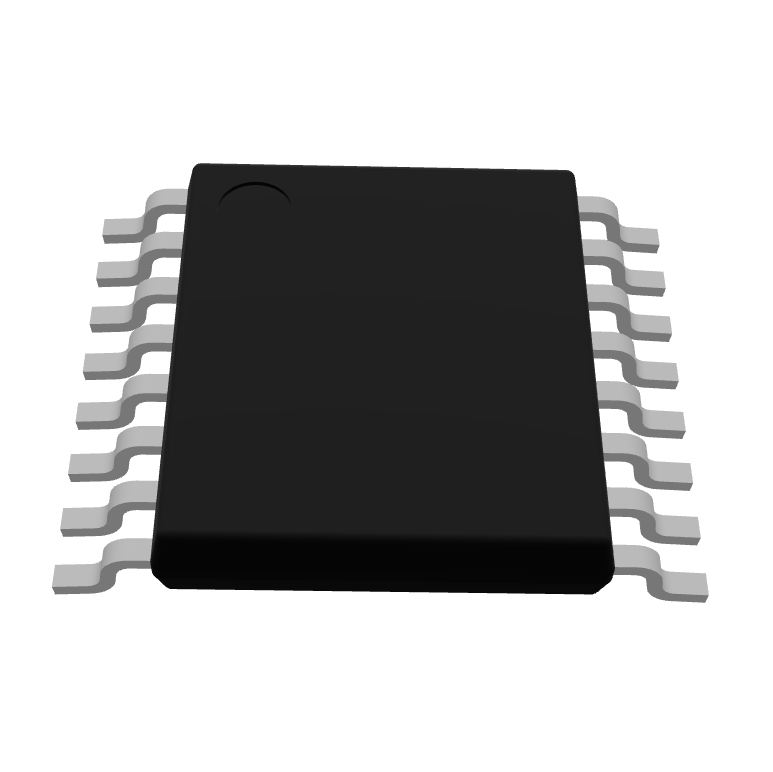
The component can operate from a 2.3V to 5.5V supply and uses an SPI-compatible serial interface. With the PGA disabled and duty-cycle operation enabled, typical power consumption can be as low as 120μA. The device is available in 16-pin VQFN and 16-pin TSSOP packages and is specified for an operating temperature range of -40°C to +125°C.
ADS1220 Pin Configuration
ADS 1220 uses a 16-pin interface that combines analog inputs, reference inputs, power connections, and an SPI-compatible digital interface.
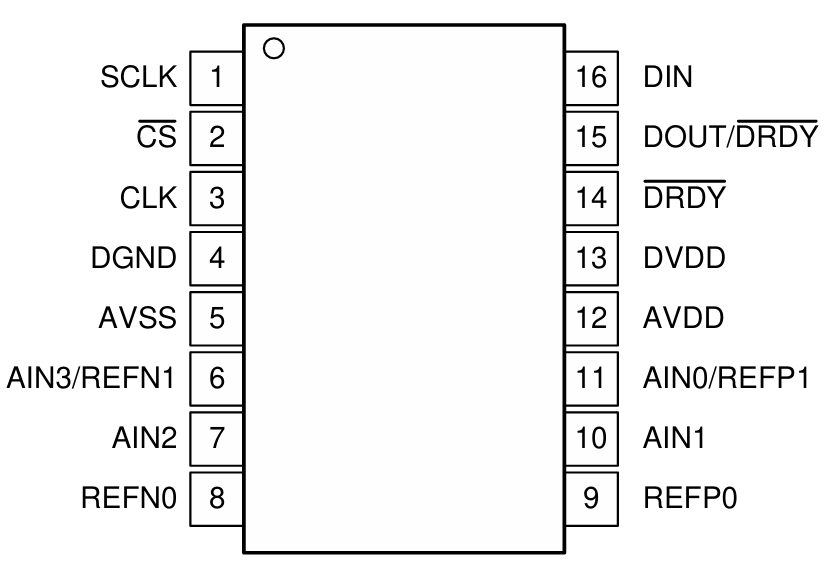
Pin | Name | Type | Description |
1 | SCLK | Digital Input | SPI serial clock input |
2 | CS | Digital Input | Active-low chip select; connect to DGND if not used |
3 | CLK | Digital Input | External clock input; connect to DGND if not used |
4 | DGND | Digital Supply | Digital ground |
5 | AVSS | Analog Supply | Negative analog power supply |
6 | AIN3/ REFN1 | Analog Input | Analog input 3 or negative reference input 1; also connected to the internal low-side power switch |
7 | AIN2 | Analog Input | Analog input 2 |
8 | REF0 | Analog Input | Negative reference input 0 |
9 | REFPO | Analog Input | Positive reference input 0 |
10 | AIN1 | Analog Input | Analog input 1 |
11 | AIN0/ REFP1 | Analog Input | Analog input 0 or positive reference input 1 |
12 | AVDD | Analog Supply | Positive analog power supply |
13 | DVDD | Digital Supply | Positive digital power supply |
14 | DRDY | Digital Output | Active-low data-ready output |
15 | DOUT/ DRDY | Digital Output | SPI serial data output combined with data-ready |
16 | DIN | Digital Input | SPI serial data input |
The circuit also includes a thermal pad. The thermal pad should not connect to external circuitry, or it can connect to AVSS according to the recommended PCB layout.
ADS1220 CAD Model
Symbol
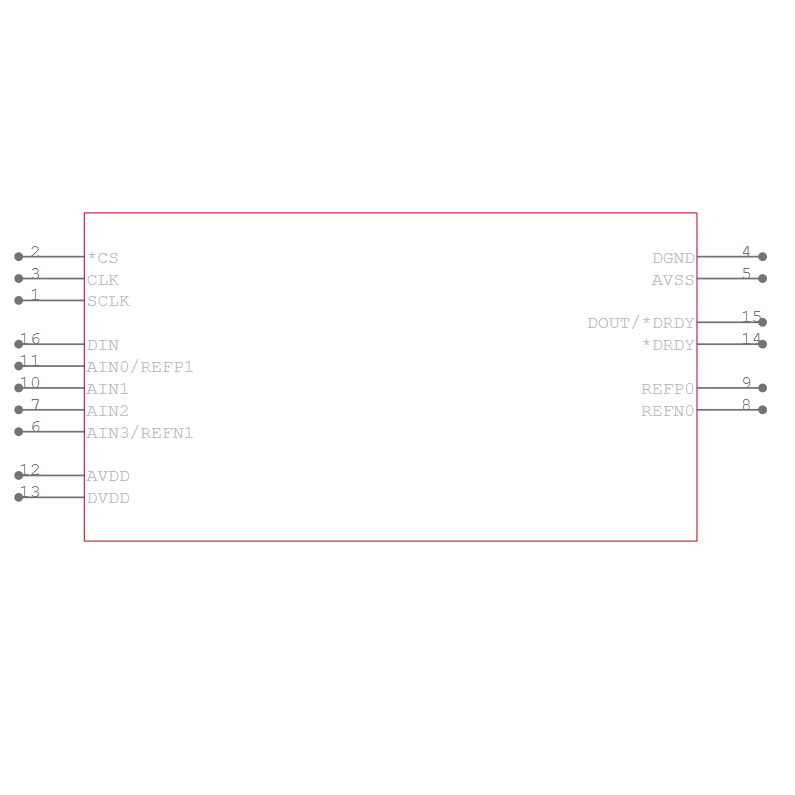
Footprint
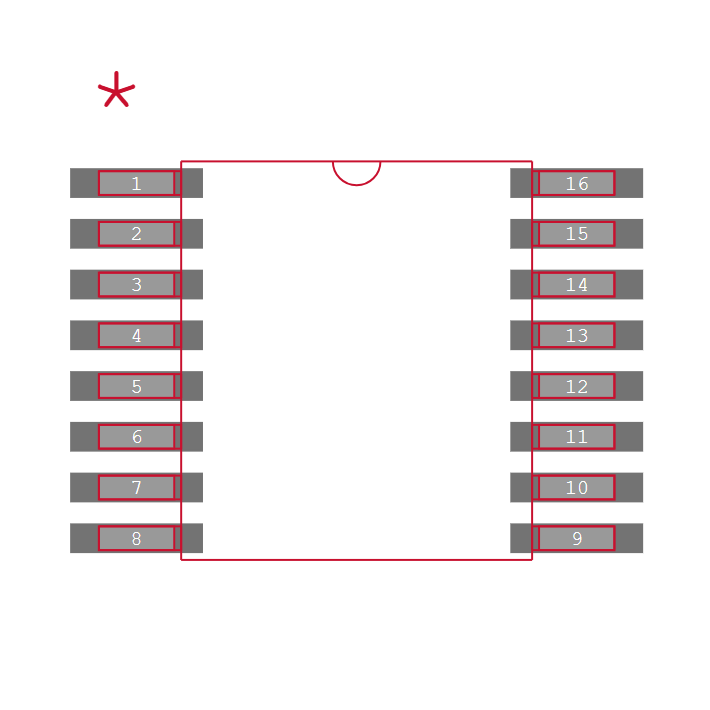
3D Model
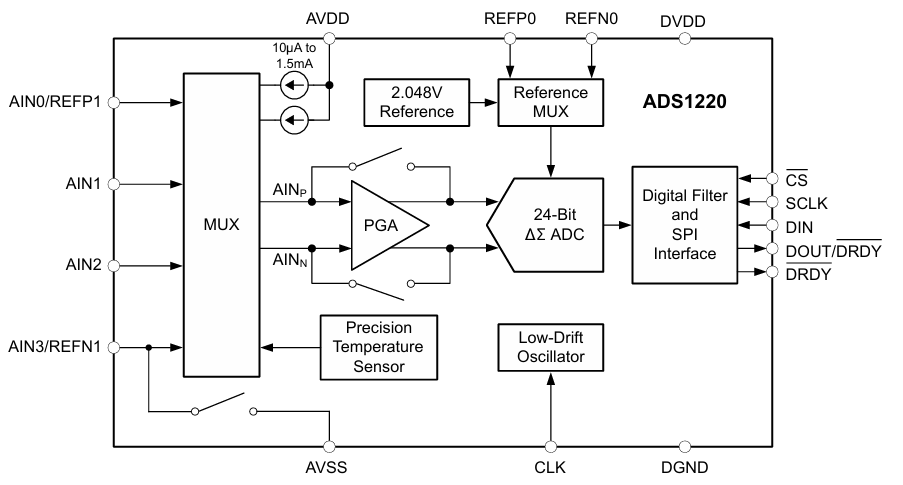
ADS1220 Functional Block Diagram
ADS1220 Features
Low Power Consumption: The ADC is designed for low-power precision measurement applications. Its current consumption can be as low as 120μA (typical) when operating in duty-cycle mode with the PGA disabled.
Wide Supply Range: The device supports a wide supply voltage range from 2.3V to 5.5V, providing flexibility for different embedded systems and sensor measurement circuits.
Programmable Gain: The integrated low-noise programmable gain amplifier offers selectable gains from 1 to 128. This high gain capability allows accurate measurement of small differential sensor signals.
Data Rates: Programmable data rates reach up to 2kSPS, allowing users to select an appropriate conversion speed for different measurement applications.
Effective Resolution: The 24-bit ADC can provide up to 20 bits of effective resolution under suitable operating conditions, making it suitable for high-precision analog signal acquisition.
50Hz and 60Hz Rejection: At a data rate of 20SPS, the digital filter provides simultaneous rejection of 50Hz and 60Hz interference. The single-cycle settling response is useful for noisy industrial measurement environments.
Input Configuration: The flexible input multiplexer supports two differential inputs or four single-ended inputs, accommodating various sensor and signal configurations.
Programmable Current Sources: Two matched programmable excitation current sources provide selectable current levels from 10μA to 1.5mA. They are particularly useful for sensor excitation applications such as RTD measurements.
Internal Voltage Reference: An integrated 2.048V voltage reference with a typical temperature drift of 5ppm/°C helps provide a stable reference for precision analog-to-digital conversion.
Internal Oscillator: The integrated oscillator offers approximately 2% accuracy, reducing the need for an external clock source in many applications.
Internal Temperature Sensor: An integrated temperature sensor provides approximately 0.5°C typical accuracy and can use for temperature monitoring and device-level temperature compensation.
SPI Interface: The SPI-compatible serial interface operates in Mode 1, providing a simple connection between the ADC and a microcontroller or other digital control system.
ADS1220 Technical Specifications
Table
Parameter | Value |
Architecture | Sigma-Delta |
Manufacturer | Texas Instruments |
Resolution | 24 Bit |
Supply Voltage, Analog | 2.3V~5.5V |
Supply Voltage, Digital | 2.3V~5.5V |
Programmable Gain | 1~128 |
Sampling Rate | Up to 2kSPS |
Effective Resolution | Up to 20 Bits |
Number of Inputs | 2 Differential / 4 Single-Ended |
Number of ADCs | 1 |
Input Type | Differential, Single-Ended |
Data Interface | SPI |
Features | PGA, Temperature Sensor |
Internal Reference | 2.048V |
Excitation Current | 10μA~1.5mA |
Operating Temperature | -40°C~+125°C |
Configuration | MUX-PGA-ADC |
Package | 16-TSSOP, 16-VQFN |
Mounting Type | Surface Mount |
ADS1220 Manufacturer
ADS 1220 is manufactured by Texas Instruments (TI), a semiconductor company known for analog and embedded processing products.
Packaging: Available in two compact 16-pin package options: 16-pin VQFN and 16-pin TSSOP. These surface-mount packages are suitable for compact PCB designs and precision sensor measurement applications.
ADS1220 Alternatives
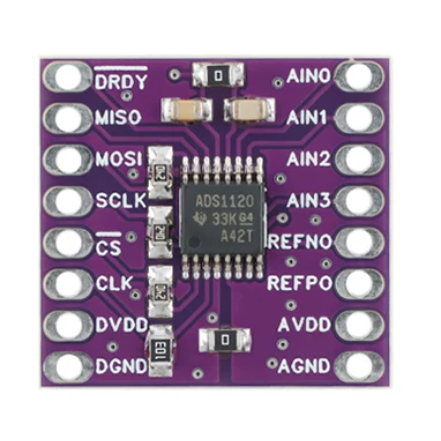
ADS1120 is one alternative to the ADS1220. It is also a precision sigma-delta ADC designed for small sensor signals and includes an input multiplexer, PGA, programmable excitation current sources, voltage reference, oscillator, low-side switch, and temperature sensor. The main difference is resolution: ADS1120 provides 16-bit conversion, while ADS 1220 provides 24-bit conversion.
For applications that require higher resolution for low-level sensor measurements, ADS 1220 is generally the more suitable choice. For applications where 16-bit resolution is sufficient and a similar integrated architecture is preferred, can consider ADS1120.
ADS1220IPW is a 24-bit ADC in a 16-pin TSSOP package and is supplied in tube packaging.
ADS1220IPWR is the corresponding 16-pin TSSOP version supplied in reel packaging, making it suitable for automated production.
ADS1220 Applications
Applications focus primarily on precision measurement systems where small analog sensor signals need to be converted into accurate digital data.
Field Transmitters: The chip is well suited for field transmitters used to measure temperature, pressure, strain, flow, and other industrial parameters. Its high resolution and programmable gain allow it to accurately capture small differential signals from sensors, even when the signal level is low. This makes it useful for reliable monitoring in demanding industrial environments.
PLC and DCS Modules: The component can be integrated into PLC and DCS analog input modules for accurate and stable signal acquisition. Its differential and single-ended input configurations support a wide range of industrial sensors and signal sources. In addition, its low-noise performance helps improve measurement accuracy and system reliability.
Patient Monitoring Systems: Can use in patient monitoring equipment for applications such as body temperature, pressure, and other low-level physiological measurements. Its high-resolution conversion capability enables precise acquisition of small sensor signals. With suitable circuit design and isolation, it can support dependable data collection in medical monitoring systems.
Factory Automation and Process Control: The circuit is suitable for factory automation, equipment monitoring, and process-control systems. Its high-resolution ADC, programmable gain, noise rejection, and integrated sensor functions help provide accurate measurements in electrically noisy environments. It can be used to monitor temperature, pressure, load, flow, and other process variables, supporting improved control and operational efficiency.
ADS1220 ADC I2C 24 Bit A/D Converter Sensor Module
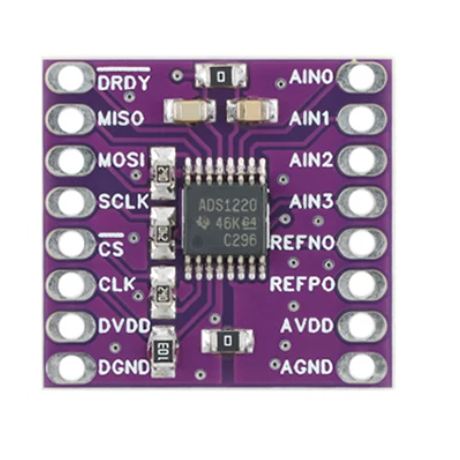
Precision ADC Sensor Module: The ADS 1220 is a 24-bit analog-to-digital converter designed for high-resolution measurement of small analog sensor signals. A typical module integrates the converter with supporting components and provides convenient connections for power, analog inputs, and digital communication.
SPI Interface: Unlike an I²C ADC, this device communicates with a microcontroller through an SPI-compatible interface. The main signals include SCLK, DIN, DOUT/DRDY, and CS, allowing connection to common microcontrollers and development boards with SPI support.
Sensor Applications: The module is suitable for RTDs, thermocouples, thermistors, resistive bridge sensors, and other low-level analog signals. Its programmable gain from 1 to 128 and high-resolution conversion capability make it useful for precision temperature, pressure, strain, and industrial measurement systems.
The data sheet provides detailed information, for circuit design, always check the latest datasheet to confirm operating limits, electrical specifications, pin functions, and recommended application conditions.
Frequently Asked Questions [FAQ]
What is ads1220 price?
Price depends on the package, ordering code, quantity, supply availability, and distributor. ADS1220IPW and ADS1220IPWR normally range from $0.6-$1.50. For an accurate current price, check the latest distributor quotation or supplier listing for the required package and quantity.
Does ADS1220 use I2C?
No. ADS1220 uses an SPI-compatible serial interface. The main digital communication pins include SCLK, DIN, DOUT/DRDY, and CS. Therefore, a microcontroller should use an SPI interface when communicating with the ADS 1220.
What sensors can ADS1220 measure?
ADS 1220 is suitable for RTDs, thermocouples, thermistors, resistive bridge sensors, and other low-level analog sensors. Its programmable PGA, differential inputs, excitation current sources, and integrated reference functions make it particularly useful for precision sensor signal acquisition.
What sensor types are best suited for the ADS1220?
The ADS 1220 is best suited for low-level precision sensors, including RTDs, thermocouples, thermistors, and resistive bridge sensors. Its programmable gain from 1 to 128, differential inputs, integrated excitation current sources, and high-resolution conversion make it particularly suitable for accurate temperature, pressure, strain, and industrial measurements.
Can the ADS1220 measure four independent single-ended signals?
Yes. The ADS 1220 can measure up to four single-ended analog signals through its flexible input multiplexer. It provides four analog input channels, AIN0 through AIN3, that can be selected for single-ended measurements. Alternatively, these inputs can be configured for two differential measurements when differential signal acquisition is required.
What is the effective resolution of the ADS1220?
The ADS 1220 is a 24-bit sigma-delta ADC, but its effective resolution depends on operating conditions such as data rate, gain, input signal, and noise. Under suitable conditions, it can provide up to 20 bits of effective resolution, making it suitable for precision measurement of small sensor signals.
Is ADS1220 a 24-bit ADC?
Yes. ADS 1220 is a 24-bit sigma-delta ADC. It is designed for precision measurement of small sensor signals and can provide up to 20 bits of effective resolution depending on operating conditions, data rate, gain, noise, and signal characteristics.
Conclusion
ADS1220 is a highly integrated 24-bit precision ADC designed for accurate measurement of small analog sensor signals. Its 1~128 programmable gain, differential and single-ended input configurations, up to 2kSPS data rate, integrated excitation current sources, voltage reference, temperature sensor, and 50Hz/60Hz noise rejection make it well suited to industrial and sensor-measurement applications.
With support for RTDs, thermocouples, thermistors, resistive bridges, PLC/DCS modules, field transmitters, and factory automation systems, ADS1220 provides a compact and flexible solution for high-resolution analog-to-digital conversion.
Read More:
1. ATMEGA8 8-bit Microcontroller Pinout and ATMEGA 8 Board
2. ATMEGA32 Microcontroller: Pinout, Features and Alternative
HOT NEWS
TP4056 Charging Module Pinout, Working, and Applications
TP4056 Charging Module Pinout, Working, and Applications
2026-01-23
LR41 Battery Guide: Specifications, Equivalents, and Uses
LR41 Battery Specifications, Equivalents, and Uses
2025-12-14
Understanding A 0603 Resistor
0603 resistor,dimensions,marking code, values
2025-05-29
MT3608 Boost Converter - An In-Depth Guide
MT3608 Boost Converter
2025-09-04
The 0402 Resistor: A Comprehensive Guide
0402 Resistor
2025-05-06
Complete Guide to the 220 Ohm Resistor
220 Ohm Resistor
2025-07-28
What Is A 1206 Resistor?
1206 resistor dimensions,footprint,value
2025-06-05
Guide To The XL6009 Boost Converter
XL6009 Boost Converter
2025-09-05
120 Ohm Resistor- Specifications, Applications, and Features
2025-05-12
Everything You Need To Know About ARE1309 Relay

2025-04-23