




 BOM
BOM Cart
Cart Product Catalog
The ATMEGA32 is one of the most popular 8-bit microcontrollers in embedded system design. Known for its balance of performance, flexibility, and low power consumption, widely use in industrial control, robotics, and consumer electronics.
In this comprehensive guide, we’ll explore everything you need to know—from architecture and pinout to applications and comparisons.
2. ATMEGA32 Pinout and CAD Model
10. Frequently Asked Questions [FAQ]
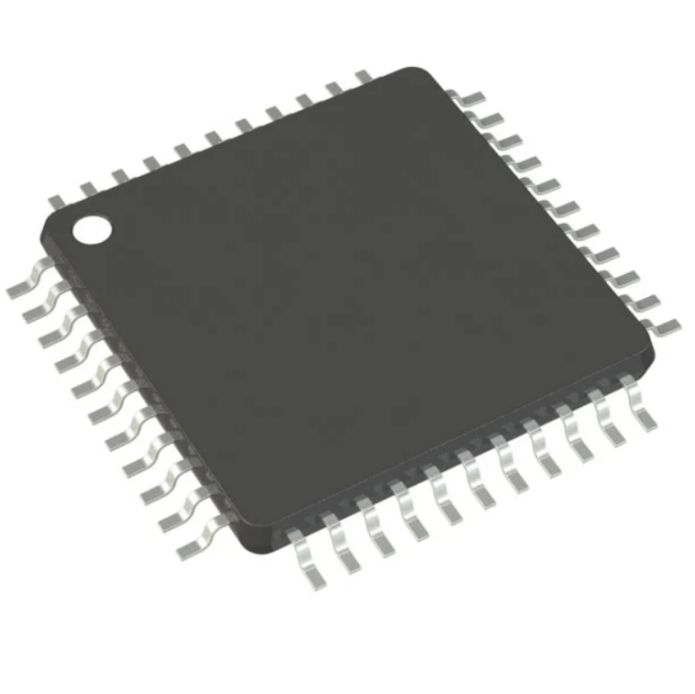
What is ATMEGA32?
The ATMEGA 32 is an 8-bit microcontroller with 32KB of In-System Programmable Flash memory, designed for a wide range of embedded applications. It belongs to the AVR family developed by Microchip Technology (formerly Atmel®) and build using advanced CMOS technology, making it highly efficient power consumption.
Based on the AVR enhanced RISC architecture, the ATMEGA 32 is capable of executing most instructions in a single clock cycle. This architecture allows the microcontroller to achieve a performance close to 1 MIPS per MHz, enabling designers to balance processing speed and energy efficiency effectively. As a result, it is well-suited for both low-power and high-performance embedded systems.
The microcontroller integrates essential components such as Flash memory, SRAM, EEPROM, timers, ADC, communication interfaces (USART, SPI, I2C), and multiple I/O ports into a single chip. This high level of integration reduces the need for external components, simplifying circuit design and lowering overall system cost.
With its flexibility, reliability, and ease of programming, the chip widely use in applications such as automation systems, robotics, consumer electronics, and industrial control systems.
ATMEGA32 Pinout and CAD Model
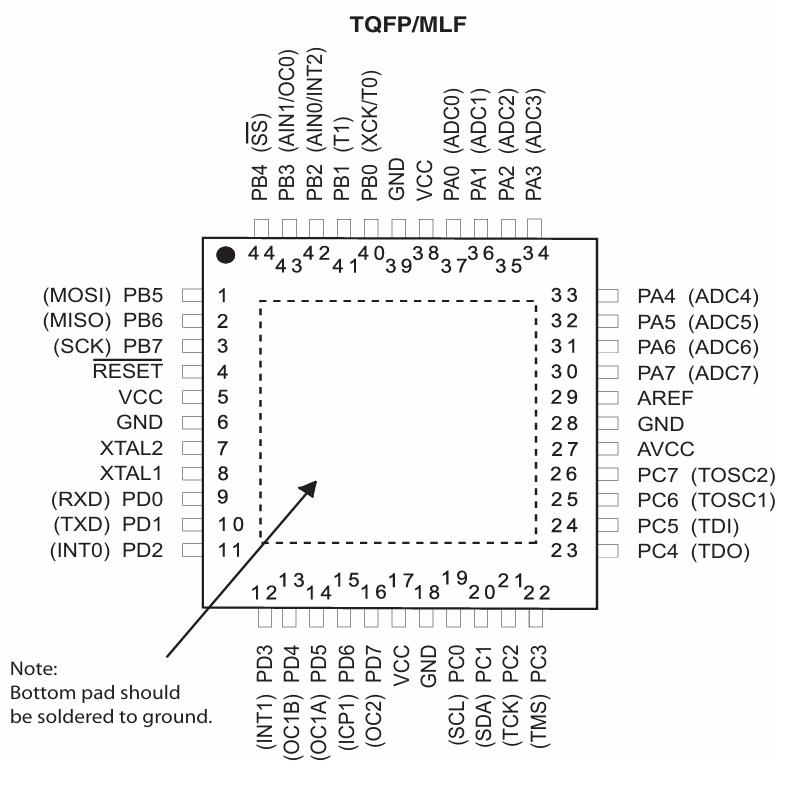
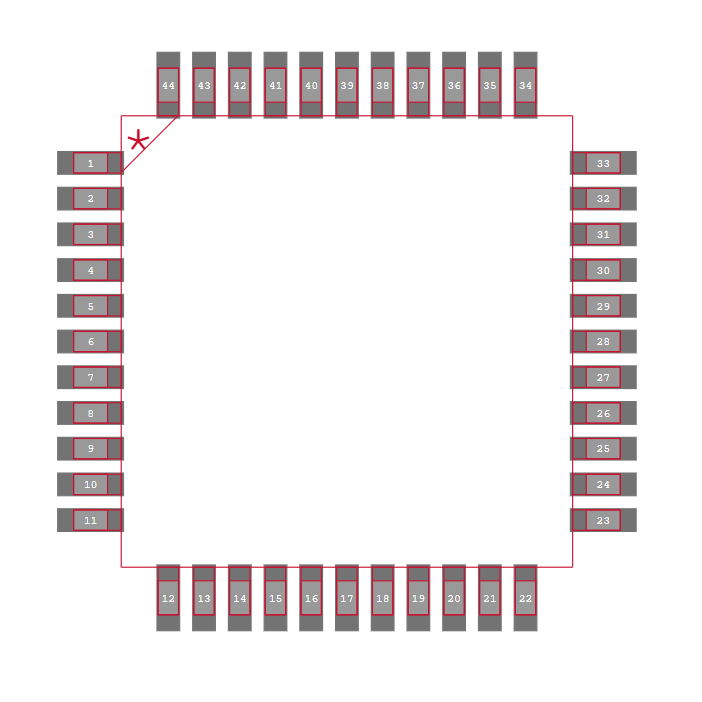
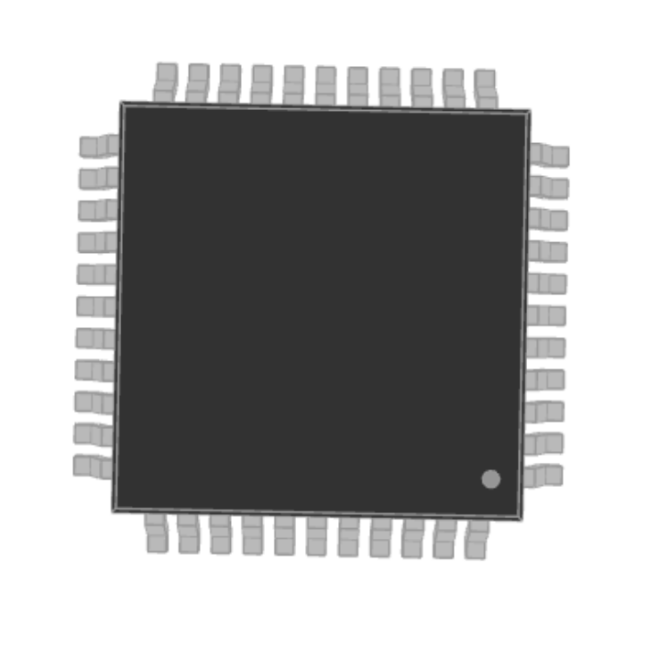
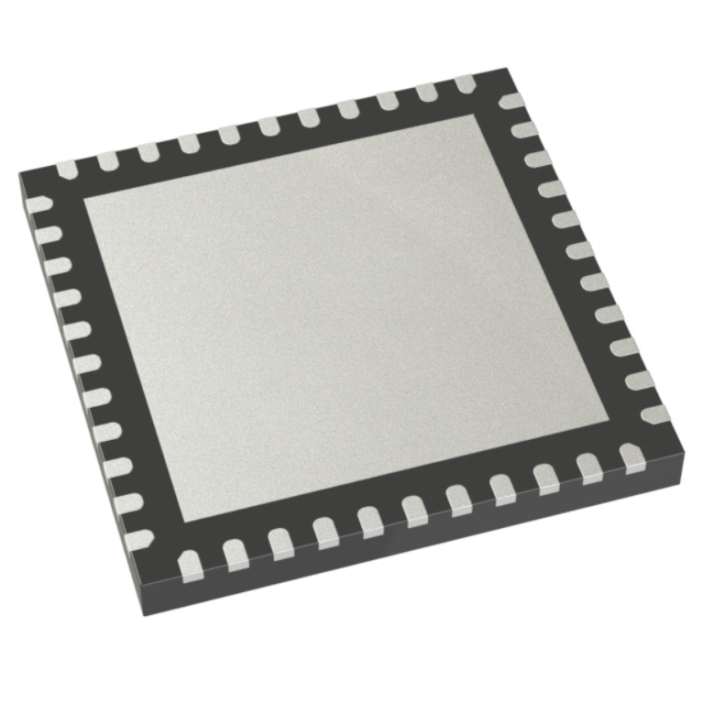
The ATMEGA 32 comes in multiple package types, including DIP-40, TQFP-44, and QFN-44. The pin configuration divide into four main ports and several control pins.
TQFP-44 and QFN-44
DIP-40
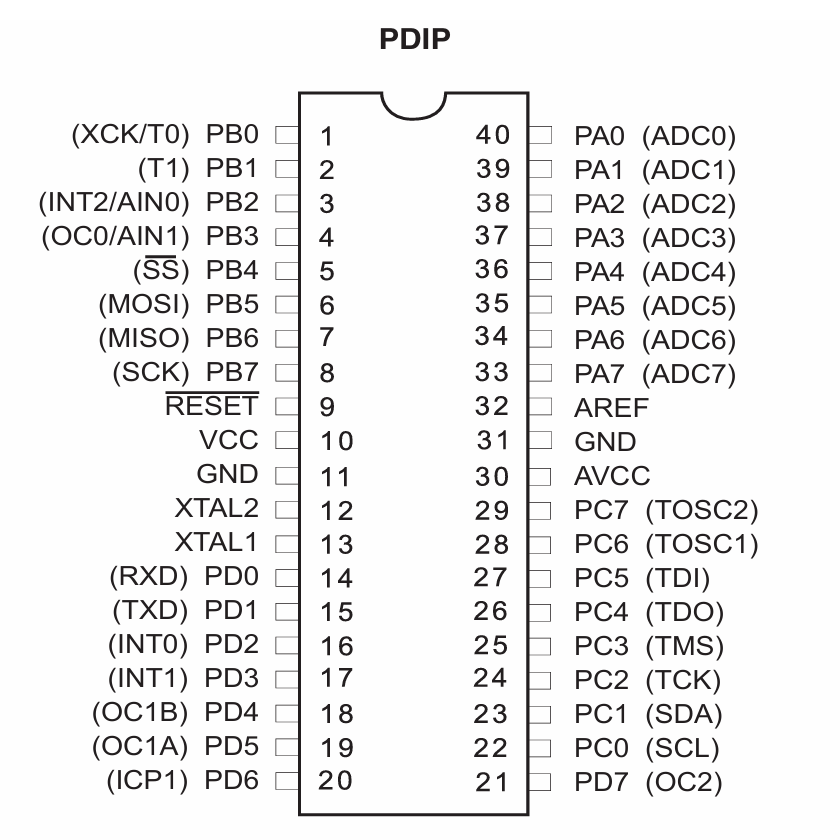
The microcontroller features multiple I/O ports, power pins, and control pins that enable flexible interfacing with external devices. Each pin group design to support both digital and analog functions, making the chip highly versatile for embedded system design.
Power Pins
VCC – Digital supply voltage that powers the microcontroller core.
GND – Ground reference for the circuit.
Port A (PA7–PA0)
Port A primarily functions as the analog input channels for the ADC (Analog-to-Digital Converter). It can also operate as an 8-bit bidirectional I/O port when not use ADC.
Supports internal pull-up resistors (configurable per pin)
Provides strong sink and source capability
When used as input with pull-ups enabled, externally low signals will cause current sourcing
Automatically enters tri-state mode during reset, even without a clock.
Port B (PB7–PB0)
Port B is a general-purpose 8-bit bidirectional I/O port.
Includes internal pull-up resistors for each pin.
Symmetrical drive strength for input/output operations.
Pins source current when pulled low externally with pull-ups enabled.
Becomes tri-stated during reset conditions.
Port C (PC7–PC0)
Port C also acts as an 8-bit I/O port with internal pull-up resistors, with additional functionality for debugging.
Supports JTAG interface:
PC5 (TDI), PC3 (TMS), PC2 (TCK)
Pull-ups remain active on JTAG pins even during reset.
TDO pin is tri-stated unless data shifting is active.
Like other ports, enters tri-state mode during reset.
Port D (PD7–PD0)
Port D is another 8-bit bidirectional I/O port, commonly used for communication and interrupts.
Internal pull-up resistors available.
Strong sink/source capability.
Sources current when externally pulled low with pull-ups enabled.
Automatically tri-stated during reset.
Control and Special Function Pins
RESET – Active-low reset input. A low signal longer than the minimum pulse width resets the microcontroller, even without a running clock.
XTAL1 – Input to the internal oscillator and clock circuitry.
XTAL2 – Output from the oscillator amplifier, typically connected to a crystal.
Analog Power and Reference Pins
AVCC – Supply voltage for Port A and ADC. Must connect to VCC even if ADC is unused. When using ADC, connect through a low-pass filter for noise reduction.
AREF – External reference voltage for the ADC, used to improve analog conversion accuracy.
This pin configuration allows the ATMEGA32 to interface easily with sensors, actuators, communication modules, and external peripherals, making it suitable for a wide range of embedded applications.
Symbol
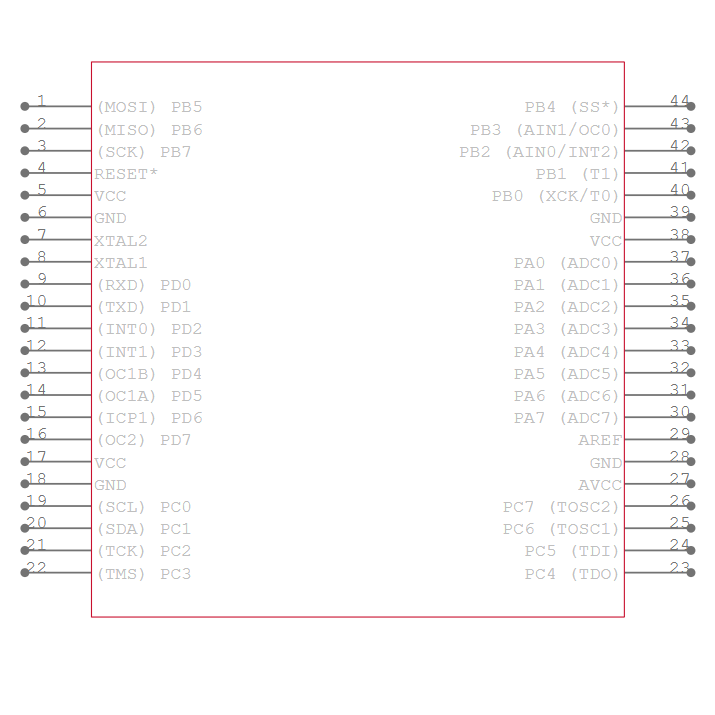
Footprint
3D Module
ATMEGA32 Specifications
ATMEGA 32 Specification Table
Parameter | Specification |
Core Processor | AVR 8-bit RISC Architecture |
Operating Voltage | 4.5V – 5.5V |
Clock Speed | Up to 16 MHz |
Flash Memory | 32 KB (In-System Programmable) |
EEPROM | 1 KB |
SRAM | 2 KB |
Number of I/O Pins | 32 Programmable I/O Lines |
Timers/Counters | 2 × 8-bit, 1 × 16-bit |
PWM Channels | 4 Channels |
ADC | 8-channel, 10-bit ADC |
Communication Interfaces | USART, SPI, I2C (TWI) |
Analog Comparator | Yes (On-chip) |
Watchdog Timer | Yes (with separate oscillator) |
Interrupt Sources | External and Internal Interrupts |
JTAG Interface | Yes (IEEE 1149.1 Compliant) |
Oscillator Types | Internal RC Oscillator, External Crystal |
Power Consumption | Active: ~1.1mA @ 1MHz, 3V |
Sleep Modes | Idle, ADC Noise Reduction, Power-save, Power-down, Standby, Extended Standby |
Data Retention | 20 years @ 85°C / 100 years @ 25°C |
Flash Write/Erase Cycles | 10,000 cycles |
EEPROM Write/Erase Cycles | 100,000 cycles |
Package Types | DIP-40, TQFP-44, QFN-44 |
Operating Temperature | -40°C to +85°C |
Manufacturer | Microchip Technology |
DIP Package (Through-Hole)
ATMEGA32-16PU – DIP-40
This version features 40 pins and widely use for prototyping and educational purposes. It is easy to handle, compatible with breadboards, and convenient for manual soldering and replacement.
SMD Packages (Surface-Mount)
ATMEGA32-16AU – TQFP-44 (Thin Quad Flat Package)
This package includes 44 pins and offers a more compact form factor than DIP. It is suitable for standard PCB designs and provides additional pins such as extra power and ground for improved stability.
ATMEGA32-16MU – QFN-44 (Quad Flat No-lead Package)
Summary Table
Package | Part Number | Pins | Type | Application |
DIP-40 | ATMEGA32-16PU | 40 | Through-hole | Prototyping, DIY |
TQFP-44 | ATMEGA32-16AU | 44 | SMD | General PCB design |
QFN-44 | ATMEGA32-16MU | 44 | SMD | Compact, high-density boards |
ATMEGA32 Manufacturer
The ATMEGAb32 microcontroller manufacture by Microchip Technology, a leading global provider of embedded control solutions and semiconductor products.
Originally developed by Atmel®, the AVR microcontroller family, including ATMEGA32, became part of Microchip Technology after its acquisition. Today, Microchip continues to support, produce, and enhance these widely used 8-bit microcontrollers for industrial, commercial, and educational applications.
ATMEGA32 Features
High-performance Microcontroller
The ATMEGA 32 is a low-power, 8-bit AVR microcontroller designed for high-performance embedded applications. Its architecture supports efficient instruction execution, allowing most commands to complete in a single clock cycle, resulting in up to 16 MIPS throughput at 16 MHz.
Advanced RISC Architecture
Featuring 131 powerful instructions, the component includes 32 × 8 general-purpose working registers and fully static operation. It also incorporates an on-chip 2-cycle multiplier, enabling faster arithmetic operations and improved processing efficiency.
Non-volatile Memory
The microcontroller integrates 32 KB of in-system programmable Flash, 1 KB EEPROM, and 2 KB SRAM. It supports 10,000 Flash and 100,000 EEPROM write/erase cycles, with data retention of 20 years at 85°C and up to 100 years at 25°C. A boot code section with independent lock bits enables secure in-system programming.
JTAG Interface
IEEE 1149.1 compliant, the ATMEGA32’s JTAG interface supports boundary-scan testing, on-chip debugging, and programming of Flash, EEPROM, fuses, and lock bits, facilitating development and testing.
Peripheral Features
It includes two 8-bit and one 16-bit timers/counters, four PWM channels, 8-channel 10-bit ADC, byte-oriented two-wire interface, programmable USART, SPI interface, watchdog timer, and analog comparator. Differential ADC channels with programmable gain are available in TQFP packages.
Special Microcontroller Functions
Power-on reset, programmable brown-out detection, internal RC oscillator, multiple sleep modes, and internal/external interrupts enhance reliability and low-power operation.
I/O and Packaging
32 programmable I/O lines are available in PDIP-40, TQFP-44, and QFN-44 packages. Operating voltages range from 4.5V to 5.5V, with ultra-low power consumption in idle and power-down modes.
ATMEGA32 Applications
Embedded Systems: Widely use in embedded system designs because its high-performance 8-bit AVR architecture and versatile I/O capabilities. It can efficiently control sensors, actuators, and small peripheral devices in various automated systems.
Robotics: Its multiple timers, PWM channels, and ADC inputs make the ATMEGA 32 ideal for robotics applications. It can manage motor control, servo positioning, and sensor feedback, enabling precise and responsive robotic movements.
Consumer Electronics: ATMEGA 32 frequently use in consumer electronic devices such as home appliances, remote controls, and digital meters. Its low-power operation and flexible communication interfaces (USART, SPI, I2C) allow reliable performance in battery-operated and portable devices.
Industrial Automation: The microcontroller is suitable for industrial applications, including process control, data acquisition, and monitoring systems. With features like watchdog timers, programmable interrupts, and ADC support, it ensures robust and precise operation in industrial environments.
Educational Projects: Thanks to its ease of use, DIP package, and support in Arduino development platforms, the chip widely use in academic labs and hobbyist projects. Students and beginners can learn microcontroller programming, interfacing, and system design effectively.
IoT Devices: With communication interfaces and low power modes, the ATMEGA32 is suitable for basic IoT applications. It can act as a controller for smart sensors, home automation modules, and other connected embedded systems.
The combination of performance, low power consumption, and rich peripheral set makes ATMEGA 32 a good choice across multiple application domains.
Alternatives for ATMEGA32
ATMEGA8: An 8-bit microcontroller with 8 KB Flash memory. It is a lower-memory alternative to the ATMEGA32, suitable for simpler projects with fewer program requirements.
ATMEGA328P: An 8-bit microcontroller with 32 KB Flash memory, similar to ATMEGA-32 in memory size. Commonly used in Arduino boards, it offers easy programmability and extensive community support.
ATMEGA16: An 8-bit microcontroller with 16 KB Flash memory. It provides fewer memory resources than ATMEGA-32 but retains similar architecture and peripheral features, making it a suitable choice for medium-complexity applications.
ATMEGA8535: An 8-bit microcontroller with 8 KB Flash memory. This older AVR variant is a cost-effective option for smaller embedded systems that do not require large program storage.
ATTINY45: A compact 8-bit microcontroller with 4 KB Flash memory. Ideal for small, low-power, and space-constrained applications with minimal program requirements.
ATTINY85: An 8-bit microcontroller with 8 KB Flash memory. Suitable for simple embedded systems and small DIY electronics projects, offering low power consumption and compact packaging.
ATTINY88: An 8-bit microcontroller with 8 KB Flash memory. Offers more I/O pins and peripherals compared to ATTINY45/85, making it a versatile small-form alternative for lightweight applications.
These alternatives provide options for designers based on memory size, peripheral requirements, and power consumption, allowing flexibility in selecting a microcontroller that fits specific project needs.
ATMEGA32 and Similar Parts Specifications
ATMEGA32-16MU: 8-bit AVR, 16 MHz, 32 I/O pins, 32 KB Flash, 1 KB EEPROM, 2 KB RAM, 8-channel 10-bit ADC, I2C/SPI/UART, internal oscillator, 4.5–5.5 V, QFN-44.
ATMEGA644A-MU: 8-bit AVR, 20 MHz, 32 I/O, 64 KB Flash, 2 KB EEPROM, 4 KB RAM, 8-channel ADC, 1.8–5.5 V, 44-VQFN.
ATMEGA1284P-MU: 8-bit AVR, 20 MHz, 32 I/O, 128 KB Flash, 4 KB EEPROM, 16 KB RAM, 1.8–5.5 V, 44-VQFN.
ATMEGA324PA-MUR: 8-bit AVR, 20 MHz, 32 I/O, 32 KB Flash, 1 KB EEPROM, 2 KB RAM, 1.8–5.5 V, 44-VQFN.
All share AVR architecture, similar I/O and peripherals, differing mainly in memory, speed, and voltage range.
Where is ATMEGA32 Used?
Embedded Systems: Widely used in embedded system applications because its high-performance 8-bit AVR architecture and versatile I/O capabilities. It efficiently handles control tasks in small automation systems, sensor interfaces, and peripheral management, making it ideal for low-power and real-time designs.
Robotics: With multiple timers, PWM channels, and ADC inputs, ATMEGA-32 is perfect for robotics. It can control motors, servos, and sensor arrays, enabling precise movements and responsive feedback in both hobbyist and professional robotic projects.
Consumer Electronics: Commonly found in consumer devices such as digital meters, home appliances, and remote controls. Its low power consumption and flexible communication interfaces (UART, SPI, I2C) make it suitable for battery-operated or portable electronics.
Industrial Automation: In industrial applications, use the IC for process control, monitoring systems, and data acquisition. Features like watchdog timers, programmable interrupts, and accurate ADCs ensure reliable operation in harsh or precision-critical environments.
Educational and DIY Projects: Thanks to its easy programmability and availability in DIP packages, widely use ATMEGA-32 in academic labs and maker projects. It allows beginners to learn microcontroller programming, circuit design, and system integration.
IoT and Smart Devices: ATMEGA32 can serve as a controller in IoT systems, handling sensor data, driving actuators, and enabling communication between devices. Its balance of performance, low power, and flexible interfaces makes it a versatile choice across numerous embedded applications.
How to Program ATMEGA32
Programming Overview: Can program the ATMEGA32 microcontroller using In-System Programming (ISP) or via a bootloader. It supports languages like C, C++, and the Arduino language, giving flexibility for both professional and hobbyist applications. Its in-system programmable Flash allows code updates without removing the chip from the circuit.
Required Hardware: To program ATMEGA32, you need a programmer such as USBasp, AVRISP mkII, or Arduino as ISP. These connect to the microcontroller’s ISP pins: MISO, MOSI, SCK, RESET, VCC, and GND. Proper connection ensures reliable uploading of code.
Software Tools: Programming is done using tools like Atmel Studio, AVRDUDE, or the Arduino IDE. Atmel Studio provides full debugging support, fuse bit configuration, and memory management. Arduino IDE simplifies the coding process, allowing beginners to write sketches and upload firmware easily.
Programming Steps: First, write and compile the program into a .hex file. Then, connect the programmer to the ATMEGA 32, select the correct target device, and upload the code using the chosen software. Can also configure fuse bits to set clock sources, brown-out detection, and bootloader options.
Bootloader Option: Installing a bootloader allows USB or UART programming without an external programmer, making firmware updates simpler in field applications.
Summary: With ISP, proper hardware, and programming software, ATMEGA32 offers flexible, reliable, and easy programming for embedded systems, robotics, and IoT projects.
ATMEGA32 vs ATMEGA328
The ATMEGA328 (used in Arduino Uno) is a close competitor.
Comparison Table
Feature | ATMEGA32 | ATMEGA328 |
Core Architecture | 8-bit AVR Enhanced RISC | 8-bit AVR Enhanced RISC |
Maximum Clock Speed | 16 MHz | 20 MHz |
I/O Pins | 32 | 23 |
Flash Memory | 32 KB (16K x16) | 32 KB (16K x16) |
EEPROM | 1 KB | 1 KB |
RAM | 2 KB | 2 KB |
Voltage Supply (Vcc/Vdd) | 4.5V – 5.5V | 1.8V – 5.5V |
ADC | 8-channel, 10-bit | 8-channel, 10-bit |
Connectivity | I2C, SPI, UART/USART | I2C, SPI, UART/USART |
Peripherals | PWM, WDT, Brown-out Detect, POR | PWM, WDT, Brown-out Detect, POR |
Oscillator | Internal | Internal |
Operating Temperature | Commercial Range | -40°C ~ 85°C |
Best Use | Applications needing more I/O pins | Compact projects, Arduino boards |
Key Difference
I/O Pins: ATMEGA32 has 32 I/O pins, while ATMEGA328 offers 23 pins, making ATMEGA32 better for projects requiring more parallel interfaces.
Clock Speed: ATMEGA-32 runs up to 16 MHz, whereas ATMEGA328 can go up to 20 MHz, giving slightly higher processing speed.
Voltage Range: ATMEGA-32 operates at 4.5–5.5 V, while ATMEGA328 supports a wider 1.8–5.5 V range, suitable for low-voltage applications.
Operating Temperature: ATMEGA328 covers -40°C to 85°C, supporting industrial environments; ATMEGA-32 is typically for standard commercial ranges.
Typical Use: ATMEGA-32 is ideal for projects needing more I/O pins and parallel connections. Prefer ATMEGA328 for compact designs, low-voltage operation, and Arduino-based projects.
In short, ATMEGA32 = more I/O, slightly slower; ATMEGA328 = faster, smaller pin count, wider voltage range.
ATMEGA32 Datasheet PDF
Can check data sheet for more technical details.
Frequently Asked Questions [FAQ]
What is ATMEGA32 price?
The microcontroller pricing varies by supplier, package type, and quantity. Typically, a DIP-40 version costs around $1.2–$5 per unit, while SMD versions (QFP-44 or QFN-44) may range $1.5–$6 per unit. Bulk orders can significantly reduce cost, and prices fluctuate depending on distributors and regional availability.
What is an ATMEGA32 microcontroller?
ATMEGA32 is an 8-bit AVR microcontroller by Microchip, featuring 32 KB in-system programmable Flash, 2 KB RAM, and 1 KB EEPROM. It uses an enhanced RISC architecture, supports multiple interfaces like I2C, SPI, UART, and includes timers, PWM, ADC, and low-power modes, making it suitable for embedded, robotics, and IoT projects.
What is the difference between STM32 and ATMEGA32?
STM32 microcontrollers are 32-bit ARM Cortex-M cores, offering higher processing speed, more memory, advanced peripherals, and 32-bit computation, while ATMEGA 32 is an 8-bit AVR MCU with lower power, simpler architecture, and fewer I/O. STM32 suits complex applications; ATMEGA-32 is better for cost-sensitive or simpler embedded systems.
What is the difference between ATMEGA16 and ATMEGA32?
The main difference is memory size and I/O. ATMEGA16 has 16 KB Flash and fewer features, whereas ATMEGA 32 offers 32 KB Flash, more I/O pins, and slightly higher throughput. Both share AVR 8-bit architecture, ADC channels, and peripheral support, but prefer ATMEGA 32 for larger or more complex programs.
Feature Set Comparison Between ATMEGA32 and ATMEGA328?
Both MCUs are 8-bit AVR, with Flash memory 32 KB, 1 KB EEPROM, and 2 KB RAM. ATMEGA32 has 32 I/O pins and 16 MHz speed, while ATMEGA328 has 23 I/O pins and 20 MHz speed. Both include ADC, PWM, UART, SPI, I2C, and WDT, but ATMEGA328 supports a wider voltage range.
Conclusion
The ATMEGA32 remains a reliable and versatile microcontroller for embedded system design. With its robust feature set, multiple I/O ports, ADC capability, and low power consumption, it continues to be a solid choice for engineers and hobbyists alike.
Whether you’re building a simple automation system or a complex embedded solution, ATMEGA32 provides a stable and efficient platform to get the job done.
Read More:
1. Guide to The PIC18F25K20 Microcontroller Chip
2. LM2596S Buck Converter IC & LM2596 S DC-DC Step Down Module
HOT NEWS
TP4056 Charging Module Pinout, Working, and Applications
TP4056 Charging Module Pinout, Working, and Applications
2026-01-23
LR41 Battery Guide: Specifications, Equivalents, and Uses
LR41 Battery Specifications, Equivalents, and Uses
2025-12-14
Understanding The CD4051 Analog Multiplexer
CD4051 analog multiplexer
2025-06-30
Understanding A 0603 Resistor
0603 resistor,dimensions,marking code, values
2025-05-29
MT3608 Boost Converter - An In-Depth Guide
MT3608 Boost Converter
2025-09-04
The 0402 Resistor: A Comprehensive Guide
0402 Resistor
2025-05-06
Complete Guide to the 220 Ohm Resistor
220 Ohm Resistor
2025-07-28
Mini MP1584 DC-DC 3A Buck Converter Module: Complete Guide
Mini MP1584 DC-DC 3A Buck Converter Module: Complete Guide
2026-03-26
Guide To The XL6009 Boost Converter
XL6009 Boost Converter
2025-09-05
What Is A 1206 Resistor?
1206 resistor dimensions,footprint,value
2025-06-05