




 BOM
BOM Cart
Cart Product Catalog
The ATMEGA8 is one of the most popular 8-bit microcontrollers in the AVR family, widely used in embedded systems, DIY electronics, and industrial control applications. Thanks to its simplicity, flexibility, and strong ecosystem support, it remains a go-to choice for beginners and professionals alike.
1. ATMEGA8 Microcontroller Description
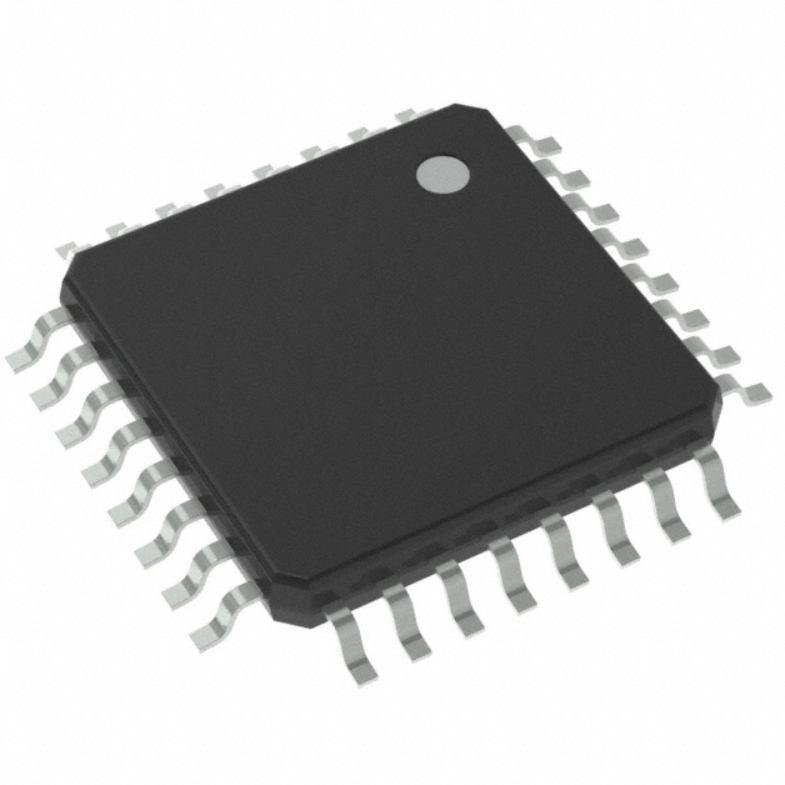
ATMEGA8 Microcontroller
The Atmel® AVR® ATmega 8 is a low-power CMOS 8-bit microcontroller based on the AVR RISC architecture. By executing powerful instructions in a single clock cycle, the ATmega8 achieves throughputs approaching 1 MIPS per MHz, enabling designers to balance performance and power consumption effectively.
At its core, the ATmega-8 integrates a highly efficient CPU with a rich instruction set and 32 general-purpose working registers. These registers directly connect to the Arithmetic Logic Unit (ALU), allowing two independent registers to be accessed in a single instruction cycle. This architecture makes it significantly faster and more efficient compared to traditional CISC-based microcontrollers.
The device includes 8KB Flash memory, 512 bytes EEPROM, and 1KB SRAM, making it suitable for a wide range of embedded applications. It also supports in-system programming via SPI or bootloader, enabling easy firmware updates without removing the chip.
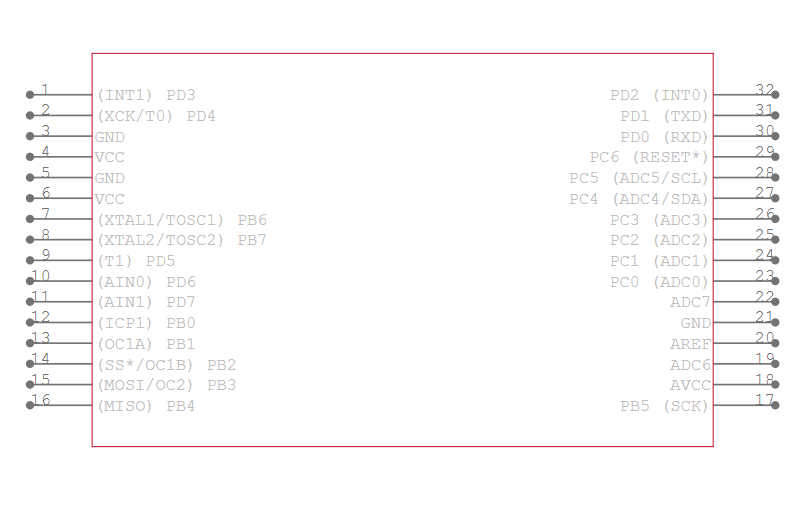
ATMEGA8 Pinout
The microcontroller includes power pins, multiple I/O ports, oscillator connections, and reset functionality, providing a flexible interface for embedded designs.
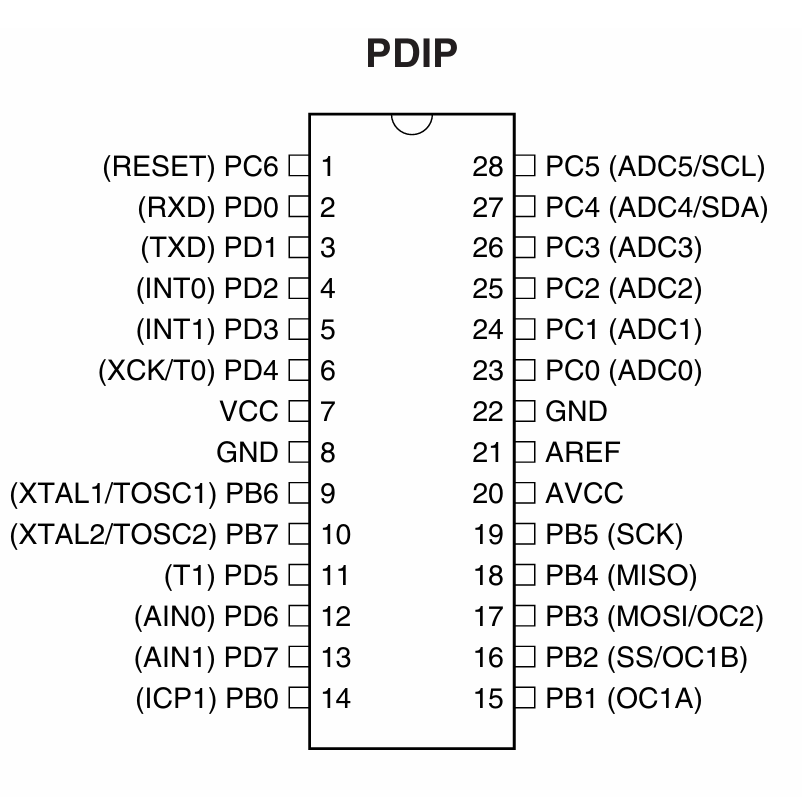
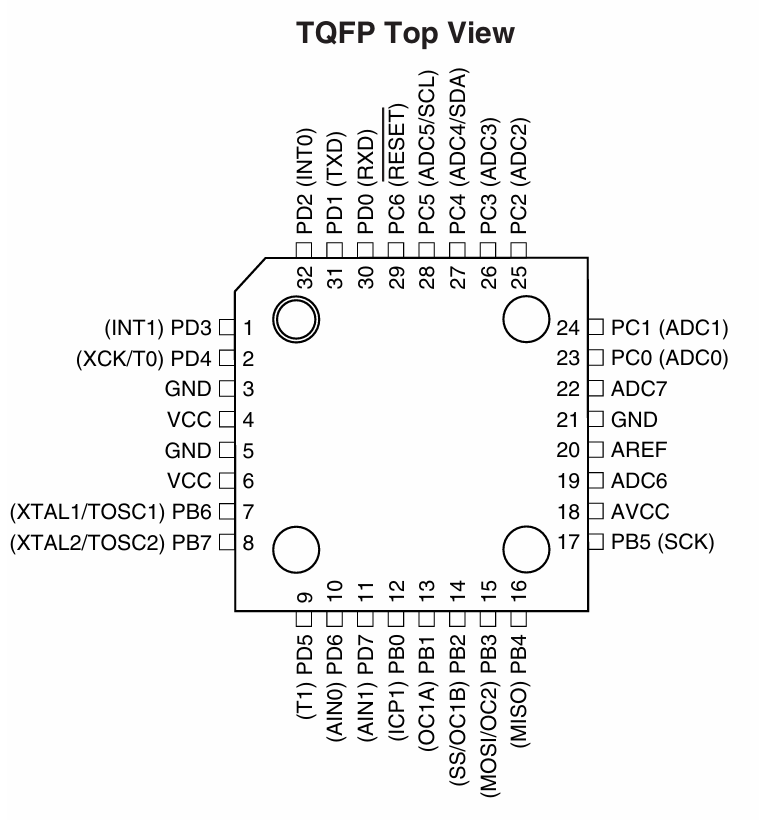
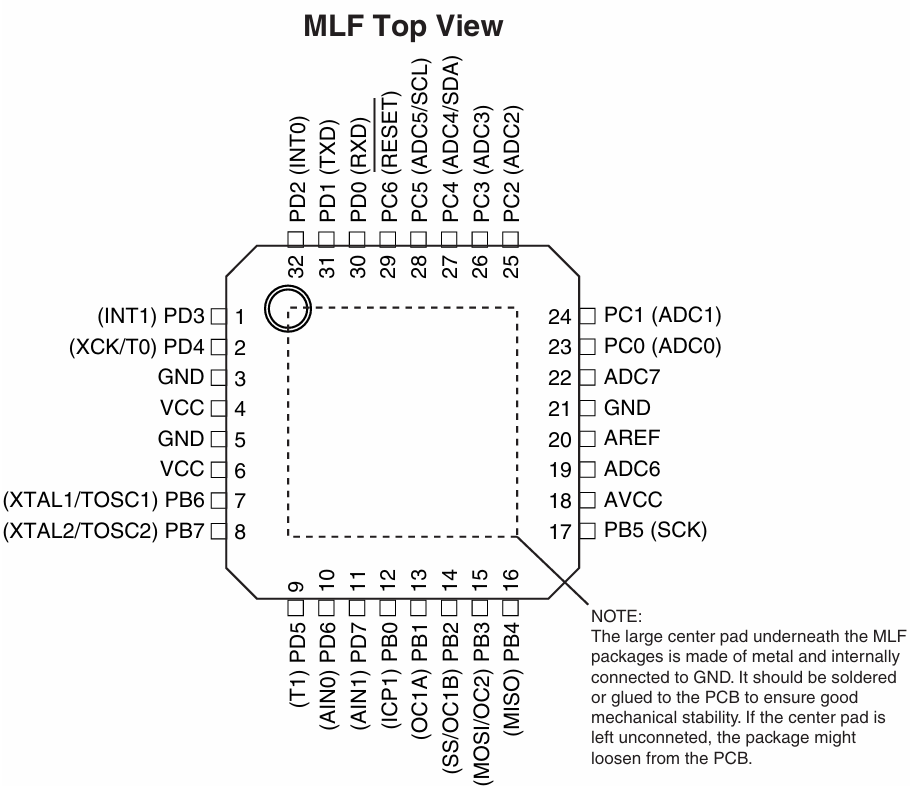
VCC (Digital Supply Voltage) supplies power to the device, while GND serves as the ground reference.
Port B (PB7..PB0) is an 8-bit bidirectional I/O port with internal pull-up resistors. It supports strong sink and source current and becomes tri-stated during reset. Pins PB6 and PB7 can also function as oscillator pins or timer inputs depending on fuse settings.
XTAL1 / XTAL2 / TOSC1 / TOSC2 use for clock generation. XTAL1 and XTAL2 connect to an external crystal, while TOSC pins support asynchronous timer operation.
Port C (PC5..PC0) is a 7-bit bidirectional I/O port with pull-up resistors and similar electrical characteristics to Port B.
PC6 / RESET can act as a reset pin or general I/O depending on fuse configuration. When used as reset, a low signal triggers a system restart.
Port D (PD7..PD0) is another 8-bit bidirectional I/O port with pull-ups, commonly used for communication and interrupts.
The RESET pin is an active-low input that ensures proper startup and system recovery, even when the clock is not running.
ATMEGA8 CAD Model
Symbol
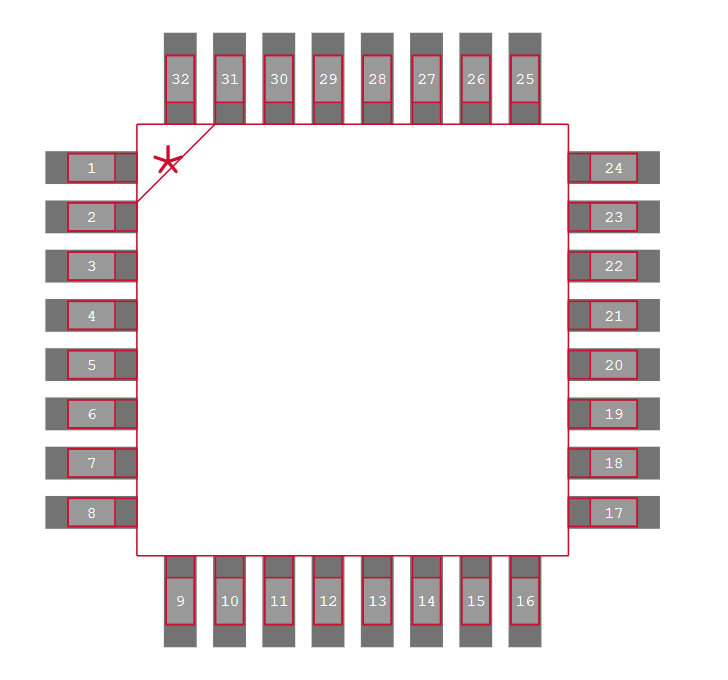
Footprint
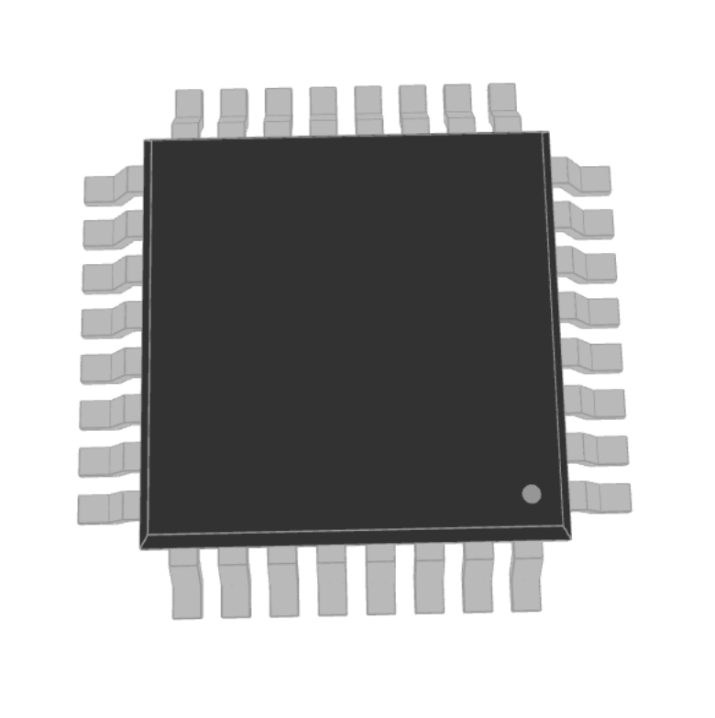
3D Model
ATMEGA8 Circuit Diagram
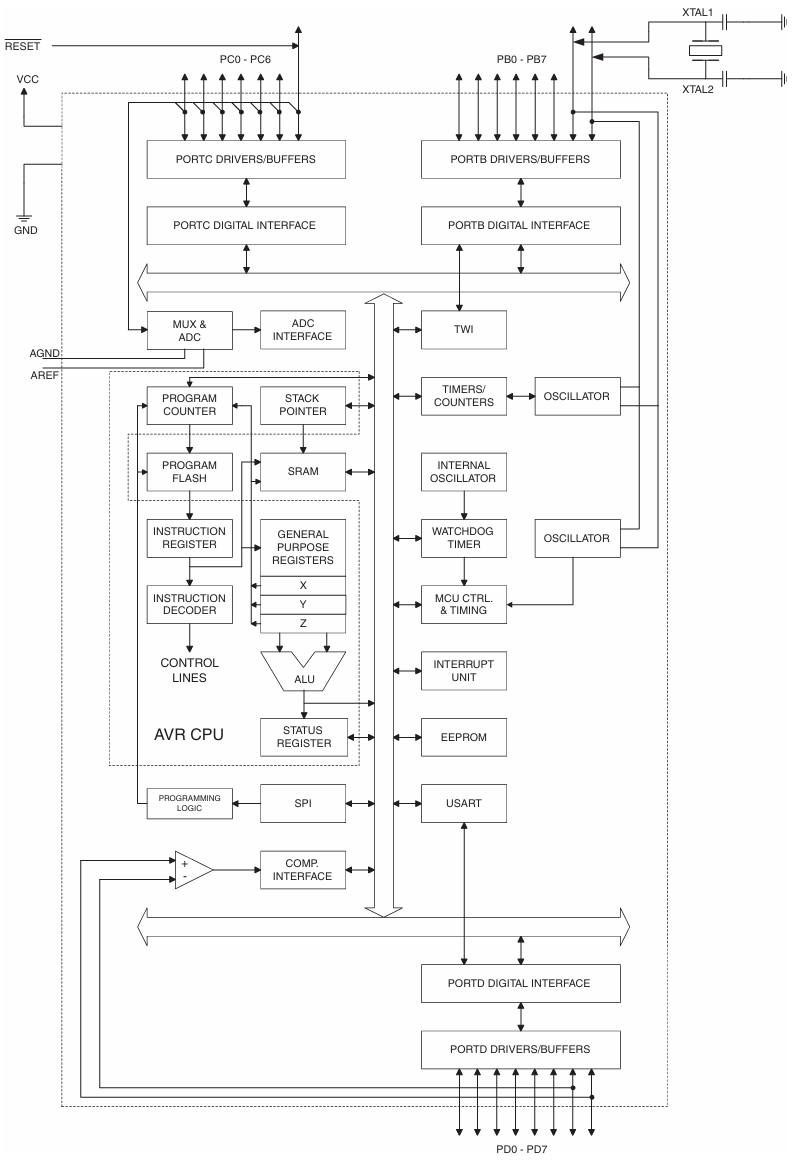
The ATMEGA 8 build around an efficient AVR RISC core with 32 general-purpose registers directly connected to the ALU, enabling single-cycle instruction execution and fast performance compared to traditional microcontrollers.
It integrates 8KB Flash, 512B EEPROM, and 1KB SRAM, along with 23 I/O lines, timers, ADC, USART, SPI, and I2C interfaces. The microcontroller also supports internal/external interrupts and a watchdog timer.
The circuit design includes multiple power-saving modes such as Idle, Power-down, Power-save, ADC Noise Reduction, and Standby, allowing flexible energy management.
Its Flash memory supports in-system programming via SPI or bootloader, enabling easy updates. Combined with strong development tool support, the ATmega 8 provides a compact and cost-effective solution for embedded applications.
ATMEGA 8 Features
High Performance Core
The circuit is a low-power 8-bit AVR microcontroller based on an advanced RISC architecture. It supports 130 instructions, most executed in a single clock cycle, and includes 32 × 8-bit working registers. It delivers up to 16 MIPS at 16 MHz and features an on-chip 2-cycle hardware multiplier.
Memory System
The microcontroller integrates 8KB Flash memory, 512B EEPROM, and 1KB SRAM. It supports in-system programming, high endurance write/erase cycles, and long data retention. The optional bootloader section enables secure firmware updates with Read-While-Write capability.
Peripheral Features
The component includes multiple peripherals such as two 8-bit timers, one 16-bit timer, PWM channels, and a real-time counter. It also provides a 10-bit ADC with 6 or 8 channels depending on the package, along with communication interfaces like USART, SPI, and I2C (TWI), plus a watchdog timer and analog comparator.
Special Functions
The device offers power-on reset, programmable brown-out detection, internal calibrated RC oscillator, and both internal and external interrupt sources. It supports five power-saving modes: Idle, ADC Noise Reduction, Power-save, Power-down, and Standby.
I/O and Package Options
It features 23 programmable I/O lines and is available in PDIP, TQFP, and QFN/MLF packages, making it suitable for both prototyping and compact designs.
Operating Conditions
The chip operates at voltages ranging from 2.7V~5.5V (ATmega8L) and 4.5V~5.5V (standard version). It supports clock speeds up to 16 MHz.
Power Consumption
At 4 MHz, 3V, and 25°C, the device typically consumes 3.6 mA in active mode, 1.0 mA in idle mode, and as low as 0.5 µA in power-down mode, making it suitable for low-power applications.
Specifications
Table
Parameter | Details |
Manufacturer | Atmel (Microchip Technology) |
Core Architecture | AVR RISC |
Core Size | 8-bit |
Flash Memory | 8 KB |
EEPROM | 512 Bytes |
SRAM | 1 KB |
Maximum Speed | 16 MHz |
Operating Voltage | 2.7V–5.5V (ATmega8L), 4.5V–5.5V (ATmega8) |
I/O Pins | 23 Programmable I/O |
ADC | 10-bit (6 or 8 channels depending on package) |
Timers/Counters | 2 × 8-bit, 1 × 16-bit |
Communication Interfaces | USART, SPI, I2C (TWI) |
PWM Channels | 3 |
Watchdog Timer | Yes (with internal oscillator) |
Analog Comparator | Yes |
Power Consumption | 3.6mA Active, 1.0mA Idle, 0.5µA Power-down |
Package Types | PDIP, TQFP, QFN/MLF |
Operating Temperature | -40°C to +85°C |
ATMEL ATMEGA8 Manufacturer
The ATMEGA 8 microcontroller is originally manufactured by Atmel Corporation, which is now part of Microchip Technology. After Microchip acquired Atmel, all AVR microcontrollers, including the ATMEGA-8, produce and support under Microchip.
Package Types
ATMEGA8 DIP (through-hole, easy prototyping)
ATMEGA8 SMD (compact, surface mount applications)
ATMEGA8 Alternatives
ATMEGA8-16AU
This is a surface-mount (TQFP) version of the ATMEGA8 running at up to 16 MHz. It offers the same functionality as the standard version but is suitable for compact PCB designs.
ATMEGA8A-AU
An improved version of the ATMEGA 8 with lower power consumption and better efficiency. Widely use as a drop-in replacement in modern designs.
ATMEGA8-16AJ
This variant provides similar performance and features as the ATMEGA 8, with differences mainly in packaging and temperature range, making it suitable for specific industrial applications.
ATMEGA8-16AC
Another package variant of the ATMEGA8, typically available in compact SMD form. It maintains the same core specifications and functionality.
ATMEGA88PA-AU
A more advanced alternative with enhanced features, including more memory, improved peripherals, and better power efficiency. It is a good upgrade option when require additional performance or features.
ATMEGA8 Applications
The ATMEGA 8 widely use in embedded systems because its flexibility and cost-effectiveness.
Common Applications
· Industrial automation systems
· Home automation devices
· Sensor interfacing systems
· Motor control applications
· Robotics projects
· Embedded control systems
· Communication devices
· DIY electronics and Arduino-based designs
ATMEGA8 Board
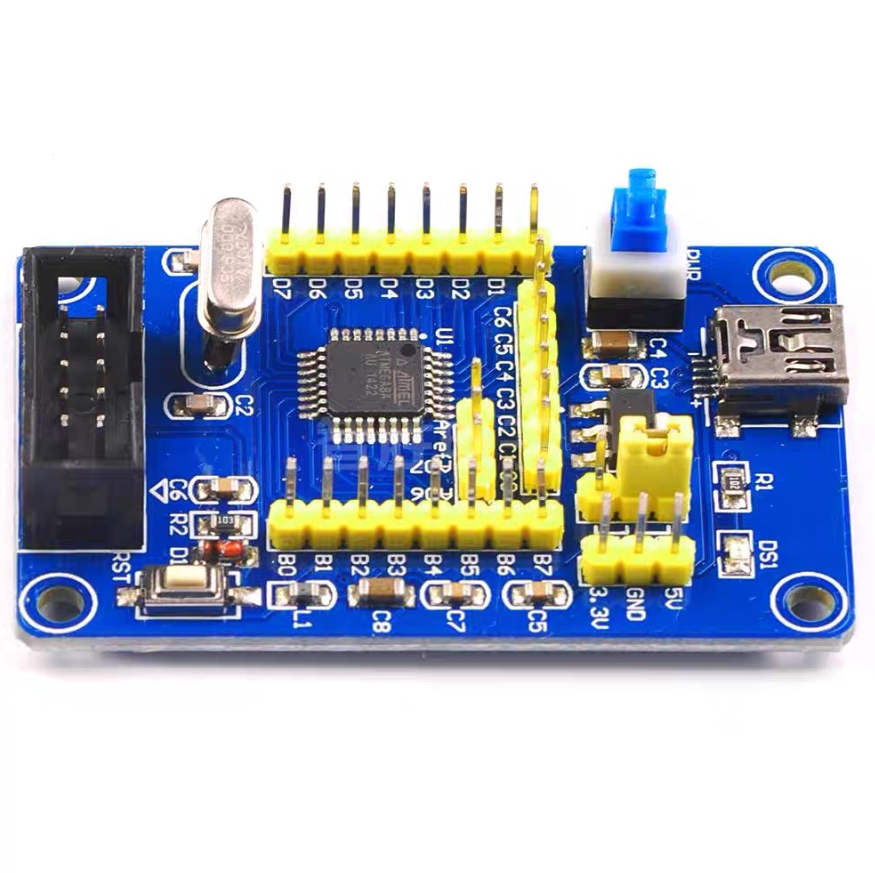
Microcontroller Chip
The board is built around the ATmega8 microcontroller, providing a reliable core for embedded development and prototyping.
Power Supply Options
It supports power input through a Mini USB interface or external header pins. An onboard AMS1117-3.3 regulator allows voltage regulation, with a jumper to select between 3.3V and 5V operation.
I/O Pin Access
All I/O pins are fully exposed and clearly labeled, making it easy to connect external components, sensors, and modules during development.
ISP Programming Interface
The board includes an onboard ISP (In-System Programming) interface, allowing direct programming of the microcontroller using standard programmers.
Reset Circuit
A stable and reliable reset circuit ensures proper startup and smooth operation during programming and runtime.
ADC Reference Filtering
The analog reference voltage for the ADC is stabilized using filtering components such as inductors and capacitors, improving measurement accuracy and reducing noise.
ATMEGA328 vs ATMEGA8
Compare table
Parameter | ATMEGA328 | ATMEGA8 |
Core Processor | AVR | AVR |
Core Size | 8-bit | 8-bit |
Maximum Speed | 20 MHz | 16 MHz |
Program Memory | 32 KB Flash | 8 KB Flash |
EEPROM | 1 KB | 512 Bytes |
SRAM | 2 KB | 1 KB |
I/O Pins | 23 | 23 |
ADC | 8-channel, 10-bit | 6–8 channel, 10-bit |
Communication | I2C, SPI, UART/USART | I2C, SPI, UART/USART |
Peripherals | PWM, WDT, Brown-out, POR | PWM, WDT, Brown-out, POR |
Operating Voltage | 1.8V – 5.5V | 2.7V – 5.5V |
Oscillator | Internal/External | Internal/External |
Operating Temperature | -40°C to +85°C | -40°C to +85°C |
Package | TQFP, QFN, DIP | PDIP, TQFP, QFN |
Key Difference
The ATMEGA328 offers more memory, higher speed, and lower voltage operation, making it suitable for more complex applications. The ATMEGA 8 is simpler and more cost-effective, ideal for basic embedded systems and learning projects.
ATMEGA8 Datasheet PDF
The data sheet provides detailed electrical characteristics, pin configurations, and programming details. Highly recommend for circuit design and firmware development.
Frequently Asked Questions
What is the difference between AT89S52 and ATMEGA8-16PU?
The AT89S52 uses the older 8051 architecture, while the ATmega8-16PU is based on AVR RISC architecture. ATmega 8 offers faster execution, more efficient instruction handling, built-in ADC, and modern peripherals like SPI and I2C, making it more suitable for advanced embedded applications and efficient system design.
Are ATMEGA8-16AC and ATMEGA8-16PU compatible?
Yes, ATMEGA8-16AC and ATMEGA8-16PU are functionally compatible. They share the same core features, memory, and performance. The main difference lies in packaging: 16PU is a DIP package, while 16AC is typically a surface-mount version, suitable for compact PCB designs.
What is the ATmega 8 processor?
The ATmega8 is an 8-bit AVR microcontroller featuring a RISC architecture, 8KB Flash memory, 1KB SRAM, and 512B EEPROM. It includes peripherals like ADC, timers, and communication interfaces. Widely use in embedded systems for control, automation, and interfacing applications.
What is the internal reference voltage of ATmega8?
The ATmega8 provides an internal reference voltage of approximately 2.56V for its ADC. This stable reference allows accurate analog-to-digital conversion without requiring an external voltage reference, making it useful for sensor-based and measurement applications where require consistent readings.
What is the operating voltage of ATmega 8?
The ATmega 8 operates typically between 4.5V and 5.5V, while the low-power ATmega8L version supports a wider range from 2.7V to 5.5V. This flexibility allows it to be used in both standard and low-voltage applications, including battery-powered embedded systems.
What is the difference between Atmega8 and ATMEGA328P?
The ATMEGA328P has more Flash memory (32KB vs 8KB), more SRAM, and lower power consumption. It also supports lower voltage operation and improved features. ATmega 8 is simpler and cheaper, suitable for basic tasks, while ATMEGA328P is preferred for more complex and modern applications.
Conclusion
The ATMEGA8 remains a reliable and widely used microcontroller for embedded system development. With its efficient AVR architecture, rich peripheral set, and low power consumption, it offers a strong balance between performance and cost.
Whether you are building a simple sensor system or a complex embedded application, the ATMEGA 8 provides a solid and flexible platform to get started.
Read More:
1. PIC12F675 Microcontroller: Pinout and Development Board
2. ATMEGA32U4 Microcontroller: And Arduino Pro Micro Board
3. ATMEGA32 Microcontroller: Pinout, Features and Alternative
HOT NEWS
TP4056 Charging Module Pinout, Working, and Applications
TP4056 Charging Module Pinout, Working, and Applications
2026-01-23
LR41 Battery Guide: Specifications, Equivalents, and Uses
LR41 Battery Specifications, Equivalents, and Uses
2025-12-14
Understanding A 0603 Resistor
0603 resistor,dimensions,marking code, values
2025-05-29
MT3608 Boost Converter - An In-Depth Guide
MT3608 Boost Converter
2025-09-04
The 0402 Resistor: A Comprehensive Guide
0402 Resistor
2025-05-06
Complete Guide to the 220 Ohm Resistor
220 Ohm Resistor
2025-07-28
What Is A 1206 Resistor?
1206 resistor dimensions,footprint,value
2025-06-05
Guide To The XL6009 Boost Converter
XL6009 Boost Converter
2025-09-05
Understanding The CD4051 Analog Multiplexer
CD4051 analog multiplexer
2025-06-30
120 Ohm Resistor- Specifications, Applications, and Features
2025-05-12