




 BOM
BOM Cart
Cart Product Catalog
The DRV8833 is a powerful and compact dual H-bridge motor driver module designed for precise control of DC motors, bipolar stepper motors, and other inductive loads commonly found in robotics, automation systems, battery-powered toys, and embedded electronics. With its dual H-bridge configuration, it can independently drive two motors simultaneously, providing full control over speed, direction, and torque.
Equipped with built-in protections such as overcurrent, short-circuit, undervoltage lockout, and overtemperature shutdown, the DRV8833 ensures safe operation even under demanding conditions. It also supports PWM (Pulse-Width Modulation) control, allowing microcontrollers to efficiently manage motor speed and achieve smooth acceleration and deceleration.
Thanks to its compact size, low-power sleep mode, and wide operating voltage range (3V to 10V), the DRV 8833 is ideal for space-constrained designs and battery-operated projects. Whether used in small robots, point-of-sale printers, gaming machines, or surveillance cameras, this driver module provides reliable, energy-efficient, and precise motor management, making it a favorite choice for hobbyists, engineers, and embedded system developers alike.
1. What is DRV8833 H-Bridge Motor Driver Module?
8. Frequently Asked Questions [FAQ]
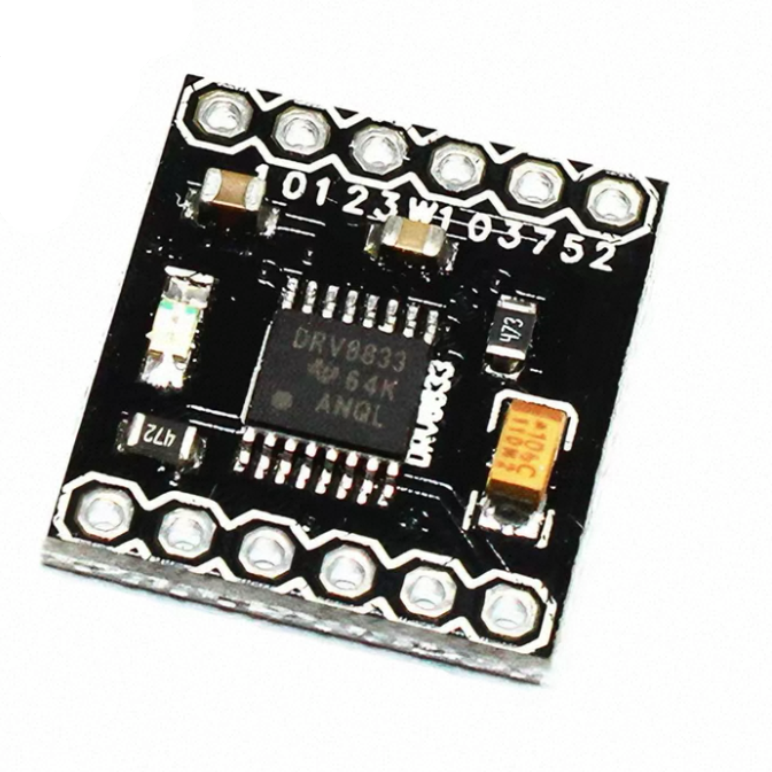
What is DRV8833 H-Bridge Motor Driver Module?
The DRV 8833 is a compact and versatile dual H-bridge motor driver module designed to control DC motors, bipolar stepper motors, solenoids, and other inductive loads. Its dual H-bridge architecture allows it to independently drive two motors simultaneously, providing precise control over speed, direction, and torque, making it ideal for robotics, automation systems, battery-powered toys, and small mechatronic devices.
Each H-bridge uses N-channel power MOSFETs arranged in a full-bridge configuration, enabling efficient current delivery to the motor windings. The device also incorporates PWM (Pulse-Width Modulation) control, allowing microcontrollers to adjust motor speed accurately, as well as smooth acceleration and deceleration for dynamic applications.
Safety is a core feature of the DRV 8833. It includes overcurrent protection, short-circuit protection, undervoltage lockout, and overtemperature shutdown, all of which prevent damage to both the motor and the driver. A low-power sleep mode is also available, which reduces current consumption when the motors are not in use, making it suitable for battery-operated projects.
With its compact size, wide voltage range (3V to 10V), and robust protection features, the module provides a reliable, energy-efficient solution for controlling small to medium motors in embedded systems, robotics, and consumer electronics, making it a preferred choice for hobbyists and engineers alike.
DRV8833 Pinout
Module Pin Configuration
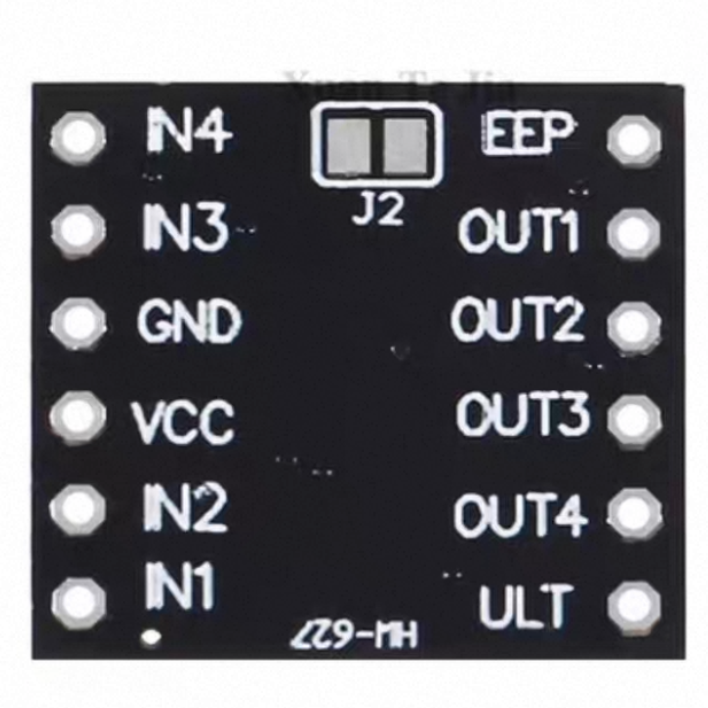
Pin No. | Pin Name | Description |
1 | EEP | Sleep mode input, active high |
2 | OUT1 | First output of the 1st H-Bridge |
3 | OUT2 | Second output of the 1st H-Bridge |
4 | OUT3 | First output of the 2nd H-Bridge |
5 | OUT4 | Second output of the 2nd H-Bridge |
6 | ULT | Fault output (low during fault condition) |
7 | IN1 | Controls OUT1 |
8 | IN2 | Controls OUT2 |
9 | VCC | Supply voltage (2.8V – 10.8V) |
10 | GND | Ground |
11 | IN3 | Controls OUT3 |
12 | IN4 | Controls OUT4 |
DRV8833 Pin Functions
VCC: This pin is the positive power supply input, supporting voltages from 3V to 10V. It provides the main voltage for driving the motors connected to the module.
GND: The ground pin serves as the reference for both the logic and motor supply. It must connect to the system ground to complete the electrical circuit.
OUT1 and OUT2: These pins are the outputs of the first H-bridge. They connect directly to the two terminals of the first motor. The states of these outputs control by the IN1 and IN2 logic pins, allowing forward, reverse, or stop operation.
OUT3 and OUT4: These pins are the outputs of the second H-bridge, controlling the second-motor or stepper motor winding. Their operation determine by the IN3 and IN4 logic inputs, allowing independent direction and speed control.
EEP: This is the sleep mode input, active low. When pulled low, the module enters a low-power sleep mode, stopping all motor activity. Normally, the module has this pin connected high via the J1 jumper on the board to keep it active.
ULT: This pin is the fault output, providing a logic low signal when overcurrent, overtemperature, or other protection events occur. It allows a microcontroller to detect and respond to error conditions, improving system safety.
DRV8833 Features
Dual-H-Bridge Motor Driver: The DRV 8833 module integrates two H-bridge drivers with current control, enabling independent operation of two DC motors or a bipolar stepper motor. This dual H-bridge design provides precise control over motor direction, speed, and torque, making it suitable for robotics, automation systems, and battery-powered mechatronic applications.
Current Capacity: Each H-bridge can safely handle 1.5A RMS continuous current and up to 2A peak current, allowing the module to drive small and medium-sized motors reliably. This ensures stable performance even during sudden motor startup, high-torque loads, or temporary spikes in current demand.
Parallel Output Configuration: For higher-power requirements, the DRV 8833 allows the H-bridge outputs to connect in parallel, delivering up to 3A RMS continuous current and 4A peak current. This flexibility makes it capable of controlling larger motors or dual-motor systems that require additional power.
Voltage Range: The module operates across a wide supply voltage range of 2.7V to 10.8V, making it compatible with both low-voltage electronics and battery-powered devices. This broad voltage range allows seamless integration into portable robots, toys, and embedded electronics projects.
PWM and Current Limiting: With PWM (Pulse-Width Modulation) support, the module allows precise control of motor speed and smooth acceleration. Built-in current regulation and limiting protect connected motors from overcurrent damage, ensuring longer motor life and safer operation.
Thermal Design: The DRV 8833 comes in a thermally enhanced surface-mount package, which efficiently dissipates heat during continuous operation. This design ensures stable performance even under heavy loads, preventing overheating and improving overall reliability in demanding applications.
DRV8833 Specifications
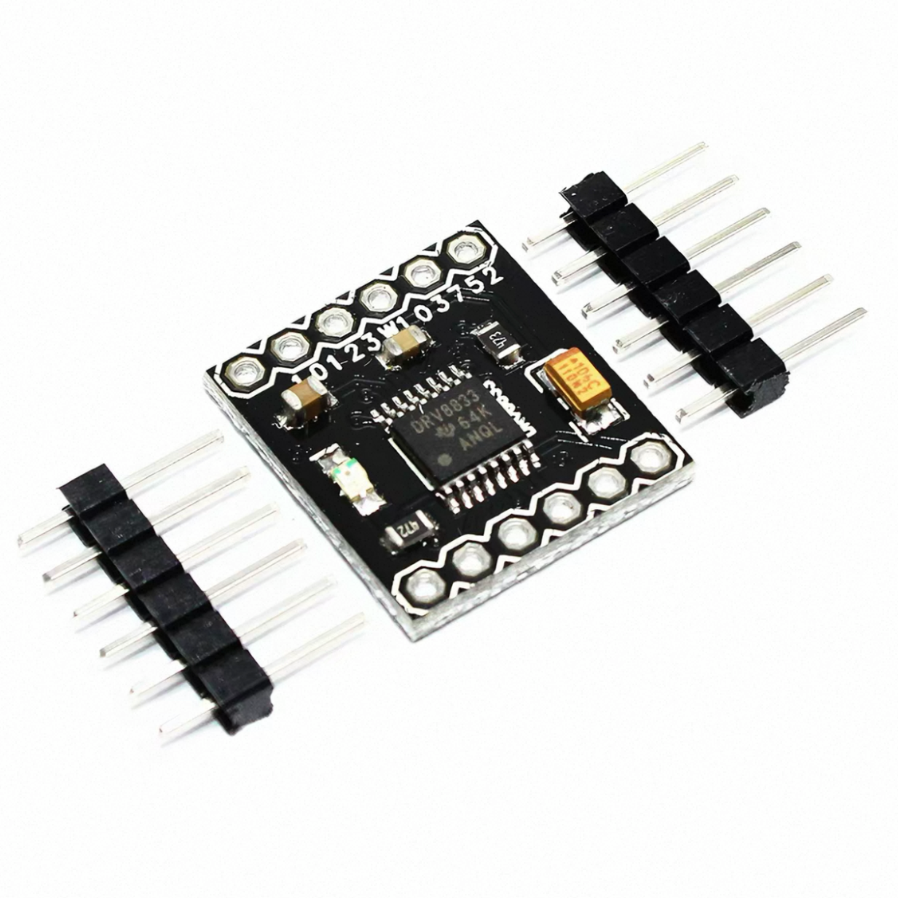
Input Voltage: The motor driver operates over a flexible voltage range of 3V to 10V, making it compatible with a variety of power sources including batteries, USB power supplies, and regulated DC adapters. This wide input range allows it to use in portable, battery-powered projects as well as fixed embedded systems.
H-Bridge Output Current: Each H-bridge of the DRV 8833 can deliver 1.5A RMS continuous current, which is sufficient to drive small DC geared motors or one winding of a bipolar stepper motor. The H-bridges can also handle peak currents up to 2A, ensuring the module can manage sudden motor startup loads or temporary high-torque demands without failure.
Protection Features: The module includes multiple safety features, such as overcurrent protection, short-circuit protection, undervoltage lockout, and overtemperature shutdown. These integrated protections prevent damage to both the motor driver and the connected motors, improving system reliability. The fault output pin can also alert the microcontroller when a protection event occurs.
Applications: Designed to control DC motors under 1.5A and 4-wire bipolar stepper motors, the DRV8833 is suitable for small robots, battery-powered toys, POS printers, and automation systems. Its dual H-bridge design enables independent control of two motors simultaneously, making it ideal for differential drive robots or dual-motor mechanisms.
Dimensions: The module comes in a compact 18.5 × 16 mm surface-mount package, which allows it to fit into space-constrained PCBs or embedded designs without adding bulk. Its small form factor, combined with efficient power management, makes it perfect for modern electronics projects where space and efficiency are critical.
DRV8833 Equivalents
TB6612 / TB6612FNG
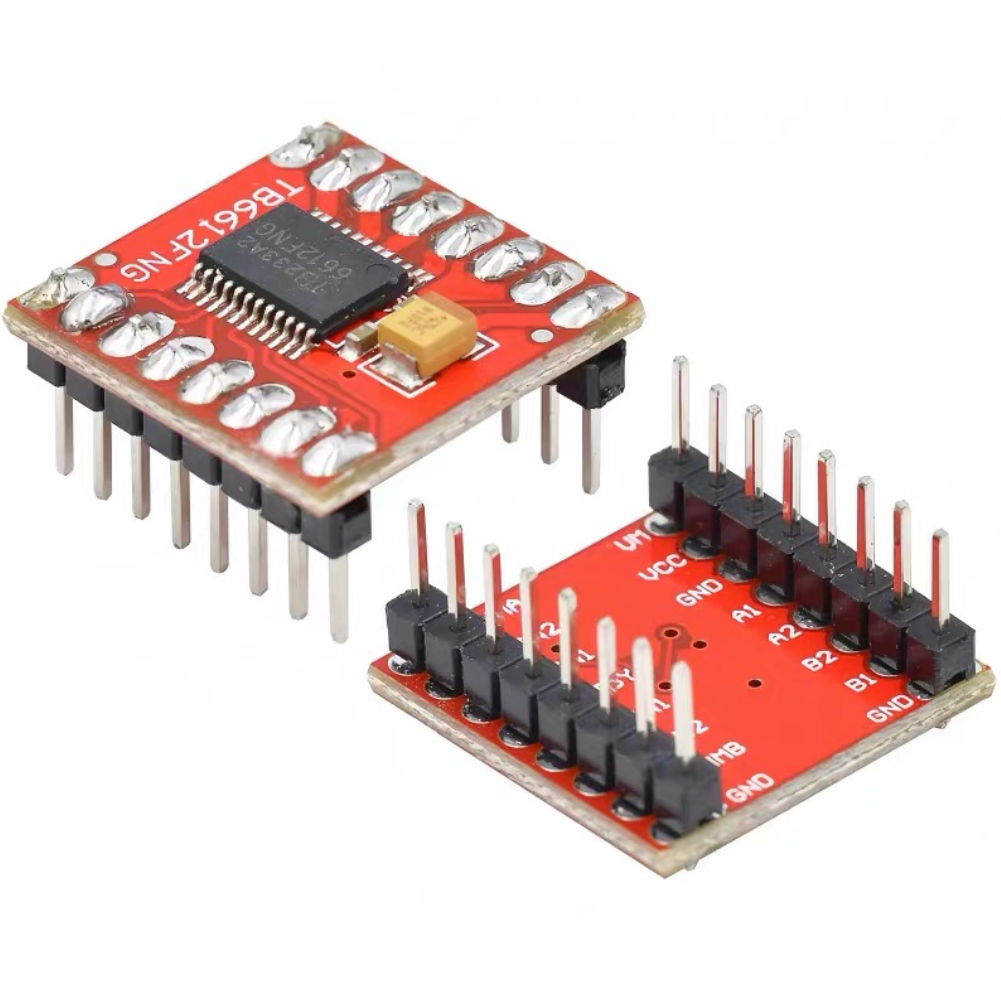
The TB6612FNG is a modern dual motor driver IC that can independently control two DC motors. It features high integration while providing sufficient output power, excellent efficiency, and low energy consumption. Because of its compact design, it is ideal for small, embedded motor control systems.
The TB6612 driver can provide enough current and power for various types of DC motors, including brushed and brushless motors. It is capable of driving motors at high speed and high torque, making it suitable for robotics, toys, and other demanding applications.
DRV8823
The DRV 8823 is an integrated motor driver solution commonly used in printers and office automation equipment. It includes four H-bridge drivers, each employing N-channel power MOSFETs arranged as full bridges to drive motor windings.
A simple serial interface allows full control of the motor driver with just a few digital signals. The device also supports low-power sleep mode and provides PWM current control. Current is programmable via an external reference voltage and sense resistor, and eight programmable current levels allow microstepping with bipolar stepper motors.
For safety, the DRV8823 includes overcurrent protection (OCP), short-circuit protection, undervoltage lockout, and overtemperature shutdown.
L298N
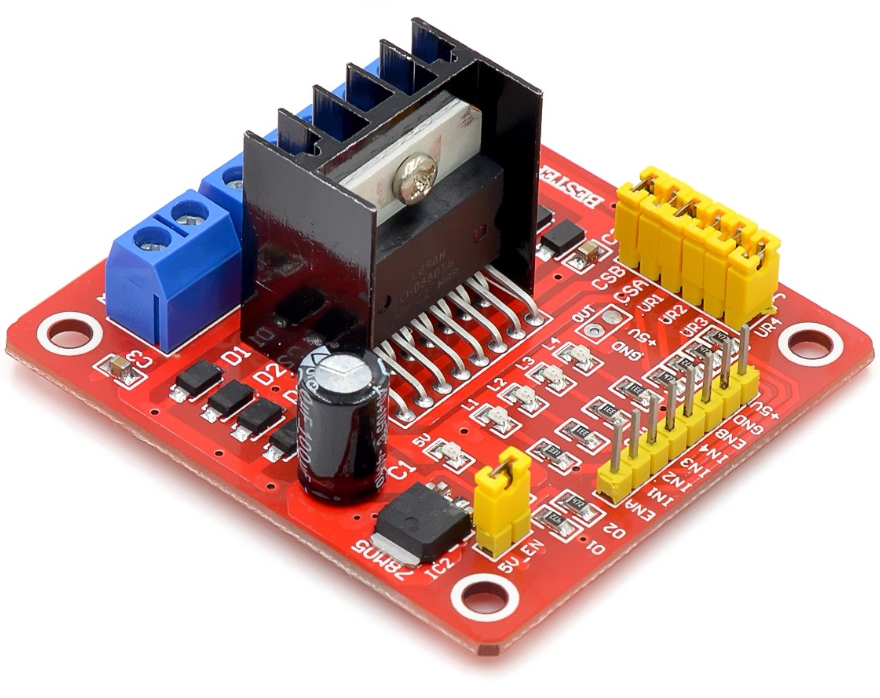
The L298N motor driver module uses STMicroelectronics’ L298N chip to directly drive two DC motors with voltages from 3V to 30V. It also provides a 5V output to power microcontroller circuits and supports 3.3V MCU control.
The module can control motor speed and direction, and can drive two-phase stepper motors, making it a common choice for smart cars and robotics projects.
Key specifications include:
Driver Chip: L298N dual H-bridge
Motor Voltage (VMS): 5~35V
Peak Current per Bridge: 2A
Logic Voltage (VSS): 4.5~5.5V
Logic Current: 0~36 mA
Control Voltage Levels: HIGH 4.5~5.5V, LOW 0V
Max Power: 20 W
Storage Temperature: -25°C to 130°C
Module Size: 55 × 60 × 30 mm
Weight: 33 g
Additional Features: Direction and power indicators, current monitoring, logic voltage supply interface
These alternatives provide options depending on your project’s power, size, or control requirements, with TB6612FNG and DRV8823 suitable for compact, efficient designs, and L298N suitable for higher voltage or heavier-duty motors.
How To Use DRV8833?
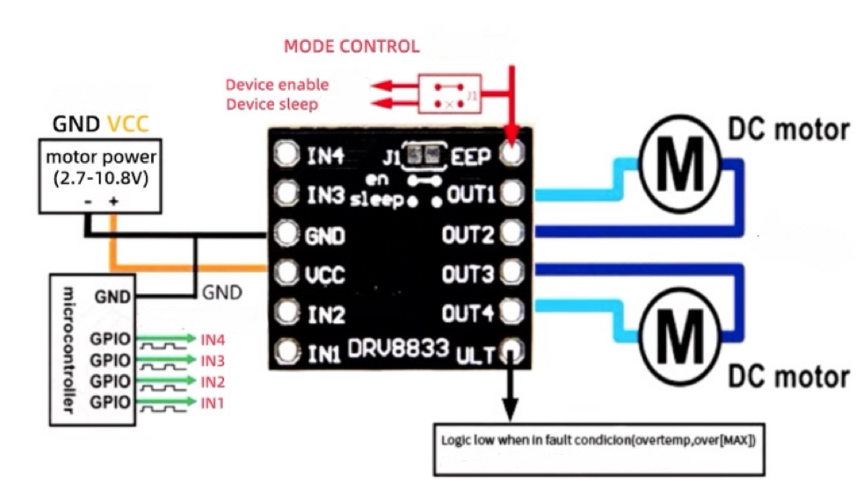
The DRV8833 is a dual H-bridge motor driver, meaning it can drive two DC motors independently. To use it, connect the STBY (EEP) pin to a microcontroller I/O pin. Setting STBY LOW puts the driver into sleep mode, stopping all motors, while setting it HIGH enables motor operation.
For Motor 1, control pins AIN1 and AIN2 determine the direction of rotation. The motor connects to OUT1 and OUT2. For Motor-2, BIN1 and BIN2 control direction, with the motor connected to OUT3 and OUT4. The VM pin provides power to the motors (up to 12V), and GND connects to system ground.
Pulse-width modulation (PWM) can be applied to control speed. For example, connecting a microcontroller PWM pin to AIN1 or BIN1 allows speed adjustment for each motor independently.
DRV8833 Table
Motor | Input1 | Input2 | Motor Action | Output Pins |
Motor 1 | 0 | 0 | Stop | OUT1 / OUT2 |
Motor 1 | 0 | 1 | Reverse | OUT1 / OUT2 |
Motor 1 | 1 | 0 | Forward | OUT1 / OUT2 |
Motor 2 | 0 | 0 | Stop | OUT3 / OUT4 |
Motor 2 | 0 | 1 | Reverse | OUT3 / OUT4 |
Motor 2 | 1 | 0 | Forward | OUT3 / OUT4 |
By combining STBY control, input pins, and PWM, DRV8833 allows precise direction and speed control for both motors in robotics and automation projects.
Applications
Battery-Powered Toys: The motor driver is perfect for battery-operated toys, enabling efficient and reliable control of DC motors with minimal energy consumption. Its low-power sleep mode helps extend battery life, while PWM control allows smooth speed adjustments for wheels, gears, or moving parts.
POS Printers: Can use in point-of-sale printers to drive motors for paper feeding and rollers. The dual H-bridge design ensures accurate direction and speed control, while built-in overcurrent and short-circuit protection improves the durability and reliability of the printer mechanism.
Security Cameras: For security and surveillance cameras, the module provides precise motor control for pan-and-tilt mechanisms. Its compact size, wide voltage range, and fault output allow safe, responsive, and energy-efficient operation in embedded camera systems.
Gaming Machines: In arcade and gaming machines, DRV 8833 powers motors for moving elements, interactive toys, or vibration feedback. Its dual H-bridge and PWM capabilities allow independent control of multiple motors, enhancing gameplay experience while maintaining safety and efficiency.
Robotics: Robotics projects benefit from DRV8833’s dual H-bridge driver to control two DC motors or a bipolar stepper motor simultaneously. With PWM speed control, current limiting, and thermal protection, it ensures precise motion control for small robots, robotic arms, and automation systems.
DRV8833 Datasheet PDF
You can find the full data sheet: DRV8833 Texas Instruments
It includes:
Electrical characteristics, timing diagrams, application circuits, thermal performance data.
Frequently Asked Questions [FAQ]
What is the current consumption of DRV8833?
The DRV 8833 current consumption depends on the load and operating mode. In standby (sleep) mode, it draws minimal current, typically a few microamps. During normal operation, the current depends on the motors’ load, with each H-bridge capable of 1.5A RMS continuous and 2A peak per motor.
What is the operating voltage of DRV8833?
The DRV 8833 operates over a wide voltage range of 3V to 10V, making it compatible with battery-powered systems and low-voltage electronic circuits. The supply voltage (VM) powers the motors, while VCC powers the logic. This flexibility allows use in small robots, toys, and other mechatronic devices.
What is a drive motor control module?
A drive motor control module is an electronic device that allows a microcontroller or processor to control the speed, direction, and operation of motors. It typically includes H-bridges, current limiting, PWM control, and protection features, enabling safe and precise motor operation in robotics, automation, and embedded systems.
What kind of motors work with DRV8833?
The DRV8833 supports DC brushed motors, bipolar stepper motors, solenoids, and other inductive loads. Each H-bridge can handle up to 1.5A RMS, making it suitable for small to medium DC motors and 4-wire stepper motors commonly used in robotics, toys, printers, and automation applications.
Does DRV8833 support PWM control?
Yes, the DRV 8833 fully supports PWM (Pulse-Width Modulation) control. PWM allows microcontrollers to adjust motor speed by varying the duty cycle of the input signals. This feature enables precise speed control, smooth acceleration, and energy-efficient operation for both DC motors and stepper motors.
What is the DRV8833?
The DRV 8833 is a dual H-bridge motor driver IC designed to control two DC motors or a bipolar stepper motor. It integrates current limiting, overcurrent, short-circuit, undervoltage, and overtemperature protection, plus a low-power sleep mode, making it ideal for robotics, toys, printers, and compact mechatronic systems.
Conclusion
The DRV8833 motor driver module is a compact, efficient, and feature-rich solution for controlling small motors in modern electronics projects. With dual H-bridges, built-in protections, PWM capability, and low power consumption, it is a strong choice for robotics, automation, and portable devices.
Whether you're building a smart robot car or a battery-powered gadget, the DRV8833 provides reliable and flexible motor control in a small footprint.
Read More:
1. TB6612 IC and Arduino TB6612FNG Motor Driver Module Guide
2. LM2596S Buck Converter IC & LM2596 S DC-DC Step Down Module
HOT NEWS
TP4056 Charging Module Pinout, Working, and Applications
TP4056 Charging Module Pinout, Working, and Applications
2026-01-23
LR41 Battery Guide: Specifications, Equivalents, and Uses
LR41 Battery Specifications, Equivalents, and Uses
2025-12-14
Understanding The CD4051 Analog Multiplexer
CD4051 analog multiplexer
2025-06-30
Understanding A 0603 Resistor
0603 resistor,dimensions,marking code, values
2025-05-29
MT3608 Boost Converter - An In-Depth Guide
MT3608 Boost Converter
2025-09-04
Complete Guide to the 220 Ohm Resistor
220 Ohm Resistor
2025-07-28
The 0402 Resistor: A Comprehensive Guide
0402 Resistor
2025-05-06
Mini MP1584 DC-DC 3A Buck Converter Module: Complete Guide
Mini MP1584 DC-DC 3A Buck Converter Module: Complete Guide
2026-03-26
Guide To The XL6009 Boost Converter
XL6009 Boost Converter
2025-09-05
What Is A 1206 Resistor?
1206 resistor dimensions,footprint,value
2025-06-05