




 BOM
BOM Cart
Cart Product Catalog
The LM741 operational amplifier (op-amp) is one of the most classic and widely used integrated circuits in analog electronics. Since its introduction, it has become a standard building block for learning and designing basic analog circuits such as amplifiers, filters, integrators, and summing circuits.
Although modern op-amps now offer lower power consumption and better precision, the LM 741 remains popular because its simplicity, robustness, and long-standing reliability in educational and experimental applications. It is often the first op-amp students encounter when learning about analog circuit design.
In this article, we will explore the LM 741 in detail, including its pin configuration, features, specifications, working principle, applications, and how it compares with other popular op-amps such as the LM324.
5. LM 741 Operational Amplifier Applications
9. Where and How to Use LM741?
10. Frequently Asked Questions[FAQ]
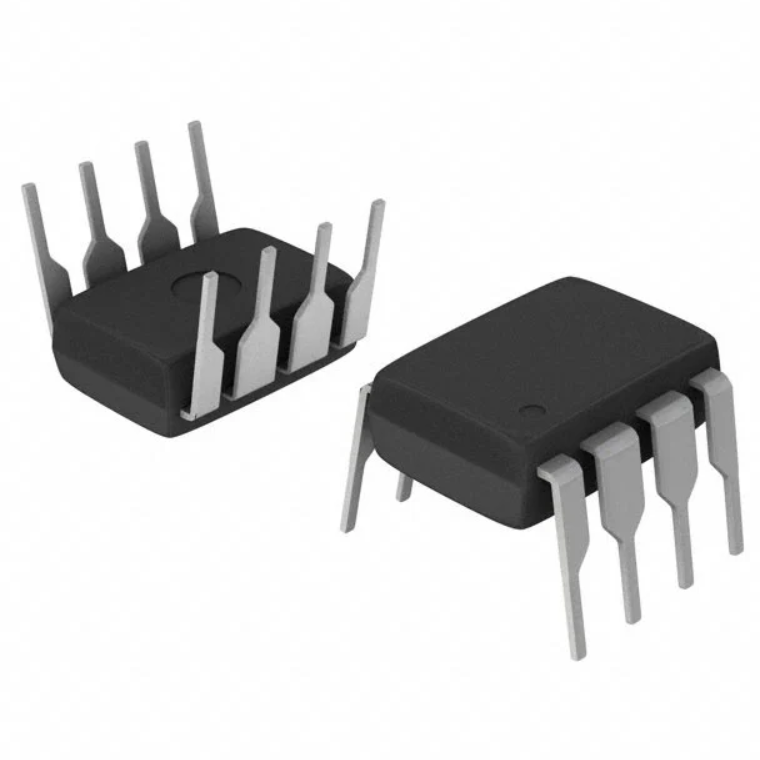
What is LM741 Op-amp IC?
The LM 741 is a general-purpose operational amplifier designed for a wide range of analog electronic applications. Widely use in signal amplification, mathematical operations, and basic analog circuit design. The circuit features high voltage gain and supports a wide operating voltage range, making it suitable for integrator, summing amplifier, and general feedback circuits. It can operate with either single or dual power supplies and provides stable performance in low to medium frequency applications. Because its reliability and simplicity, the chip commonly use in educational experiments, prototyping, and basic analog signal processing systems.
LM741 Pinout
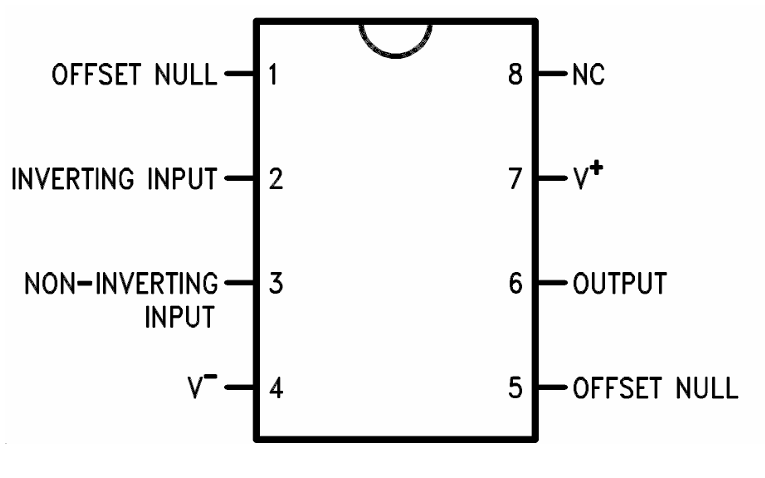
The 741 operational amplifier comes in an 8-pin package, where each pin serves a specific function for input, output, and power supply control.
NAB Package 8-Pin CDIP or PDIP
LMC Package 8-Pin TO-99 LM741H
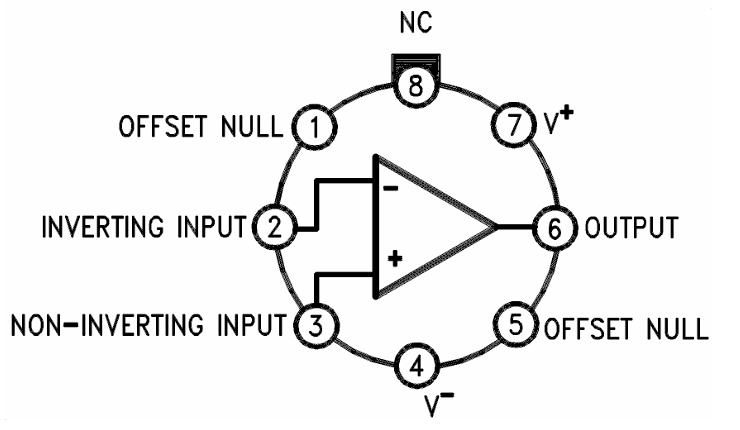
Pin No. | Pin Name | Function Description |
1 | Offset Null 1 | Used for adjusting input offset voltage |
2 | Inverting Input | Receives the negative (-) input signal |
3 | Non-Inverting Input | Receives the positive (+) input signal |
4 | V- | Connects to the negative power supply |
5 | Offset Null 2 | Works with Pin 1 for offset adjustment |
6 | Output | Provides the amplified output signal |
7 | V+ | Connects to the positive power supply |
8 | NC | No internal connection (not used) |
This pin configuration allows the LM 741 to perform signal amplification and analog operations in a wide range of electronic circuits.
LM741 Feature & Specifications
Features
Short circuit protection
The component design with built-in short circuit protection, which helps prevent damage to the IC when the output is accidentally shorted. This improves reliability and makes it safer to use in basic circuit designs.
Excellent temperature stability
It offers good stability across a wide temperature range, ensuring consistent performance even when environmental conditions change.
Internal frequency compensation
The op-amp includes internal frequency compensation, which simplifies circuit design by reducing the need for external components to maintain stability.
High input voltage range
The LM 741 supports a relatively high input voltage range, allowing it to handle a variety of analog signal levels in different applications.
Offset null capability
It provides offset null pins that allow users to adjust and minimize input offset voltage for improved accuracy in precision applications.
Specification
Parameter | Specification |
Manufacturer (Mfr) | Texas Instruments |
Amplifier Type | Standard (General Purpose Op-Amp) |
Number of Circuits | 1 |
Current - Output / Channel | 25 mA |
Supply Voltage (Min) | 10 V |
Supply Voltage (Max) | 36 V |
Operating Temperature | 0°C to 70°C |
Mounting Type | Through Hole, Surface Mount |
Slew Rate | 0.5 V/µs |
Gain Bandwidth Product | 1.5 MHz |
Input Bias Current | 80 nA |
Input Offset Voltage | 2 mV |
Supply Current | 1.7 mA |
Package Options | 8-DIP, 8-SOP |
This specification makes the LM 741 suitable for low to medium-speed analog applications such as amplifiers, filters, and signal conditioning circuits.
Comparing LM741 to LM324
The LM741 and LM324 are both general-purpose operational amplifiers, but they differ in channel count, supply voltage range, and overall application flexibility. The table below highlights their key specifications.
Parameter | LM741 | LM324 |
Manufacturer (Mfr) | Texas Instruments | Texas Instruments |
Amplifier Type | Standard (General Purpose) | Standard (General Purpose) |
Number of Circuits | 1 | 4 (Quad Op-Amp) |
Supply Voltage (Min) | 10 V | 3 V |
Supply Voltage (Max) | 36 V | 30 V |
Output Current / Channel | 25 mA | 30 mA |
Input Bias Current | 80 nA | 20 nA |
Input Offset Voltage | 2 mV | 3 mV |
Gain Bandwidth Product | 1.5 MHz | 1.2 MHz |
Slew Rate | 0.5 V/µs | 0.5 V/µs |
Operating Temperature | 0°C to 70°C | 0°C to 70°C (TA) |
Package | 8-DIP | 14-SOIC |
Supply Current | 1.7 mA | 1.4 mA (per 4 channels) |
Key Difference Summary
The LM741 and LM324 are both widely used general-purpose operational amplifiers, but they are designed for different types of circuit requirements and operating conditions.
Number of op-amps (integration level)
The LM 741 contains a single operational amplifier in one package, making it suitable for simple or dedicated analog circuit designs. In contrast, the LM324 integrates four independent op-amps in a single IC, which is more efficient for multi-stage or multi-channel applications.
Power supply requirements
The LM741 typically requires a higher dual power supply (such as ±12V or ±15V), while the LM324 can operate on a single supply as low as 3V, making it more compatible with modern low-voltage electronic systems.
Input and output performance
The LM324 has a lower input bias current (around 20 nA) compared to the LM 741, which improves accuracy in certain applications. However, often prefer the LM741 in traditional analog designs because its stable behavior with dual-supply configurations.
Application suitability
Commonly use the LM741 in educational experiments, signal processing, and classic analog circuits. The LM324 is more suitable for battery-powered devices, portable electronics, and multi-channel systems because its low power consumption and quad-op-amp design.
Overall usage trend
While the 741 remains popular for learning and legacy designs, the LM324 is more widely used in modern practical circuits because of its flexibility, efficiency, and single-supply operation capability.
LM 741 Operational Amplifier Applications
Voltage Comparison
The 741 can function as a simple voltage comparator, detecting differences between two input signals and switching the output based on their relative levels. Commonly use in threshold detection and level sensing applications.
Pulse Generation (Multivibrator Use)
Use in astable and monostable configurations to generate square waves or timing pulses. Widely apply these circuits in oscillators, timers, and signal generation systems.
DC Signal Amplification
The LM 741 is suitable for amplifying low-level DC signals from sensors and measurement devices, providing stable gain for analog signal conditioning.
Signal Summing Operation
It can combine multiple input signals into a single output, making it useful in audio mixing, sensor fusion, and analog computation tasks.
Mathematical Signal Processing (Integrator & Differentiator)
The LM 741 performs integration and differentiation of input signals using external components, enabling waveform shaping and analog computation functions.
Analog Filtering
Use in active filter designs to allow or block specific frequency ranges, commonly applied in audio processing, noise reduction, and communication systems.
LM741 Equivalent
LM741A
LM741A is a higher-grade version of the standard LM741. It is often available in a metal can (CAN-8) package and provides improved performance, better stability, and lower offset compared to the basic version.
LM741C
LM741C is the commercial-grade version of the LM 741 op-amp. Widely use in general-purpose analog circuits and is commonly available in the standard 8-DIP package.
LM709C
LM709C is an older general-purpose operational amplifier available in the TO-99-8 package. It was widely used before the LM 741 and offers similar functionality but with lower overall performance and stability.
LM201
LM201 is a legacy op-amp used in early analog circuit designs. It performs similar basic amplification functions as the LM 741 but is less commonly used in modern applications.
MC1439
MC1439 is another compatible general-purpose operational amplifier used in older electronic systems. Can use in basic analog signal amplification circuits.
LM748
LM748 is a dual operational amplifier in an 8-DIP package. It can serve as a functional replacement in circuits that require more than one op-amp stage, depending on the design requirements.
Op Amp LM 741 Advantage
Wide Availability and Low Cost
The LM 741 is one of the most widely produced operational amplifiers, making it easy to source from almost any electronics supplier. Its low cost makes it highly suitable for educational purposes, prototyping, and basic analog circuit development without increasing overall project expense.
Simple and Easy to Use
The component is designed for straightforward operation with standard pin configuration and well-documented behavior. This simplicity allows beginners to quickly understand op-amp concepts such as amplification, feedback, and signal processing without complex setup requirements.
Internal Frequency Compensation
The built-in frequency compensation improves stability and reduces the need for additional external components. This makes circuit design easier and helps prevent unwanted oscillations in many basic applications.
Good Stability and Reliability
The chip offers stable performance over a wide temperature range, making it reliable for general-purpose analog applications. It maintains consistent operation in low-frequency signal processing circuits.
Versatile Analog Applications
Can used in many different analog functions such as amplifiers, filters, integrators, and summing circuits. This versatility makes it a valuable component in both educational experiments and basic electronic system design.
LM741 Working Principle
The LM741 is a general-purpose operational amplifier that works based on the principle of differential voltage amplification. It has two input terminals, the inverting (−) and non-inverting (+) inputs, and it amplifies the difference in voltage between these two inputs. The output signal is a multiplied version of this small voltage difference, depending on the gain of the internal circuitry.
In most practical applications, use the LM 741 with negative feedback. This means a portion of the output signal is fed back to the inverting input, which stabilizes the gain and allows the amplifier to operate in a linear and controlled manner. Without feedback, the op-amp would quickly saturate because its high open-loop gain.
The LM 741 can operate with either a single power supply or a dual power supply, making it flexible for different circuit designs. It is widely used in analog signal processing tasks such as amplification, filtering, integration, and mathematical operations like summing signals.
Internally, the LM741 contains multiple transistor stages that provide high voltage gain, frequency compensation, and improved stability. Compared to earlier op-amps like the LM709, it offers better performance and reliability in general-purpose analog applications. This makes it suitable for both educational use and basic electronic system design.
Where and How to Use LM741?
Where to Use LM 741
Commonly used in low to medium frequency analog circuits where not require high precision or high speed. Widely apply in educational experiments, basic signal processing systems, and simple analog design projects. Typical use cases include audio preamplifiers, sensor signal conditioning, active filters, and waveform generation circuits. It is also found in laboratory setups for teaching op-amp fundamentals and feedback concepts.
How to Use LM741 in a Circuit
To use the chip correctly, connect the positive supply (V+) to pin-7 and the negative supply (V−) to pin-4. Apply the input signal to pin-2 (inverting input) or pin-3 (non-inverting input), depending on the desired configuration. Take the output from pin 6. In most applications, not use external resistors to set the gain and provide negative feedback, which stabilizes the operation and prevents signal distortion.
Design Considerations
Shoule place proper decoupling capacitors near the power supply pins to reduce noise. The LM741 performs best with dual power supplies (such as ±12V or ±15V). It should not use in high-frequency or low-voltage modern digital circuits because its limited speed and higher power requirements.
LM741 Datasheet
The data sheet provides detailed technical information including pin configuration, electrical characteristics, operating limits, and typical application circuits. It explains key parameters such as supply voltage, gain bandwidth, slew rate, and input offset voltage.
For complete specifications and design guidance, recommend to download the official LM741 datasheet from the manufacturer.
Frequently Asked Questions[FAQ]
What is LM741 cost and where to buy?
The LM741 is a low-cost op-amp, typically ranging from a few cents to under one dollar depending on quantity and package type. Widely available from electronics suppliers and local electronic component stores.
How to safely long run LM741 in circuit
To run LM 741 safely long-term, use a stable dual power supply within ±10V to ±15V, avoid exceeding absolute maximum ratings, and add decoupling capacitors near power pins. Ensure proper heat dissipation
How to connect the LM741 Op Amp chip to a circuit
Connect pin-7 to positive supply (V+), pin-4 to negative supply (V−). Input signals go to pin-2 (inverting) and pin-3 (non-inverting). Take output from pin-6. Use feedback resistors to set gain and stabilize operation.
What is the function of LM741?
It functions as a general-purpose operational amplifier that amplifies voltage differences between two input terminals. Used for signal amplification, mathematical operations, filtering, and waveform processing in analog electronic circuits.
What is the current limit on a 741 op-amp?
The LM741 typically provides an output current limit of about 25 mA per channel. Exceeding this can cause distortion or damage, so recommend external buffering for driving low-resistance or high-current loads.
What is the maximum supply voltage for LM741?
The maximum supply voltage for the LM 741 is ±18V, meaning a total of 36V across the supply rails. Operating beyond this limit will damage the device or reduce its reliability and lifespan.
What are the limitations of using the LM741?
The LM741 has low slew rate, limited bandwidth, and requires dual power supply in many cases. It is not suitable for low-voltage or high-frequency applications and has higher noise compared to modern op-amps like LM358 or LM324.
What are the differences among LM741, LM358, and LM324?
LM741 is a single op-amp needing dual supply, LM358 is a dual op-amp for single supply, and LM324 is a quad op-amp also single-supply capable. LM358 and LM324 are more modern, low-power, and suitable for battery-powered circuits.
Can I use UA741 instead of LM741?
Yes, UA741 is generally compatible and can replace LM741 in most circuits. Both share similar pin configuration and electrical characteristics. However, always check datasheet differences in voltage range and performance for critical applications.
What are the main uses of IC 741?
IC 741 is used in amplifiers, filters, oscillators, comparators, and signal processing circuits. Also widely used in educational labs for teaching op-amp fundamentals, feedback systems, and basic analog circuit design concepts.
Conclusion
The LM741 operational amplifier is a classic and widely used general-purpose op-amp in analog electronics. It provides stable performance, simple usage, and reliable operation in basic signal processing circuits such as amplifiers, filters, integrators, and summing systems. Although it is not suitable for modern low-voltage or high-speed applications, it remains highly valuable for education, prototyping, and learning fundamental analog concepts.
With proper circuit design and correct operating conditions, the LM741 continues to be a dependable choice for a wide range of simple electronic applications.
Read More:
1. JRC4558 Operational Amplifier (Op-Amp) Guide
2. LM2903 Comparator IC: Pinout, Applications, and Datasheet
3. LM324N Operational Amplifiers - Guide Pinout and Datasheet
HOT NEWS
TP4056 Charging Module Pinout, Working, and Applications
TP4056 Charging Module Pinout, Working, and Applications
2026-01-23
LR41 Battery Guide: Specifications, Equivalents, and Uses
LR41 Battery Specifications, Equivalents, and Uses
2025-12-14
Understanding The CD4051 Analog Multiplexer
CD4051 analog multiplexer
2025-06-30
Understanding A 0603 Resistor
0603 resistor,dimensions,marking code, values
2025-05-29
MT3608 Boost Converter - An In-Depth Guide
MT3608 Boost Converter
2025-09-04
Complete Guide to the 220 Ohm Resistor
220 Ohm Resistor
2025-07-28
The 0402 Resistor: A Comprehensive Guide
0402 Resistor
2025-05-06
Mini MP1584 DC-DC 3A Buck Converter Module: Complete Guide
Mini MP1584 DC-DC 3A Buck Converter Module: Complete Guide
2026-03-26
Guide To The XL6009 Boost Converter
XL6009 Boost Converter
2025-09-05
What Is A 1206 Resistor?
1206 resistor dimensions,footprint,value
2025-06-05