




 BOM
BOM Cart
Cart Product Catalog
The MAX31855 thermocouple module is a compact and highly efficient solution for precise temperature measurement in a wide range of electronic and industrial applications. Designed to interface directly with K-type thermocouples, it converts tiny thermoelectric voltages into accurate digital temperature readings using an integrated cold-junction compensation system. With its built-in signal processing and SPI communication interface, the MAX31855 eliminates the need for external amplifiers or analog-to-digital converters, making it especially suitable for microcontroller-based systems such as Arduino, ESP32, and other embedded platforms. This module simplifies high-temperature sensing while maintaining stable and reliable performance across demanding environments.
1. What is MAX31855 Thermocouple Module?
5. Arduino Code Example Program
8. Frequently Asked Questions [FAQ]
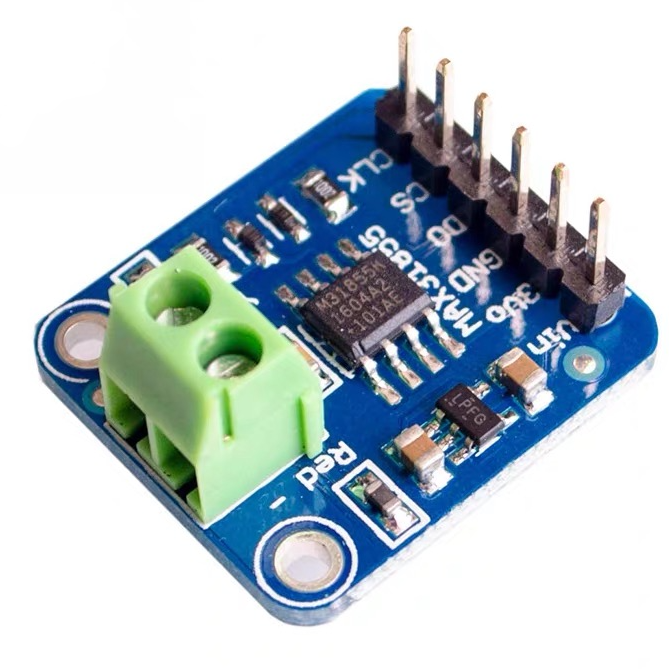
What is MAX31855 Thermocouple Module?
The MAX31855 is a digital temperature measurement module designed to work with thermocouples, especially K-type sensors. Thermocouples are sensitive devices that generate a tiny voltage based on temperature differences, so they require accurate cold-junction compensation and a high-quality amplifier to ensure reliable readings. The MAX 31855 integrates this signal conditioning internally, making temperature measurement simple and accurate.
This product does everything for you and can easily connect to any microcontroller, even those without analog input pins. Instead of dealing with weak analog signals, the module directly provides a digital output through an SPI interface, which improves stability and reduces noise interference in real applications.
The interface board includes the MAX31855 chip itself, a built-in 3.3V voltage regulator with a 10µF bypass capacitor, and level shifting circuitry for stable communication. It is fully assembled and tested, so users can start using it immediately without additional circuit design. A 2-pin terminal block is provided for easy connection to the thermocouple.
In addition, the module comes with header pins, allowing it to plug directly into a breadboard or perfboard for prototyping. This makes it highly convenient for DIY electronics, industrial monitoring, and embedded temperature sensing projects.
Technical Specifications
Key technical parameters of the MAX31855:
Parameter | Specification |
Thermocouple Type | K-type (standard) |
Temperature Measurement Range | -200°C to +1350°C |
Resolution | 14-bit output |
Output Format | Digital (SPI interface) |
Supply Voltage | 3V to 5V DC |
Interface | SPI (3-wire: DO, CS, CLK) |
Cold-Junction Compensation | Internal |
Temperature Accuracy | ±2°C to ±6°C (typical K-type system accuracy, depends on thermocouple) |
Internal Temperature Sensor | Yes (for reference junction compensation) |
Signal Conditioning | Fully integrated (no external amplifier required) |
ADC Requirement | Not required (direct digital output) |
Calibration | Not required (factory calibrated module) |
The module directly outputs temperature data without requiring external ADCs, instrumentation amplifiers, or additional calibration circuits, making it simple and reliable for embedded temperature measurement systems.
MAX31855 Board Key Features
Temperature Range
The board supports a wide measurement range from -200°C to +1350°C, making it suitable for both low-temperature monitoring and high-temperature industrial applications.
SPI Interface (High-Speed Communication)
It uses a SPI digital interface that enables fast and stable data transmission with microcontrollers, ensuring reliable temperature readings with minimal noise interference.
Supply Voltage (3–5V DC)
The module operates on a 3V to 5V DC power supply, making it compatible with most common development boards such as Arduino, ESP32, and STM32 systems.
Direct Digital Output (No ADC Required)
It provides direct digital temperature output, eliminating the need for external amplifiers or ADC circuits, which simplifies system design and improves accuracy.
Resolution (14-bit, ~0.25°C)
With a 14-bit resolution, the module delivers approximately 0.25°C temperature resolution, allowing precise temperature monitoring in sensitive applications.
Thermocouple Compatibility
It works with any K-type thermocouple, which widely use in industrial temperature sensing because its durability and broad measurement range.
Accuracy of K-Type Thermocouple
A typical K-type thermocouple provides an accuracy of about ±2°C to ±6°C, depending on wire quality and environmental conditions.
Internal Temperature Reading
The module includes an internal temperature sensor for cold-junction compensation, ensuring more accurate and stable readings.
Logic Level Compatibility
It supports 3V to 5V power and logic levels, making it easy to interface with both 3.3V and 5V microcontrollers.
Minimal I/O Requirement
The SPI communication requires only 3 digital I/O pins (DO, CS, CLK), reducing wiring complexity in embedded designs.
MAX31855 Module Pinout
The board uses a simple SPI-based interface for easy connection with microcontrollers.
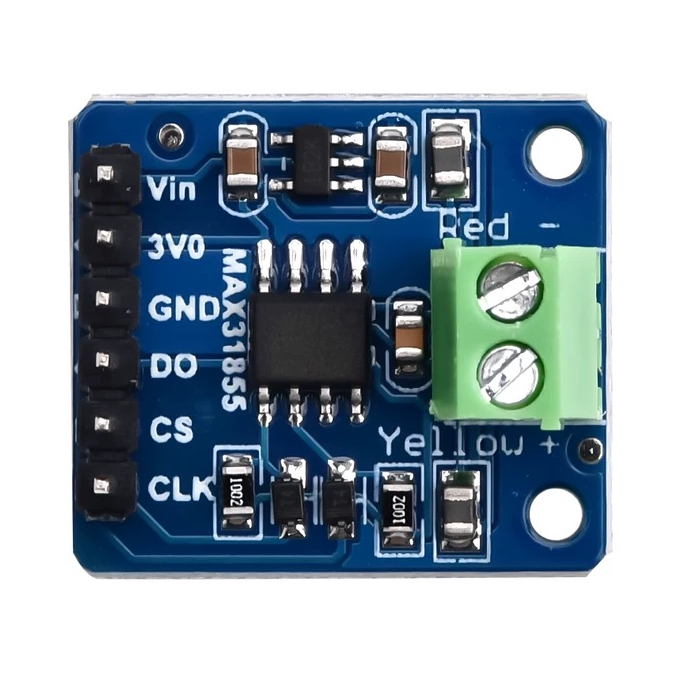
Pinout Table
Pin Name | Description |
VIN | Power supply input (3–5V DC) |
3V0 | 3.3V regulated output (can power external low-power devices) |
GND | Ground reference |
DO | SPI Data Output (MISO – sends temperature data to MCU) |
CS | Chip Select (selects the device for SPI communication) |
CLK | SPI Clock signal (synchronizes data transfer) |
Summary
This pin configuration allows the MAX31855 module to communicate using only three SPI signals (DO, CS, CLK), while VIN and GND provide power and 3V0 offers an optional regulated output for small external circuits.
MAX31855 Arduino Code Example Program
Example for Arduino using SPI communication:
#include <SPI.h>
int CS = 10;
void setup() {
Serial.begin(9600);
pinMode(CS, OUTPUT);
digitalWrite(CS, HIGH);
SPI.begin();
}
double readTemp() {
uint32_t v;
digitalWrite(CS, LOW);
delay(1);
v = SPI.transfer32(0x00);
digitalWrite(CS, HIGH);
if (v & 0x7) {
return NAN; // fault detection
}
v >>= 18;
if (v & 0x2000) {
v |= 0xC000; // sign extend negative
}
return v * 0.25;
}
void loop() {
Serial.print("Temperature: ");
Serial.println(readTemp());
delay(1000);
}
Applications of MAX31855
The MAX 31855 widely use in many temperature sensing and control applications because its accuracy, simplicity, and digital SPI output.
Industrial Temperature Monitoring Systems
Commonly used in industrial environments to monitor machinery, production lines, and equipment temperatures in real time. Its wide measurement range makes it suitable for harsh operating conditions.
Furnace and Kiln Temperature Measurement
In high-temperature environments such as furnaces and kilns, the MAX 31855 provides stable readings when paired with K-type thermocouples, helping maintain safe and controlled heating processes.
3D Printer Hot-End Thermal Control
Widely used in 3D printers to monitor and regulate the hot-end temperature, ensuring consistent filament melting and preventing overheating during printing.
HVAC Systems
The module is applied in heating, ventilation, and air conditioning systems for accurate temperature feedback and efficient climate control.
Scientific Laboratory Equipment
In laboratory instruments, it provides precise temperature measurements for experiments that require stable thermal conditions and repeatable results.
Engine and Exhaust Temperature Sensing
Used in automotive and mechanical systems to measure engine block and exhaust temperatures, helping improve performance and prevent overheating.
DIY Arduino Temperature Projects
The module is popular in DIY electronics and Arduino-based projects because its simple SPI interface and easy integration with microcontrollers, even those without analog inputs.
MAX31855 vs MAX31856
The MAX31856 is a more advanced successor to the MAX31855 with significantly improved accuracy and flexibility.
Feature | MAX31855 | MAX31856 |
Thermocouple Support | K-type only | K, J, N, R, S, T, E, B |
Temperature Range | -200°C to +1350°C | -210°C to +1800°C (depends on type) |
Resolution | 14-bit (~0.25°C) | 19-bit (~0.0078125°C) |
Cold-Junction Compensation | Built-in (basic) | Built-in (advanced, high accuracy) |
Accuracy | Typical ±2°C to ±6°C (system dependent) | Up to ±0.15% (high precision) |
Linearization | None | Built-in LUT linearization |
Noise Filtering | Basic | 50Hz / 60Hz rejection filters |
Fault Detection | Limited | Open thermocouple, over/under temp detection |
Input Protection | Basic | ±45V protection |
Interface | SPI | SPI (configurable registers) |
Configuration | Fixed (K-type only) | Fully configurable (sensor type & settings) |
Complexity | Simple | Advanced |
Cost | Low | Higher |
Best Use Case | DIY, Arduino projects, basic monitoring | Industrial systems, precision measurement |
Key Differences
MAX31856 provides:
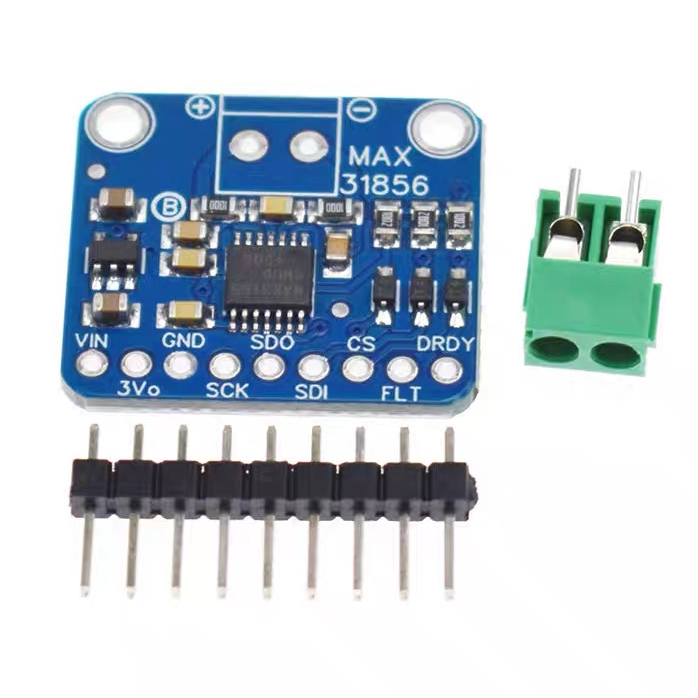
· Supports multiple thermocouple types (K, J, N, R, S, T, E, B)
· Higher resolution: 19-bit (~0.0078°C step size)
· Wider temperature range: -210°C to +1800°C (depending on thermocouple type)
· Improved accuracy: up to ±0.15% measurement error
· Integrated LUT linearization for better precision
· Better noise filtering (50Hz/60Hz rejection)
· Fault detection: open thermocouple, over/under temperature alarms
· ±45V input protection
MAX31855 Advantages
· Lower cost
· Simpler configuration
· Perfect for K-type-only applications
· Fewer settings required
MAX31856 Advantages
· Higher accuracy and resolution
· Multi-thermocouple support
· Better industrial-grade performance
· Advanced diagnostics and filtering
MAX31855 Datasheet
You can check the official datasheet for more detailed electrical characteristics, timing diagrams, and application circuits
Frequently Asked Questions [FAQ]
What is MAX31855 price?
The MAX31855 typically costs between $2 and $10 depending on supplier, quantity, and breakout board quality. Bare IC versions are cheaper, while fully assembled modules with connectors and regulators are slightly more expensive for Arduino and DIY applications.
What is the difference between MAX31856 and MAX31855?
MAX31855 supports only K-type thermocouples with 14-bit resolution and basic accuracy. MAX31856 supports multiple thermocouple types, higher 19-bit resolution, better accuracy, fault detection, filtering, and industrial-grade performance, making it more flexible and precise for advanced applications.
What is the range of MAX31855?
The MAX31855 measures approximately -200°C to +1350°C when used with a K-type thermocouple. Actual range vary slightly depending on thermocouple quality, wiring conditions, and environmental interference affecting measurement accuracy.
What is the best thermocouple for high temperature?
For high temperatures, Type K is common, but Type S, R, or B thermocouples are better for extreme heat up to 1600°C–1800°C. These types provide better stability and accuracy in industrial furnace and laboratory applications.
What is the resolution of MAX31855?
The MAX31855 provides a 14-bit digital output with an effective resolution of about 0.25°C per bit. This allows stable temperature readings suitable for embedded systems, industrial monitoring, and general-purpose thermocouple measurement applications.
Conclusion
The MAX31855 is a simple and reliable solution for accurate thermocouple temperature measurement. It removes the complexity of analog signal conditioning and allows direct SPI communication with microcontrollers. For more advanced industrial applications, the MAX31856 is a powerful upgrade, but for most K-type thermocouple projects, the MAX 31855 remains a cost-effective and widely used choice.
Read More:
1. CC1101 Wireless RF Transceiver Module Board Guide
2. TJA1050 Transceiver Pinout, Applications and Can Bus Module
HOT NEWS
TP4056 Charging Module Pinout, Working, and Applications
TP4056 Charging Module Pinout, Working, and Applications
2026-01-23
LR41 Battery Guide: Specifications, Equivalents, and Uses
LR41 Battery Specifications, Equivalents, and Uses
2025-12-14
Understanding The CD4051 Analog Multiplexer
CD4051 analog multiplexer
2025-06-30
Understanding A 0603 Resistor
0603 resistor,dimensions,marking code, values
2025-05-29
MT3608 Boost Converter - An In-Depth Guide
MT3608 Boost Converter
2025-09-04
Complete Guide to the 220 Ohm Resistor
220 Ohm Resistor
2025-07-28
The 0402 Resistor: A Comprehensive Guide
0402 Resistor
2025-05-06
Mini MP1584 DC-DC 3A Buck Converter Module: Complete Guide
Mini MP1584 DC-DC 3A Buck Converter Module: Complete Guide
2026-03-26
Guide To The XL6009 Boost Converter
XL6009 Boost Converter
2025-09-05
What Is A 1206 Resistor?
1206 resistor dimensions,footprint,value
2025-06-05