




 BOM
BOM Cart
Cart Product Catalog
The MAX4466 electret microphone amplifier module is a compact, low-power audio preamplifier designed to amplify the small analog signal produced by an electret microphone. Based on the MAX4466 micropower operational amplifier from Maxim Integrated, now part of Analog Devices, the module is suitable for Arduino, STM32, Raspberry Pi, and other embedded development platforms.
The MAX 4466 specifically optimize for microphone preamplifier applications. It combines low-voltage operation, low power consumption, a 600 kHz gain-bandwidth product at gains of 5 V/V or higher, rail-to-rail output capability, and excellent power-supply and common-mode rejection.
1. What is the MAX4466 Electret Microphone Amplifier Module?
8. Frequently Asked Questions [FAQ]
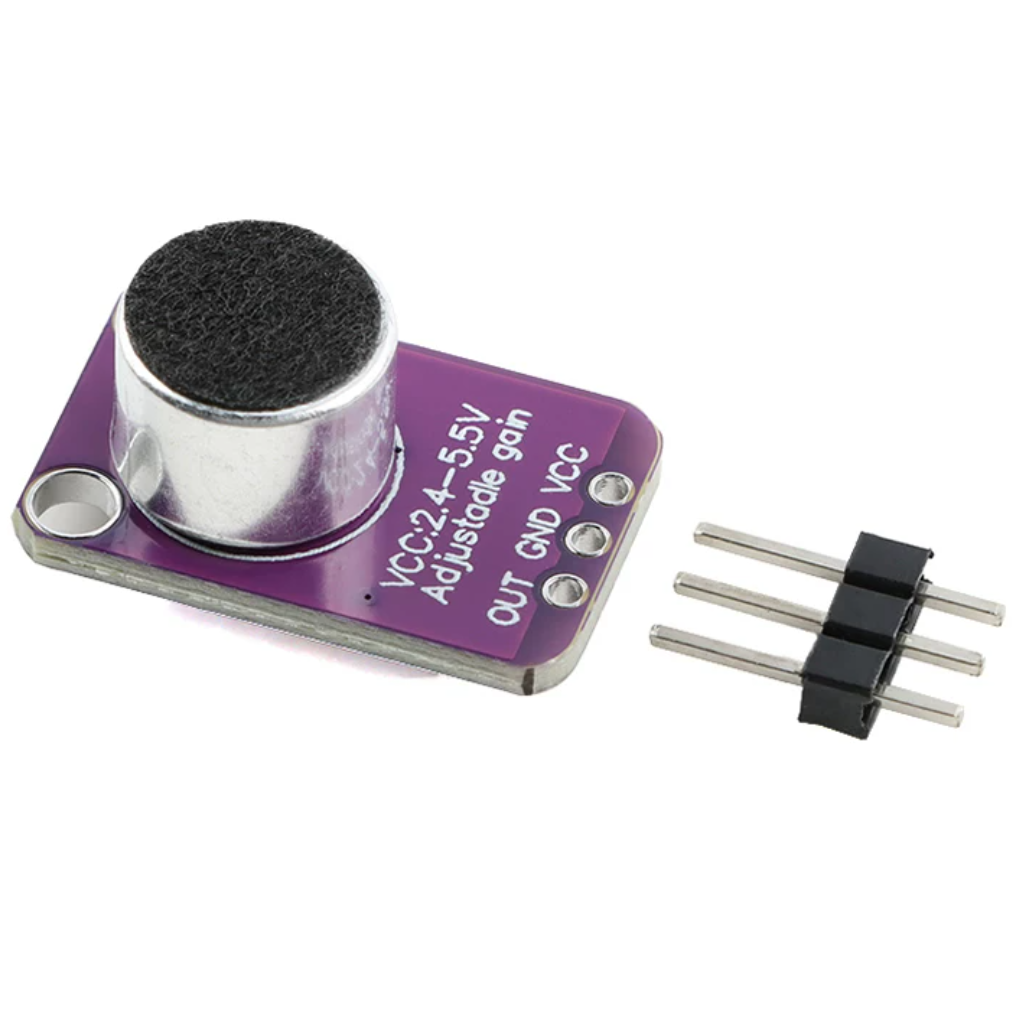
What is the MAX4466 Electret Microphone Amplifier Module?
The MAX4466 is a micropower operational amplifier optimized for use as a microphone preamplifier. It operates from a low supply voltage and consumes only about 24 μA of quiescent current, making it suitable for compact and low-power audio applications.
Unlike a microphone that produces a relatively small electrical signal, the MAX 4466 amplifier increases the microphone signal to a level that can more easily process by a microcontroller's analog-to-digital converter. This makes it useful for applications such as sound detection, voice-related projects, audio measurement, and embedded speech systems.
The module provides a 600 kHz gain-bandwidth product when operated at a minimum stable gain of +5 V/V. It also features a rail-to-rail output, high open-loop voltage gain, and excellent power-supply rejection ratio (PSRR) and common-mode rejection ratio (CMRR), which help maintain signal quality in electrically noisy environments.
The amplifier operates from +2.4 V to +5.5 V, allowing the module to work with many common development boards. The MAX 4466 itself is available in compact SC70 and SOT23-related package options, while breakout modules typically add an electret microphone and supporting components for easier prototyping.
MAX4466 Module Technical Specifications
Table
Specification | Value |
Supply Voltage | +2.4 V to +5.5 V |
Power-Supply Rejection Ratio | 112 dB |
Common-Mode Rejection Ratio | 126 dB |
Open-Loop Voltage Gain (AVOL) | 125 dB (RL = 100 kΩ) |
Output | Rail-to-rail |
Quiescent Supply Current | <24 μA |
Gain-Bandwidth Product | 600 kHz at AV ≥ 5 |
Module Dimensions | 20.8 mm × 13.8 mm × 7.5 mm |
Operating Temperature | -40°C to +85°C |
Key Features of the MAX4466 Module
Low-Power Operation
The board is designed for low-power applications and has a typical quiescent supply current of only about 24 μA. This makes it useful in battery-powered and portable projects where power consumption is important.
Wide Supply Voltage Range
The amplifier can operate from 2.4 V to 5.5 V, making it compatible with many 3.3 V and 5 V systems. This allows the module to use with common development boards such as Arduino and STM32 systems, provided the module's output voltage is compatible with the controller's ADC input.
Rail-to-Rail Output
The MAX 4466 has a rail-to-rail output stage. This allows the amplified signal to make effective use of the available supply-voltage range, which is particularly useful when interfacing with low-voltage microcontrollers.
Excellent Noise Rejection
With a specified PSRR of 112 dB and CMRR of 126 dB, the MAX4466 has strong rejection characteristics that help reduce the influence of supply and common-mode interference. This is useful in embedded systems where digital circuits and power electronics can introduce electrical noise.
Easy Development-Board Connection
The MAX4466 microphone module normally provides only three main interface pins: VCC, GND, and OUT. This makes it easy to connect directly to an analog input on an Arduino, STM32 development board, or other compatible controller.
MAX4466 Amplifier Module Pinout
The microphone amplifier module uses a simple three-pin interface.
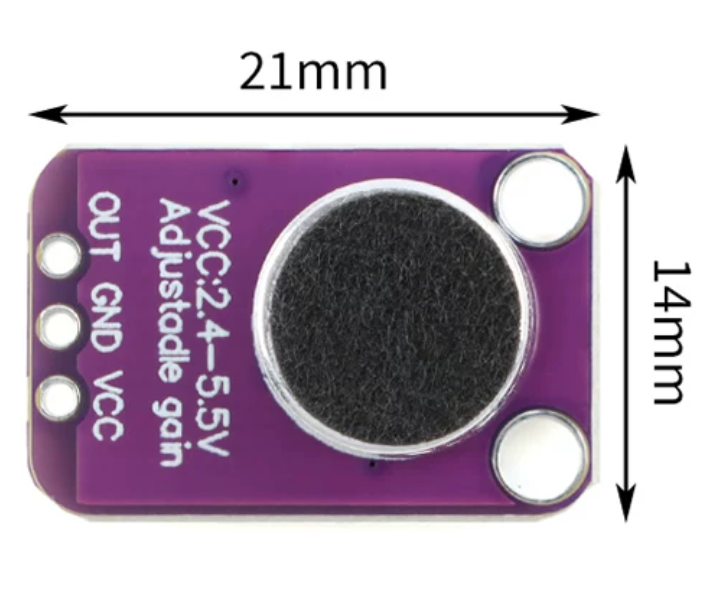
Pin | Function |
VCC | Positive power supply |
GND | Ground |
OUT | Analog audio output |
VCC: Connect this pin to a suitable supply voltage between 2.4 V and 5.5 V, according to the module specification.
GND: Connect to the common ground of the development board.
OUT: Provides the amplified analog microphone signal. Connect this pin to an analog input or ADC channel.
Because the output is analog, the connected microcontroller needs an analog-to-digital converter or another suitable analog signal-processing circuit to measure the microphone waveform.
How to work with Arduino?
The MAX 4466 module can easily connect to an Arduino Uno R3. Since the module provides an analog output, the Arduino can use one of its analog input pins to sample the microphone signal.
Arduino Uno R3 Wiring
MAX4466 | Arduino Uno R3 |
OUT | A0 |
GND | GND |
VCC | 5V |
After connecting the module, the Arduino can read the microphone signal through the A0 analog input.
Simple Arduino Example
const int micPin = A0;
void setup() {
Serial.begin(9600);
}
void loop() {
int micValue = analogRead(micPin);
Serial.println(micValue);
delay(10);
}
This simple program continuously reads the MAX4466 output and sends the ADC value to the Serial Monitor. When sound reaches the electret microphone, the analog output changes, causing corresponding variations in the ADC readings.
For more advanced applications, you can sample the signal more rapidly and use the measured waveform for sound-level detection, frequency analysis, voice activity detection, or other audio-processing functions.
Application of the MAX4466 Module
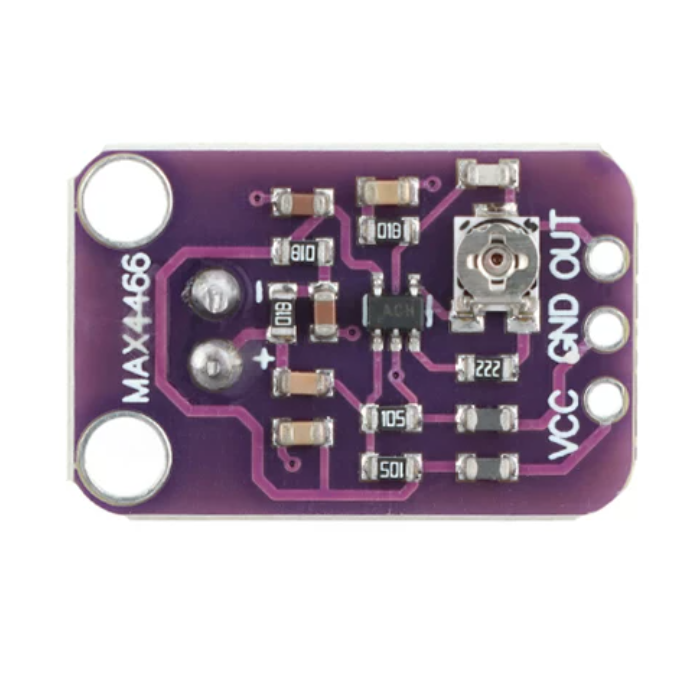
The module is designed for microphone preamplification and can be used in a wide range of audio and embedded applications.
Microphone Preamplifiers: The module can amplify the low-level output from an electret microphone before it is sent to an ADC, audio processor, or other circuit.
Voice Recognition Systems: The amplified microphone signal can sample by a microcontroller or processor and use as an input for voice-recognition or voice-command systems.
Digital Dictation Devices: Low-power microphone amplification is useful in portable voice-recording and dictation equipment.
Headsets: Microphone preamplification can use in compact communication and headset circuits.
Hearing Aids: The MAX4466 family is specified for applications including hearing aids and other low-power audio systems.
Portable Computers and Embedded Devices: Its low operating current and small package make the MAX 4466 suitable for compact electronic equipment.
Other applications include cellular phones, audio sensing systems, sound-activated projects, and general-purpose embedded microphone interfaces.
How to Use MAX4466?
Using the MAX4466 module is relatively simple. First, connect VCC to an appropriate power supply and connect GND to the system ground. Then connect OUT to an analog input of the microcontroller or ADC.
When sound reaches the electret microphone, the microphone converts acoustic pressure into a small electrical signal. The MAX 4466 amplifies this signal, and the module presents the resulting analog waveform at its OUT pin.
For Arduino projects, can connect the OUT pin to A0 and sampled using analogRead(). For more advanced audio applications, the signal can be sampled at a controlled rate and processed using filtering, peak detection, RMS measurements, or frequency analysis.
The MAX4466 is not itself a digital microphone interface. Its output is an analog audio signal, so the host system must provide an ADC or analog processing stage.
MAXIM MAX4466 Datasheet
For detailed electrical characteristics, operating conditions, package information, and application circuits, refer to the official Analog Devices data sheet.
Frequently Asked Questions [FAQ]
What is difference between MAX4466 and MAX9814?
The MAX4466 is a low-power microphone preamplifier based on an op amp, while the MAX9814 is a microphone amplifier with integrated automatic gain control (AGC). MAX 4466 is useful when prefer predictable analog amplification, whereas MAX9814 can automatically adjust gain as sound levels change.
What are the disadvantages of electret mics?
Electret microphones require bias power and generally produce a relatively small analog signal, so they often need a preamplifier. Their performance can also vary with microphone quality, environmental noise, mechanical vibration, temperature, and acoustic conditions. They are not inherently digital audio devices.
Can I plug a microphone directly into an amplifier?
It depends on the amplifier. An electret microphone usually needs a bias voltage and may produce a signal that is too small for a conventional amplifier input. A suitable microphone preamplifier, such as a MAX4466 module, can provide the required signal conditioning before the main amplifier stage.
How to power an electret microphone?
An electret microphone typically requires a small DC bias current supplied through a resistor or an integrated microphone-bias circuit. A MAX4466 microphone module normally includes the required supporting circuitry, so you only need to connect the module's VCC and GND pins to an appropriate supply.
How do I connect an Electret microphone?
Normally connect an electret microphone to a bias supply and a preamplifier input. With a MAX4466 microphone module, the microphone and amplifier circuitry are already integrated. Connect VCC to the supply, GND to ground, and OUT to an analog input of your controller.
What does an electret microphone do?
An electret microphone converts sound waves into an electrical audio signal. The microphone diaphragm responds to changes in air pressure, producing a small voltage variation that represents the sound. A microphone amplifier such as the MAX 4466 can then increase this signal for further processing.
What is the lifespan of an electret mic?
An electret microphone can operate for many years under normal conditions. Its practical lifespan depends on humidity, temperature, mechanical stress, contamination, and operating environment. High-quality electret microphones can remain functional for a long time when operated within their specified environmental limits.
Conclusion
The MAX4466 electret microphone amplifier module provides a simple way to amplify an electret microphone signal for microcontroller and embedded applications. Its low power consumption, 2.4 V to 5.5 V supply range, rail-to-rail output, 600 kHz gain-bandwidth product at the specified gain, and strong PSRR and CMRR make it a useful choice for compact analog audio projects.
With only VCC, GND, and OUT connections, can quickly connect the module to an Arduino Uno R3 or another development board. For applications requiring automatic gain control, the MAX9814 may be a better choice; for straightforward low-power analog microphone amplification, the MAX4466 offers a simple and flexible solution.
Read More:
1. MAX9814 Electret Microphone Amplifier Module Board: Guide
2. MAX31865 PT100 RTD Temperature Sensor Module: Complete Guide with Arduino
HOT NEWS
TP4056 Charging Module Pinout, Working, and Applications
TP4056 Charging Module Pinout, Working, and Applications
2026-01-23
LR41 Battery Guide: Specifications, Equivalents, and Uses
LR41 Battery Specifications, Equivalents, and Uses
2025-12-14
Understanding The CD4051 Analog Multiplexer
CD4051 analog multiplexer
2025-06-30
Understanding A 0603 Resistor
0603 resistor,dimensions,marking code, values
2025-05-29
MT3608 Boost Converter - An In-Depth Guide
MT3608 Boost Converter
2025-09-04
Complete Guide to the 220 Ohm Resistor
220 Ohm Resistor
2025-07-28
The 0402 Resistor: A Comprehensive Guide
0402 Resistor
2025-05-06
Mini MP1584 DC-DC 3A Buck Converter Module: Complete Guide
Mini MP1584 DC-DC 3A Buck Converter Module: Complete Guide
2026-03-26
Guide To The XL6009 Boost Converter
XL6009 Boost Converter
2025-09-05
What Is A 1206 Resistor?
1206 resistor dimensions,footprint,value
2025-06-05