




 BOM
BOM Cart
Cart Product Catalog
The MAX9814 electret microphone module is a compact, low-cost, and high-performance audio amplifier designed for electret condenser microphones. Built around the MAX9814ETD+T integrated circuit from Analog Devices (formerly Maxim Integrated), this module combines a low-noise microphone preamplifier with Automatic Gain Control (AGC), making it ideal for voice recognition, sound detection, portable recorders, and Arduino audio projects.
Unlike traditional microphone amplifiers that require manual gain adjustment, the MAX 9814 automatically adapts to changing sound levels. Quiet sounds are amplified while loud sounds are reduced, ensuring clear and stable audio output in various environments.
Whether you're building a voice-controlled robot, an IoT sound sensor, or a digital recording system, the MAX9814 provides an easy-to-use analog audio solution.
1. What is the MAX9814 Electret Microphone Amplifier Module?
2. MAX9814 Amplifier Board Technical Specifications
4. MAX9814 Microphone Module Pinout
8. Frequently Asked Questions [FAQ]
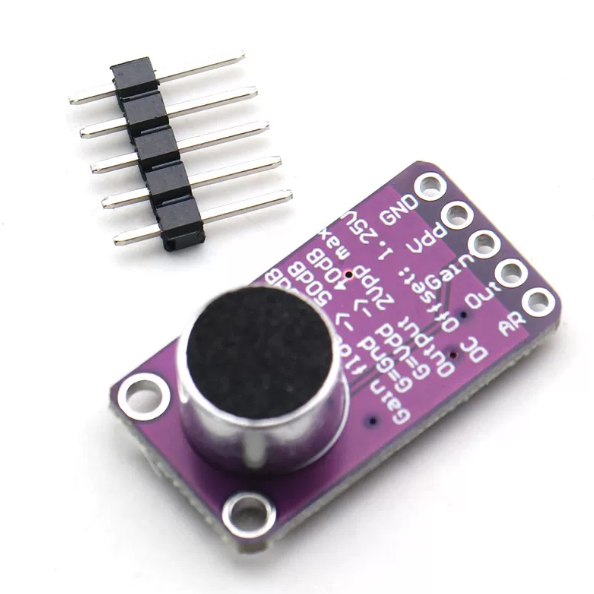
What is the MAX9814 Electret Microphone Amplifier Module?
The MAX9814 module is a low-cost, high-performance audio amplifier designed for electret condenser microphones. It features Automatic Gain Control (AGC) and a built-in low-noise microphone bias, allowing it to automatically adjust microphone gain based on ambient sound levels for clear and consistent audio output.
The MAX 9814 integrates a low-noise microphone preamplifier, Variable Gain Amplifier (VGA), output amplifier, microphone bias voltage generator, and AGC control circuitry into a single chip. Supporting selectable gains of 40dB, 50dB, and 60dB, it delivers excellent voice clarity with minimal distortion. Its wide operating voltage of 2.7V to 5.5V makes it compatible with Arduino, ESP32, Raspberry Pi, and other microcontroller platforms for voice recognition, sound detection, recording, and communication applications.
MAX9814 Amplifier Board Technical Specifications
Table
Specification | Value |
Operating Voltage | 2.7V – 5.5V |
Supply Current | Approximately 3mA |
Audio Output | 2Vpp on 1.25V DC bias |
Frequency Response | 20Hz – 20kHz |
Automatic Gain Control | Built-in (AGC) |
Selectable Maximum Gain | 40dB, 50dB, or 60dB |
Attack & Release Ratio | Programmable |
Input-Referred Noise Density | 30nV/√Hz (Typical) |
Total Harmonic Distortion (THD) | 0.04% (Typical) |
Output Signal | Analog |
Microphone Bias Voltage | Built-in 2V Low-Noise Bias |
Compatible Logic Levels | 3.3V and 5V Microcontrollers |
Operating Temperature | -40°C to +85°C (IC) |
MAX9814 Key Features
The MAX 9814 microphone module offers several advanced audio features while maintaining low power consumption.
Automatic Gain Control (AGC)
The integrated AGC continuously monitors the microphone signal and automatically adjusts amplifier gain, producing consistent audio even when sound levels change dramatically.
Three Gain Settings
The maximum gain can be selected as:
· 40dB
· 50dB
· 60dB
This allows the module to be optimized for different recording distances and environmental noise levels.
Programmable Attack Time
The attack time determines how quickly the AGC reacts when loud sounds occur.
Programmable Attack and Release Ratio
Users can configure the AGC response characteristics for smoother audio performance in various applications.
Wide Operating Voltage
The module operates from 2.7V to 5.5V, making it compatible with both 3.3V and 5V microcontrollers.
Low Distortion
Typical Total Harmonic Distortion (THD) is only 0.04%, resulting in clean and natural sound reproduction.
Low Power Shutdown
A shutdown mode minimizes power consumption for battery-powered devices.
Built-in 2V Microphone Bias
The integrated low-noise microphone bias eliminates the need for additional external components.
MAX9814 Microphone Module Pinout
The module provides five connection pins.
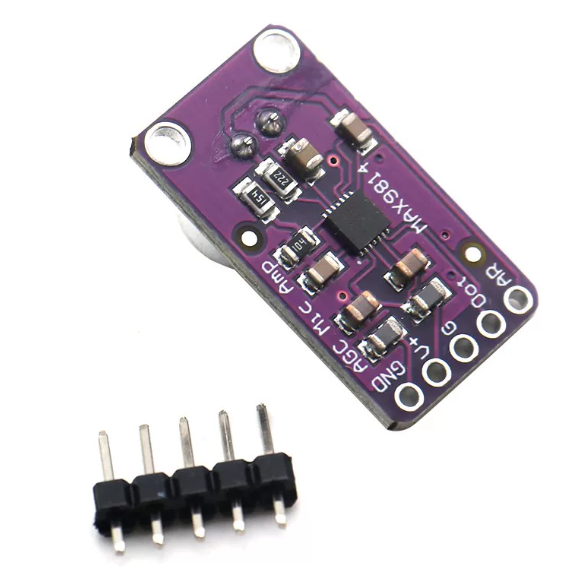
Pin | Description |
VCC | Power supply (2.7V–5.5V) |
GND | Ground |
OUT | Analog audio output |
Gain | Selects maximum amplifier gain |
AR | Selects attack/release timing |
Pin Description
VCC
Connect to either 3.3V or 5V power supply.
GND
Common ground connection.
OUT
Provides the amplified analog audio signal that can be read using an Arduino analog input or ADC.
Gain
Changes the maximum amplifier gain between 40dB, 50dB, and 60dB.
AR
Configures the AGC attack and release timing ratio for different audio environments.
MAX9814 Arduino Wiring
Connecting the MAX 9814 to an Arduino Uno is simple.
MAX9814 | Arduino Uno |
VCC | 5V |
GND | GND |
OUT | A0 |
Gain | Leave default or configure |
AR | Leave default or configure |
The OUT pin connects directly to an Arduino analog input where sound intensity can be sampled using the ADC.
Simple Arduino Example
const int micPin = A0;
void setup() {
Serial.begin(9600);
}
void loop() {
int sound = analogRead(micPin);
Serial.println(sound);
delay(20);
}
This program continuously reads the microphone output and displays the audio level in the Serial Monitor.
MAX9814 Amplifier Board Application
Thanks to its low noise, AGC, and wide operating voltage, the MAX9814 is suitable for many audio projects.
Digital Cameras
Provides high-quality audio capture for compact digital cameras.
Entertainment Systems
Suitable for karaoke systems, portable speakers, and multimedia equipment.
Digital Camcorders
Improves voice recording quality for video recording devices.
Two-Way Communication Devices
Ideal for intercoms, walkie-talkies, and communication terminals.
PDAs and Portable Devices
Low power consumption makes it suitable for handheld electronics.
Portable Voice Recorders
Produces clear speech recordings with automatic level adjustment.
Bluetooth Headsets
Enhances voice quality in wireless headsets and hands-free communication.
IP Phones and Conference Systems
Provides automatic microphone gain control for improved conference audio.
Voice Recognition Systems
Compatible with speech recognition modules and AI voice assistants.
Sound Detection Projects
Perfect for Arduino and ESP32 sound monitoring applications.
MAX9814 vs MAX4466
Both modules are popular microphone amplifiers, but they serve different purposes.
Feature | MAX9814 | MAX4466 |
Automatic Gain Control | Yes | No |
Gain Adjustment | 40/50/60dB Selectable | Manual Potentiometer |
Operating Voltage | 2.7V–5.5V | 2.4V–5.5V |
Power Consumption | ~3mA | <24μA |
Gain Bandwidth | Integrated AGC | 600kHz |
Output | Analog | Analog |
THD | 0.04% | Low |
Best For | Voice recording and speech | Precision microphone amplification |
About the MAX4466
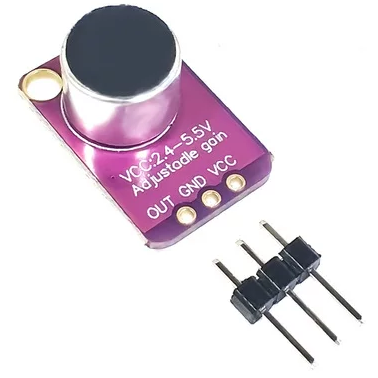
The MAX4466 is an ultra-low-power operational amplifier optimized for microphone preamplifiers. It provides an excellent balance of gain bandwidth and power consumption while operating from 2.4V to 5.5V.
Key specifications include:
· Supply voltage: 2.4V–5.5V
· Power supply rejection ratio: 112dB
· Common-mode rejection ratio: 126dB
· Open-loop gain: 125dB
· Quiescent current: <24μA
· Gain bandwidth: 600kHz
· Module size: 20.8 × 13.8 × 7.5mm
Typical applications include:
· Cellular phones
· Digital voice recorders
· Headphones
· Hearing aids
· Microphone preamplifiers
· Portable computers
· Speech recognition systems
Which Should You Choose?
Choose the MAX9814 if your project requires automatic volume adjustment and speech recording in changing environments.
Choose the MAX4466 if you need manual gain adjustment, extremely low power consumption, or more control over microphone amplification.
MAX9814 Datasheet
The data sheet provides complete electrical characteristics, AGC timing diagrams, recommended operating conditions, pin functions, and reference circuits. Recommend reviewing the datasheet for advanced circuit design and custom PCB development.
Frequently Asked Questions [FAQ]
How good is the audio quality of the MAX9814?
The MAX9814 offers excellent voice quality with low input noise, 20Hz–20kHz frequency response, and only 0.04% typical THD. Its automatic gain control maintains consistent recording levels, making it ideal for speech, voice recognition, and general-purpose audio applications.
What are the dimensions of the Electret MAX9814 microphone?
Most MAX9814 breakout boards measure approximately 25.58 mm long and 14.28 mm wide, though dimensions vary slightly by manufacturer. Their compact size makes them easy to integrate into portable electronics, Arduino projects, and embedded audio systems.
What are common issues using MAX9814?
Common issues include unstable power supplies, incorrect gain selection, electrical noise from nearby components, and ADC sampling limitations. Proper grounding, short wiring, and adequate power filtering significantly improve recording quality and reduce unwanted background noise.
Is MAX9814 compatible with Arduino?
Yes. The MAX9814 is fully compatible with Arduino boards. It operates from both 3.3V and 5V supplies and outputs an analog signal that connects directly to Arduino analog input pins for sound level measurement or audio sampling.
What is price of MAX9814?
The MAX9814 microphone amplifier module typically costs between US$2 and US$6, depending on the manufacturer, included microphone quality, and purchase quantity. Bulk pricing is generally lower for educational, DIY, and commercial electronics projects.
Conclusion
The MAX9814 electret microphone amplifier module is an excellent choice for embedded audio applications requiring clean sound, automatic gain control, and low power consumption. Its integrated AGC, selectable gain settings, and wide operating voltage make it suitable for Arduino, ESP32, Raspberry Pi, STM32, and many other development platforms.
Whether you're designing a voice-controlled system, portable recorder, conference device, or sound detection project, the MAX 9814 delivers reliable analog audio performance with minimal external components.
Read More:
1. Mini MP1584 DC-DC 3A Buck Converter Module: Complete Guide
2. TP4056 Charging Module Pinout, Working, and Applications
3. LR41 Battery Guide: Specifications, Equivalents, and Uses
HOT NEWS
TP4056 Charging Module Pinout, Working, and Applications
TP4056 Charging Module Pinout, Working, and Applications
2026-01-23
LR41 Battery Guide: Specifications, Equivalents, and Uses
LR41 Battery Specifications, Equivalents, and Uses
2025-12-14
Understanding A 0603 Resistor
0603 resistor,dimensions,marking code, values
2025-05-29
MT3608 Boost Converter - An In-Depth Guide
MT3608 Boost Converter
2025-09-04
Complete Guide to the 220 Ohm Resistor
220 Ohm Resistor
2025-07-28
The 0402 Resistor: A Comprehensive Guide
0402 Resistor
2025-05-06
Understanding The CD4051 Analog Multiplexer
CD4051 analog multiplexer
2025-06-30
What Is A 1206 Resistor?
1206 resistor dimensions,footprint,value
2025-06-05
Guide To The XL6009 Boost Converter
XL6009 Boost Converter
2025-09-05
Mini MP1584 DC-DC 3A Buck Converter Module: Complete Guide
Mini MP1584 DC-DC 3A Buck Converter Module: Complete Guide
2026-03-26