




 BOM
BOM Cart
Cart Product Catalog
The MPU9250 is one of the most widely used motion-tracking sensors in embedded systems, robotics, drones, and wearable devices. With its compact size and powerful integration, it combines multiple sensing capabilities into a single chip, making it highly attractive for engineers and hobbyists alike.
1. What is MPU9250 Accelerometer?
8. MPU9250 9-Axis Sensor Module Board (GY-9250)
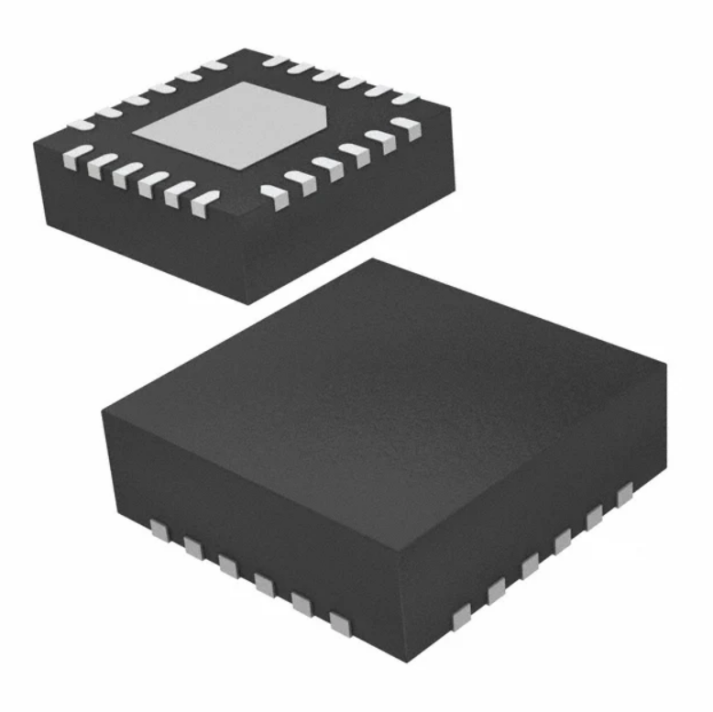
What is MPU9250 Accelerometer?
The MPU-9250 is a highly integrated 9-axis motion tracking sensor developed by TDK InvenSense. Build as a multi-chip module (MCM) that combines two silicon dies into a compact 3×3×1 mm QFN package.
One die contains a 3-axis gyroscope and a 3-axis accelerometer, while the second die integrates the AK8963 3-axis magnetometer from Asahi Kasei Microdevices. This architecture enables the MPU-9250 to deliver full 9-axis sensing, making it capable of tracking motion, orientation, and heading with high precision.
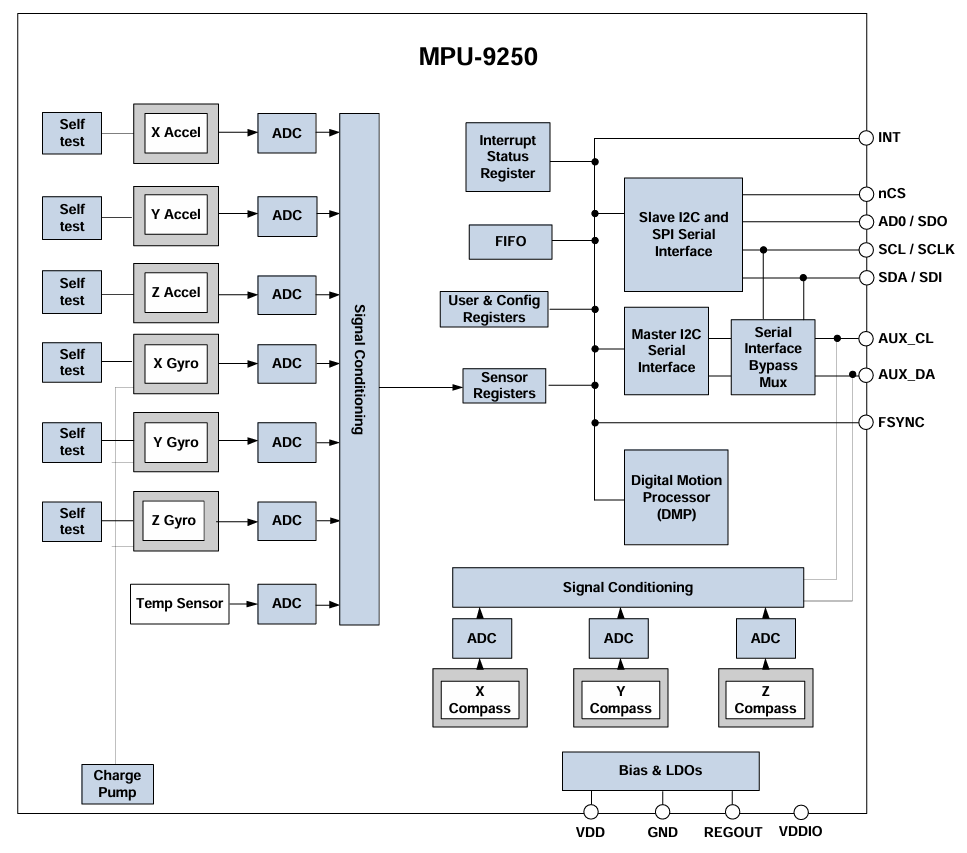
The device also includes a built-in Digital Motion Processor™ (DMP), which performs real-time sensor fusion. This allows the MPU-9250 to output processed data such as quaternions, Euler angles, and rotation matrices, reducing the computational load on the host microcontroller. With its dedicated I2C sensor bus, it can directly provide complete MotionFusion™ data.
To ensure accurate measurement of both slow and fast motion, the MPU-9250 offers programmable ranges:
· Gyroscope: ±250, ±500, ±1000, ±2000°/sec
· Accelerometer: ±2g, ±4g, ±8g, ±16g
· Magnetometer: ±4800µT
Internally, the sensor uses nine 16-bit ADCs (three for each sensing unit) to digitize motion data with high resolution. It also includes advanced features such as programmable digital filters, an embedded temperature sensor, precision timing with low drift, and configurable interrupts.
The MPU-9250 supports both I2C (up to 400kHz) and SPI (up to 20MHz) communication, with an operating voltage range of 2.4V to 3.6V and a separate I/O voltage supply (VDDIO). Additionally, it provides an auxiliary I2C interface for connecting external sensors like pressure sensors.
Thanks to its CMOS-MEMS fabrication technology, the device achieves a small size while maintaining strong performance and durability, including shock resistance up to 10,000g. Overall, the MPU-9250 simplifies system design by integrating multiple sensors into a single, efficient, and cost-effective solution for motion tracking applications.
Pin Configuration
The following table shows the pin configuration of the MPU 9250 along with their descriptions:
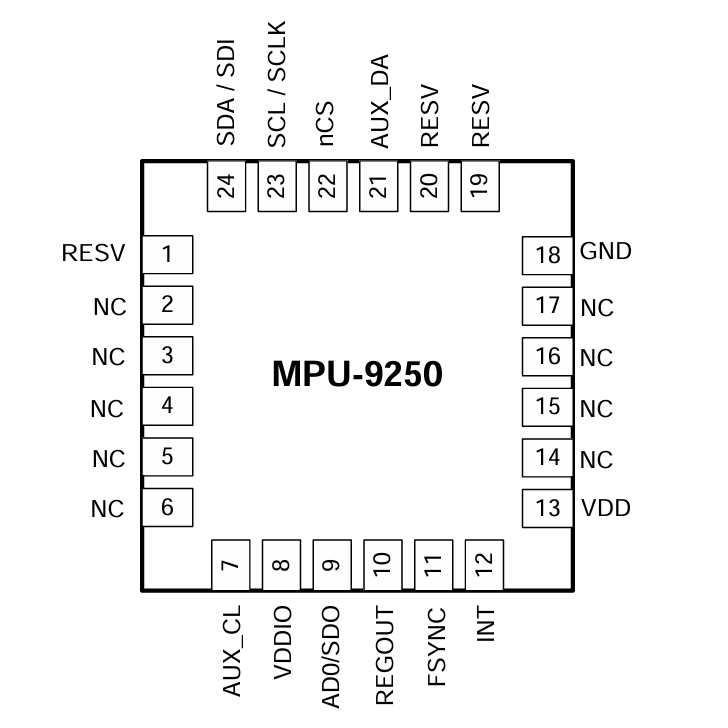
Pin Number | Pin Name | Description |
1 | RESV | Reserved. Connect to VDDIO. |
7 | AUX_CL | I2C master serial clock for connecting to external sensors. |
8 | VDDIO | Digital I/O supply voltage. |
9 | ADO / SDO | I2C slave address LSB (ADO); SPI serial data output (SDO). |
10 | REGOUT | Regulator filter capacitor connection. |
11 | FSYNC | Frame synchronization digital input. Connect to GND if unused. |
12 | INT | Interrupt digital output (totem pole or open-drain). |
13 | VDD | Power supply voltage and Digital I/O supply voltage. |
18 | GND | Power supply ground. |
19 | RESV | Reserved. Do not connect. |
20 | RESV | Reserved. Connect to GND. |
21 | AUX_DA | I2C master serial data for connecting to external sensors. |
22 | nCS | Chip select (SPI mode only). |
23 | SCL / SCLK | I2C serial clock (SCL); SPI serial clock (SCLK). |
24 | SDA / SDI | I2C serial data (SDA); SPI serial data input (SDI). |
2–6, 14–17 | NC | Not internally connected; can use for PCB trace routing. |
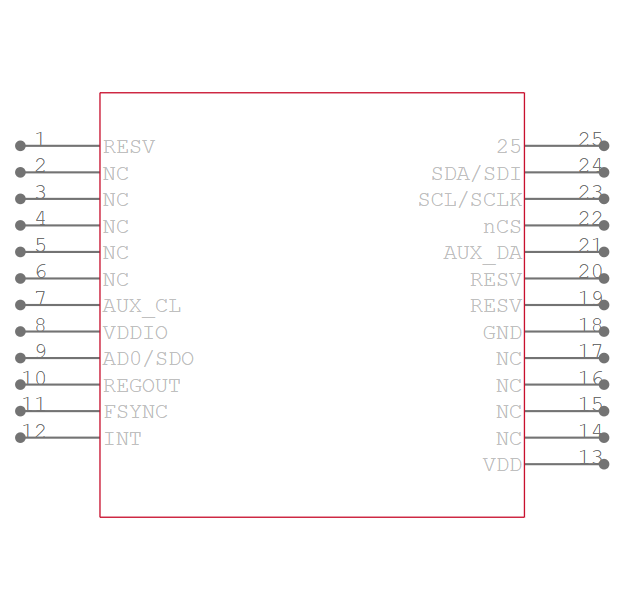
This pin layout supports both I2C and SPI communication, along with an auxiliary I2C interface for integrating additional sensors.
CAD Model of MPU9250
Symbol
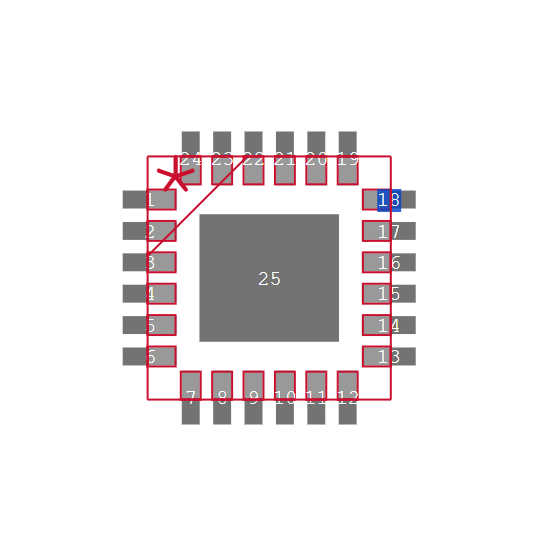
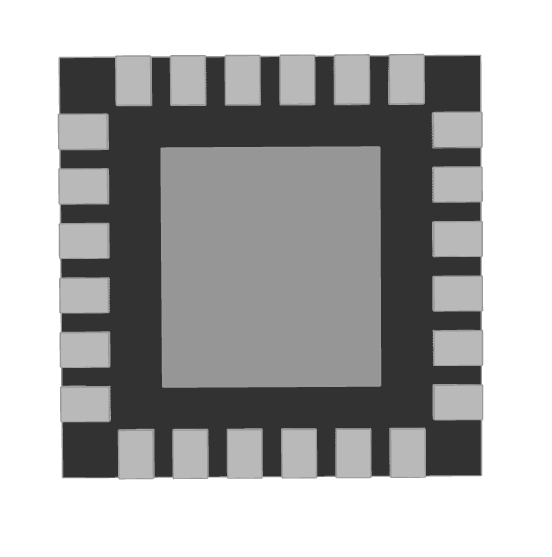
Footprint
3D Model
System Block Diagram Overview
Specifications
The key specifications of the MPU-9250 are summarized in the table below:
Parameter | Specification |
Manufacturer | TDK InvenSense |
Package Type | 24-QFN (3 × 3 × 1 mm) |
Motion Axes | 9-axis (3-axis accelerometer + 3-axis gyroscope + 3-axis magnetometer) |
Gyroscope Range | ±250, ±500, ±1000, ±2000 °/sec |
Accelerometer Range | ±2g, ±4g, ±8g, ±16g |
Magnetometer Range | ±4800 µT |
ADC Resolution | 16-bit (gyro, accelerometer, magnetometer) |
Communication Interfaces | I2C (up to 400 kHz), SPI (up to 20 MHz) |
Operating Voltage (VDD) | 2.4V – 3.6V |
I/O Voltage (VDDIO) | 1.71V – VDD |
Operating Temperature | -40°C to +85°C |
FIFO Buffer | 512 bytes |
Gyroscope Current | ~3.2 mA |
Accelerometer Current | ~450 µA |
Magnetometer Current | ~280 µA |
Sleep Mode Current | ~8 µA |
Shock Tolerance | Up to 10,000 g |
Additional Features | DMP, temperature sensor, programmable filters, interrupts |
Packaging Information
The component is available in a 24-pin QFN (Quad Flat No-Lead) package with compact dimensions of 3 mm × 3 mm × 1 mm. This surface-mount package uses a leadless design, where electrical connections are made through pads located on the underside of the chip.
Manufacturer TDK InvenSense
Manufacture by TDK InvenSense, a leading company in motion sensing and MEMS technology.
TDK InvenSense specializes in developing high-performance sensors such as accelerometers, gyroscopes, and motion tracking solutions widely used in consumer electronics, automotive systems, industrial devices, and IoT applications.
MPU9250 Alternative
MPU-6000
A 6-axis sensor that integrates a 3-axis-accelerometer and 3-axis gyroscope. It supports both I2C and SPI communication and is suitable for applications that do not require magnetometer data.
MPU-6050
One of the most widely used 6-axis motion sensors. It combines an accelerometer and gyroscope with I2C interface only. It is cost-effective and ideal for basic motion detection and orientation tasks.
MPU-6500
An improved version of earlier 6-axis sensors, offering better performance and lower power consumption. It supports both I2C and SPI interfaces.
ICM-20648
A more advanced 6-axis sensor that includes accelerometer, gyroscope, and temperature sensing. It provides improved noise performance and lower power consumption compared to older MPU series devices.
Sensor Features
Gyroscope Features
3-axis angular rate sensing
Programmable ranges: ±250 to ±2000°/sec
16-bit ADC resolution
Low-pass digital filtering
Operating current: 3.2mA
Sleep current: 8µA
Built-in self-test
Accelerometer Features
3-axis acceleration sensing
Programmable ranges: ±2g to ±16g
16-bit ADC output
Low power modes:
8.4µA (0.98Hz)
19.8µA (31.25Hz)
Wake-on-motion interrupt
Self-test capability
Magnetometer Features
3-axis Hall-effect magnetic sensor
Resolution: 14-bit (0.6µT/LSB)
Full-scale range: ±4800µT
Operating current: 280µA
Built-in self-test
MPU9250 Application
Location Based Services
Widely use in location-based services, points of interest detection, and dead reckoning systems. By combining accelerometer, gyroscope, and magnetometer data, it helps estimate movement direction and position even when GPS signals are weak or unavailable, making it suitable for navigation and tracking applications.
Handset and Portable Gaming
In handset and portable gaming devices, the chip enables interactive motion control. It allows smartphones and handheld consoles to detect tilt, rotation, and gestures, providing a more immersive gaming experience.
Motion-Based Game Controllers
The sensor is commonly integrated into motion-based game controllers, where it captures real-time hand movements. This enables precise control in gaming environments such as sports simulations, racing games, and VR-based interactions.
3D Remote Controls and Input Devices
Use component in 3D remote controls for internet-connected DTVs, set-top boxes, and 3D mice. It allows users to control devices through natural hand movements, improving user interaction and ease of navigation.
Wearable Sensors for Health and Fitness
In wearable health, fitness, and sports devices, the sensor tracks motion, steps, and orientation. Widely use in fitness bands, smartwatches, and sports monitoring systems to analyze physical activity and improve performance tracking.
MPU9250 9-Axis Sensor Module Board (GY-9250)
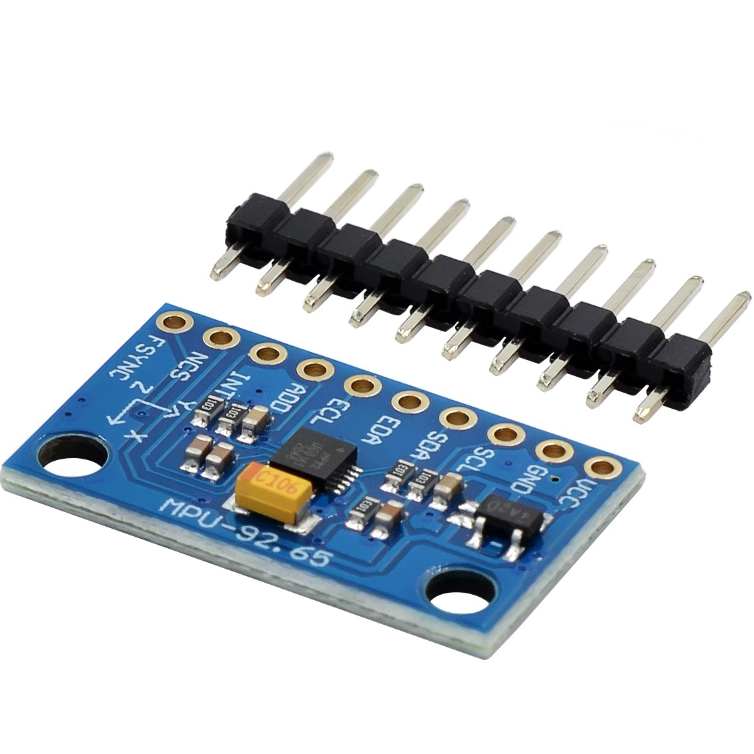
The GY-9250 module is a compact breakout board that integrates a 3-axis gyroscope, 3-axis accelerometer, and 3-axis magnetometer, making it a complete 9-axis motion sensing solution.
Module Overview
The GY-9250 module build around the MPU9250 chip and design for easy integration into embedded systems, robotics, and motion tracking projects. It provides stable performance with onboard voltage regulation and standard communication interfaces.
Power Supply
The module operates with a 3V to 5V power supply, supported by an internal low-dropout (LDO) regulator, making it compatible with both 3.3V and 5V microcontroller systems.
Communication Interface
It supports standard I2C (IIC) and SPI communication protocols, allowing flexible connection with Arduino, STM32, ESP32, and other microcontrollers.
Sensor Ranges
· Gyroscope range: ±250, ±500, ±1000, ±2000°/s
· Accelerometer range: ±2g, ±4g, ±8g, ±16g
· Magnetometer range: ±4800 µT
Resolution
The module features an internal 16-bit ADC converter, providing high-resolution digital output for all three sensing units.
PCB and Build Quality
The board uses gold-plated (ENIG) PCB technology with machine soldering for improved reliability and signal integrity. It also features a standard 2.54 mm pin spacing, making it breadboard-friendly.
Physical Size
The compact module measures approximately 15 mm × 25 mm, making it suitable for space-constrained applications such as drones, wearables, and robotics.
MPU9250 Datasheet PDF
Frequently Asked Questions
What is the function of MPU-9250?
The MPU-9250 measures motion and orientation using 9-axis sensing (accelerometer, gyroscope, and magnetometer). It provides processed data such as orientation, rotation, and heading for applications like drones, robotics, and wearable devices.
Is MPU-9250 any good?
Yes, it offers high integration, good accuracy, and low power consumption. While newer sensors exist, it remains a reliable and cost-effective solution for many embedded motion-tracking applications.
Which is better MPU9250 or ICM-20948?
The ICM-20948 is newer, with improved power efficiency and performance. However, the MPU 9250 is easier to use, widely supported, and still suitable for most projects.
Does the MPU-9250 have a magnetometer?
Yes, it includes a built-in AK8963 3-axis magnetometer, enabling full 9-axis motion sensing.
What is the difference between MPU6050 and MPU9250?
MPU6050: 6-axis (accelerometer + gyroscope only)
MPU-9250: 9-axis (adds magnetometer)
This makes the MPU-9250 better for applications requiring orientation and compass heading.
Conclusion
The MPU9250 remains a powerful and compact motion sensor that combines accelerometer, gyroscope, and magnetometer into a single package. Its built-in processing, flexible interfaces, and wide application range make it a strong choice for engineers designing motion-aware systems.
If you're building projects involving orientation tracking, motion detection, or navigation, the MPU 9250 continues to be a practical and widely supported solution.
Read More:
1. MPU6050 Accelerometer and Gyroscope Sensor Module
HOT NEWS
TP4056 Charging Module Pinout, Working, and Applications
TP4056 Charging Module Pinout, Working, and Applications
2026-01-23
LR41 Battery Guide: Specifications, Equivalents, and Uses
LR41 Battery Specifications, Equivalents, and Uses
2025-12-14
Understanding A 0603 Resistor
0603 resistor,dimensions,marking code, values
2025-05-29
MT3608 Boost Converter - An In-Depth Guide
MT3608 Boost Converter
2025-09-04
The 0402 Resistor: A Comprehensive Guide
0402 Resistor
2025-05-06
Complete Guide to the 220 Ohm Resistor
220 Ohm Resistor
2025-07-28
What Is A 1206 Resistor?
1206 resistor dimensions,footprint,value
2025-06-05
Guide To The XL6009 Boost Converter
XL6009 Boost Converter
2025-09-05
Understanding The CD4051 Analog Multiplexer
CD4051 analog multiplexer
2025-06-30
120 Ohm Resistor- Specifications, Applications, and Features
2025-05-12