




 BOM
BOM Cart
Cart Product Catalog
The OPT101 Module is a high-performance analog light sensor designed for precise light intensity measurement. Unlike ordinary photoresistors, the OPT101 integrates a photodiode and a precision transimpedance amplifier into a single chip, providing a stable voltage output that is directly proportional to the incident light. This highly integrated design minimizes external components while delivering excellent accuracy, low noise, and fast response.
Thanks to its wide spectral response and high sensitivity, the module widely use in medical equipment, laboratory instruments, barcode scanners, optical detectors, and industrial automation systems. It is also a popular choice for Arduino and other microcontroller-based light sensing projects.
In this article, we'll explore the OPT101's pinout, specifications, features, applications, and answer some frequently asked questions.
5. How Does the OPT101 Module Work?
7. How to Connect OPT101 Module to Arduino
8. Frequently Asked Questions [FAQ]
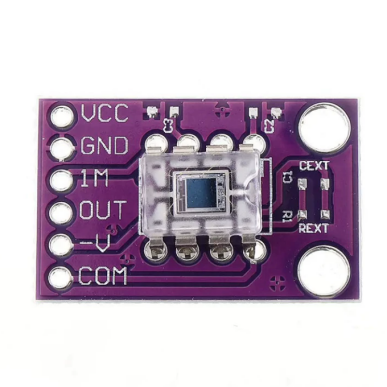
What is OPT101 Module?
A light intensity sensor that integrates a precision photodiode and a specially optimized operational amplifier into a single chip. This integrated design simplifies circuit development while providing accurate and stable light measurements.
The transparent package gives the photodiode a larger sensing area, resulting in higher sensitivity and a wide spectral response range from 300 nm to 1000 nm, covering both visible and near-infrared light. The built-in amplifier converts the photodiode current directly into a proportional voltage output, eliminating the need for complex external amplification circuits.
Because its high sensitivity, low power consumption, and excellent linearity, the OPT 101 module widely use in medical instruments, laboratory equipment, optical detection systems, barcode scanners, and industrial light-sensing applications.
OPT101 Module Pinout
The module provides several pins for power, signal output, and optional circuit expansion. Understanding the function of each pin helps ensure proper operation and integration into your circuit.
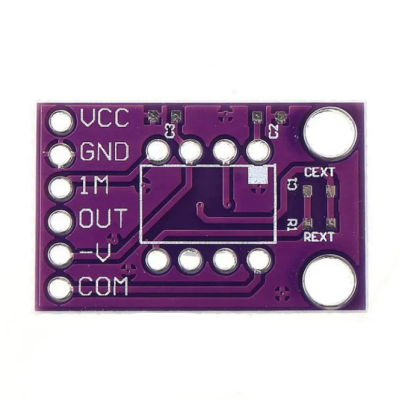
Pin | Description |
VCC | Positive power supply input. Connect this pin to a DC supply ranging from 2.7 V to 36 V. |
−V | Negative power supply input. In single-supply applications, typically connect this pin to GND. |
−IN | Inverting input of the internal operational amplifier and the cathode of the internal photodiode. This pin is internally configured and should normally be left unconnected unless implementing a custom feedback network. |
1M | Connection point for the internal 1 MΩ feedback resistor of the built-in transimpedance amplifier. Can use for customized gain configurations when required. |
OUT | Analog output of the amplifier. The output voltage is proportional to the detected light intensity and can connect directly to an ADC input of a microcontroller. |
COM | Common pin connected to the anode of the internal photodiode. Typically connected to GND during normal operation. |
Note: Most OPT101 modules do not populate the CEXT (external capacitor) and REXT (external resistor). However, the PCB includes solder pads for these components, allowing users to easily add external capacitance or resistance to adjust bandwidth, gain, or filtering for specific applications.
OPT101 Module Specifications
The following specifications highlight the electrical and optical characteristics of the OPT 101 module, making it suitable for precision light measurement applications.
Parameter | Specification |
Supply Voltage | 2.7 V to 36 V |
Operating Temperature | 0°C to 70°C |
Photodiode Active Area | 5.2 mm² |
Spectral Response | 300 nm to 1000 nm |
Peak Responsivity | 0.45 A/W (λ = 650 nm) |
Output Voltage Responsivity | 0.45 V/µW |
Analog Output Voltage Range | Up to VS − 1.15 V |
Bandwidth | 14 kHz |
Quiescent Current | 120 µA (typical) |
Internal Feedback Resistor | 1 MΩ |
Output Type | Analog Voltage |
Sensor Type | Integrated Photodiode with Transimpedance Amplifier |
External Gain Adjustment | Supported via optional REXT pad |
External Bandwidth Adjustment | Supported via optional CEXT pad |
Light Detection | Ultraviolet, Visible, and Near-Infrared |
Amplifier Type | Precision Low-Noise Operational Amplifier |
Output Response | Linear with Incident Light Intensity |
These specifications enable the OPT 101 module to deliver accurate, low-noise, and linear light measurements while requiring few external components, making it an excellent choice for embedded systems, laboratory equipment, industrial controls, and optical sensing applications.
Key Features
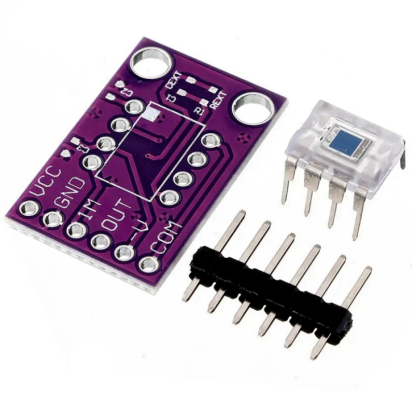
Integrated Photodiode and Amplifier
The module combines a precision photodiode and an operational amplifier into one device, eliminating the need for external amplification circuits.
Wide Operating Voltage
The module supports supply voltages from 2.7 V to 36 V, making it compatible with 3.3 V, 5 V, 12 V, and higher-voltage systems.
Wide Spectral Response
Its photodiode responds to wavelengths from 300 nm to 1000 nm, allowing detection of ultraviolet, visible, and near-infrared light.
High Sensitivity
The transparent package and large sensing area improve light collection, enabling accurate detection even under low-light conditions.
Low Power Consumption
With only 120 µA of quiescent current, the OPT 101 is suitable for battery-powered and portable devices.
Linear Analog Output
The module outputs a voltage that is linearly proportional to incident light intensity, simplifying signal processing.
Low Noise Performance
The integrated amplifier is optimized for photodiode applications, providing stable measurements with minimal electrical noise.
Easy Circuit Integration
Because most amplification circuitry is built into the sensor, only a power supply and output connection are required for operation.
How Does the OPT101 Module Work?
The Photodiode module operates by converting light energy into a proportional analog voltage through the combination of an integrated photodiode and a precision transimpedance amplifier. When light strikes the photodiode's active surface, photons generate electron-hole pairs within the semiconductor material. This process produces a small photocurrent whose magnitude is directly proportional to the intensity of the incoming light.
Unlike a standard photodiode that requires an external amplifier, the OPT101 contains a built-in low-noise operational amplifier and an internal 1 MΩ feedback resistor. The amplifier immediately converts the tiny photocurrent into a measurable voltage signal, greatly simplifying circuit design while maintaining excellent accuracy and linearity.
As the light intensity increases, the photocurrent also increases, causing the output voltage to rise proportionally. Conversely, when the light intensity decreases, the photocurrent becomes smaller, and the output voltage drops accordingly. This linear voltage output allows microcontrollers such as Arduino, ESP32, STM32, Raspberry Pi (with an ADC), and other embedded systems to easily measure ambient light levels without complex signal conditioning.
The module responds to wavelengths from 300 nm to 1000 nm, covering ultraviolet, visible, and near-infrared light. Its transparent package and 5.2 mm² photodiode sensing area improve light collection efficiency, providing high sensitivity even in low-light environments.
For applications requiring different gain or frequency response, users can populate the optional REXT (external resistor) and CEXT (external capacitor) pads available on the module. These components allow the gain and bandwidth to be customized for specific sensing requirements. The combination of high sensitivity, low power consumption, low noise, and minimal external circuitry makes the OPT101 module an excellent solution for precision optical sensing in industrial, laboratory, and embedded electronic applications.
Applications of OPT101 Module
Medical Instruments
Widely used in medical diagnostic equipment, pulse detection systems, and optical monitoring devices where require accurate light measurement.
Laboratory Instruments
Scientific instruments rely on the module for optical experiments, photometric measurements, and light intensity calibration.
Position and Proximity Sensors
The sensor can detect reflected light, making it suitable for position sensing, object detection, and proximity measurement.
Photometric Analyzers
Its high linearity makes it an excellent choice for light analyzers used in environmental monitoring and laboratory testing.
Barcode Scanners
The OPT101 accurately detects reflected light from printed barcode patterns, improving scanning reliability.
Optical Detectors
Industrial optical detection systems use the module for object sensing, beam interruption detection, and production automation.
Currency Detection Systems
Many currency verification machines use optical sensors like the OPT101 to identify security markings, ink properties, and reflective features.
How to Connect OPT101 Module to Arduino
Connecting the OPT101 module is straightforward.
OPT101 Module | Arduino |
VCC | 5V |
COM | GND |
OUT | A0 |
−V | GND (single-supply operation) |
The Arduino reads the analog voltage using its ADC and converts it into digital values for light intensity measurement.
Frequently Asked Questions [FAQ]
What is OPT101 price?
The OPT101 IC typically costs between US$2 and US$8, while complete modules board generally range from US$4 to US$15, depending on the manufacturer, board design, and purchase quantity.
What is OPT101?
The OPT101 is an integrated photodiode and precision transimpedance amplifier that converts light directly into an analog voltage. Its built-in amplifier simplifies circuit design while providing accurate, low-noise light intensity measurements for industrial, scientific, and embedded applications.
How to connect photodiode to Arduino?
Can connect a photodiode directly to an Arduino through a transimpedance amplifier or by using an integrated sensor such as the OPT101. Connect VCC to the power supply, GND to ground, and the analog output to one of the Arduino's analog input pins.
What type of sensor is a photodiode?
A photodiode is an optical semiconductor sensor that converts incoming light into electrical current. Commonly use for light measurement, optical communication, object detection, barcode reading, and scientific instrumentation.
How does a photodiode sensor work?
When light strikes the semiconductor junction inside the photodiode, photons generate electron-hole pairs that produce a photocurrent. The stronger the light intensity, the larger the generated current. In the OPT101, this current is converted into a proportional voltage by the integrated amplifier.
Conclusion
The OPT101 Module is an accurate, low-noise analog light sensor that integrates both a precision photodiode and a transimpedance amplifier into a single package. Its wide operating voltage, broad spectral response, low power consumption, and linear voltage output make it suitable for a wide range of applications, from medical instruments and laboratory equipment to industrial automation and Arduino projects. With minimal external components required, the OPT101 provides an efficient and reliable solution for precise light intensity measurement.
Read More:
1. BPW34 Photodiode: Datasheet, Pinout, and Alternative
2. TPA3116D2 Class-D Stereo Amplifier: Pinout and Module Board
3. 1N4148W Diode - Datasheet, Equivalent, 1N4148W vs 1N4148WS
HOT NEWS
TP4056 Charging Module Pinout, Working, and Applications
TP4056 Charging Module Pinout, Working, and Applications
2026-01-23
LR41 Battery Guide: Specifications, Equivalents, and Uses
LR41 Battery Specifications, Equivalents, and Uses
2025-12-14
Understanding A 0603 Resistor

0603 resistor,dimensions,marking code, values
2025-05-29
MT3608 Boost Converter - An In-Depth Guide
MT3608 Boost Converter
2025-09-04
The 0402 Resistor: A Comprehensive Guide

0402 Resistor
2025-05-06
Complete Guide to the 220 Ohm Resistor
220 Ohm Resistor
2025-07-28
What Is A 1206 Resistor?

1206 resistor dimensions,footprint,value
2025-06-05
Guide To The XL6009 Boost Converter
XL6009 Boost Converter
2025-09-05
Understanding The CD4051 Analog Multiplexer
CD4051 analog multiplexer
2025-06-30
120 Ohm Resistor- Specifications, Applications, and Features
2025-05-12