




 BOM
 Cart
 Product Catalog
The SGP40 air quality sensor is a compact digital gas sensor developed by Sensirion for monitoring indoor air quality and detecting volatile organic compounds (VOCs). Based on advanced CMOSens® technology, it integrates a metal-oxide (MOx) sensing element, a temperature-controlled micro-hotplate, and an I²C digital interface into a small package. With its humidity-compensated VOC signal, low power consumption, and excellent long-term stability, the SGP40 is suitable for air purifiers, HVAC systems, smart home devices, and indoor air quality monitors. In this article, we will explore its working principle, pinout, specifications, key features, applications, GY-SGP40 module, and the differences between the SGP40 and SGP30.
1. What is SGP40 Air Quality Sensor?
6. GY- SGP40 Air Quality Gas Sensor Module
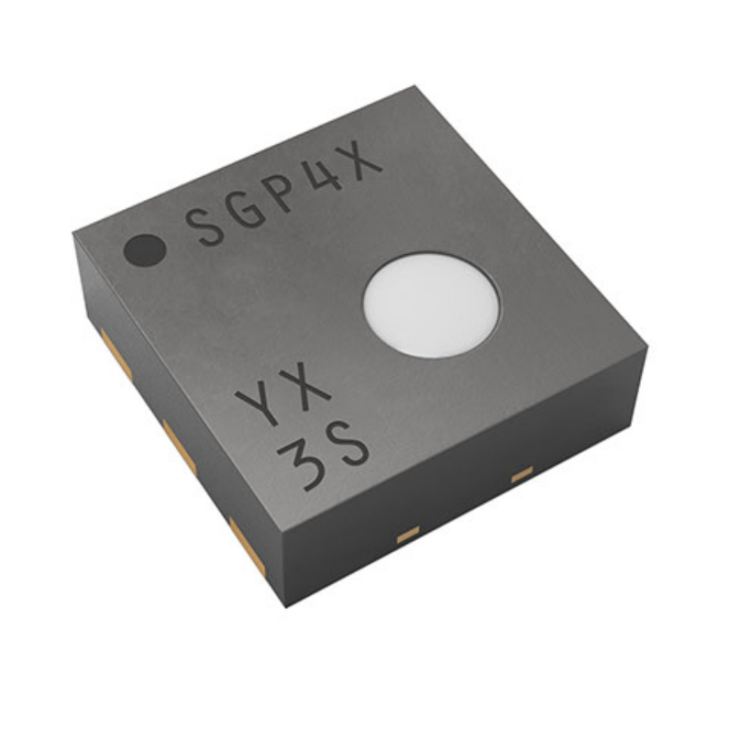
What is SGP40 Air Quality Sensor?
The SGP40 is a digital gas sensor developed by Sensirion for indoor air quality monitoring. Designed for easy integration into air purifiers, demand-controlled ventilation systems, and other air quality monitoring devices. Based on Sensirion's CMOSens® technology, this sensor integrates a metal-oxide (MOx) sensing element, a temperature-controlled micro-hotplate, and a digital I²C interface into a single compact chip.
The device provides a humidity-compensated signal based on volatile organic compounds (VOCs) in indoor environments. Its raw measurement signal can process by Sensirion's Gas Index Algorithm to generate a VOC Index, offering a practical indication of changes in indoor air quality. The algorithm automatically adapts to the surrounding environment, helping maintain reliable measurements under different operating conditions.
The SGP40 also offers excellent long-term stability, low signal drift, and minimal device-to-device variation. Its sensing element and processing algorithm are designed to withstand contaminating gases commonly found in real-world applications. Housed in a compact 2.44 × 2.44 × 0.85 mm DFN package, it is suitable for space-constrained electronic products. Tape-and-reel packaging and compatibility with standard surface-mount assembly processes also make it appropriate for high-volume manufacturing.
Sensirion SGP40 Specifications
The following table summarizes the main electrical and operating specifications of the SGP 40.
Parameter | Value |
Manufacturer | Sensirion AG |
Sensor Type | Air Quality Sensor |
Sensing Technology | Metal-Oxide (MOx) |
Output Interface | I²C |
Operating Temperature | -10°C~50°C |
Supply Voltage | 1.7V~3.6V |
Supply Current | 2.6mA |
Package | 6-pin DFN |
Package Dimensions | 2.44 × 2.44 × 0.85 mm |
SGP40 Pinout
The SGP 40 comes in a 6-pin DFN package. Its pins provide power, ground, and I²C communication connections, allowing the sensor to communicate with microcontrollers and other digital systems.
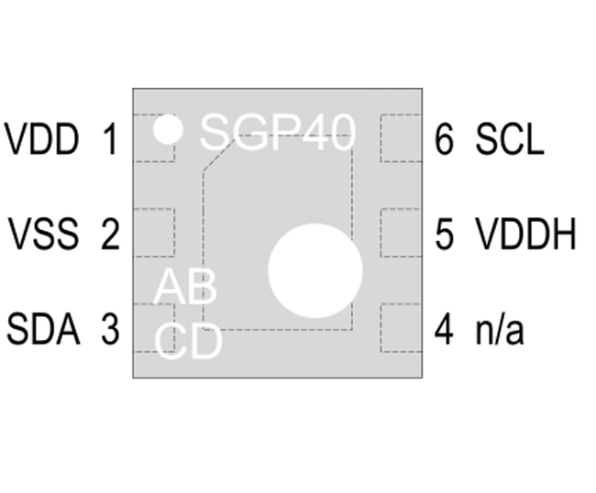
Pin | Name | Description |
1 | VDD | Supply voltage |
2 | VSS | Ground |
3 | SDA | Bidirectional serial data |
4 | N/A | Connect to ground; no electrical function |
5 | VDDH | Hotplate supply voltage |
6 | SCL | Bidirectional serial clock |
SGP40 Pin Connection Notes
VDD supplies the sensor, while VDDH provides power to the integrated micro-hotplate. VSS serves as the ground connection. SDA and SCL form the I²C communication interface, allowing the sensor to exchange measurement data with a host controller.
Pin 4 has no electrical function and should be connected to ground according to the recommended connection arrangement.
SGP40 Features
The SGP 40 combines compact dimensions, low power consumption, and digital communication to support indoor air quality monitoring applications.
MOx Gas Sensing Technology: Uses a metal-oxide sensing element to detect volatile organic compounds in indoor environments.
Long-Term Stability: Provides excellent operational stability and a long service lifetime, with low drift and limited device-to-device variation.
Digital I²C Interface: Offers a digital output signal for straightforward connection to microcontrollers and embedded systems.
Compact DFN Package: Features a small 6-pin DFN package measuring 2.44 × 2.44 × 0.85 mm.
Low Power Consumption: Operates with a typical supply current of 2.6 mA at 3.3 V.
Easy Manufacturing: Supports tape-and-reel packaging and standard reflow soldering processes for automated SMD assembly.
Humidity Compensation: Provides a humidity-compensated VOC measurement signal when supplied with the required humidity information.
SGP40 Applications
The SGP 40 is designed for indoor air quality monitoring and VOC detection. Its digital interface, compact package, and long-term stability make it suitable for various consumer and industrial electronic products.
Common applications include:
Air Purifiers: Monitors indoor VOC levels and provides information for automatically adjusting purification performance.
Demand-Controlled Ventilation: Helps ventilation systems respond to changes in indoor air quality.
Smart Home Devices: Integrates into smart home systems for continuous indoor air quality monitoring.
HVAC Systems: Supports air quality monitoring in heating, ventilation, and air conditioning equipment.
Indoor Air Quality Monitors: Provides VOC-related measurement data for residential, office, and commercial environments.
Smart Appliances: Can be incorporated into electronic appliances that require indoor air quality detection.
Portable Air Quality Devices: Its small DFN package makes it suitable for compact and portable monitoring equipment.
GY-SGP40 Air Quality Gas Sensor Module
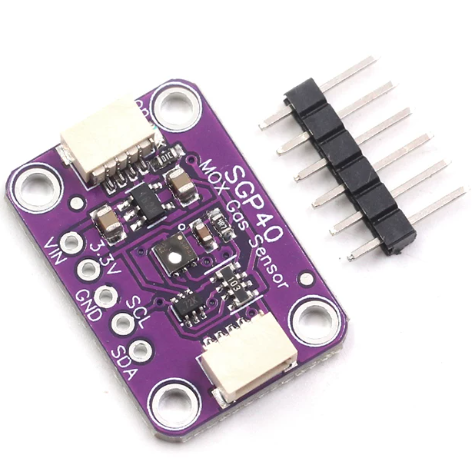
The GY-SGP40 is a breakout module based on the Sensirion SGP40 digital gas sensor. It is designed to simplify integration into microcontroller projects by providing an accessible interface for indoor air quality monitoring. Can use the module with development boards such as Arduino, ESP32, and other controllers that support I²C communication.
Unlike a standalone sensor chip, the breakout board provides convenient power and signal connections. Depending on the module design, it also include voltage regulation and supporting circuitry.
The module measures VOC-related changes and provides digital raw signals that can be processed to obtain a VOC Index. It is important to note that the SGP40 detects VOC-related air quality changes rather than directly measuring CO₂ concentration. Any CO₂-equivalent value provided by a processing algorithm is an estimated indicator, not a direct CO₂ measurement.
GY-SGP40 Module Specifications
Parameter | Value |
Sensor Chip | SGP40 |
Sensor Output | Two 16-bit digital raw signals |
Processed Output | VOC Index: 0~500 |
TVOC Measurement Range | 0~1000 ppm (module-reported) |
Device-to-Device Variation (TVOC) | ±15% m.v. |
Response Time | Less than 10 seconds |
Startup Time | 1 hour |
Humidity Compensation | Supported |
Supply Voltage | 3.3V~5V (module-reported) |
Average Supply Current | 2.6mA |
Maximum Supply Current | 3mA |
Communication Interface | I²C |
Detection Limit | Less than 0.05 ppm ethanol equivalent or 10% of concentration setpoint, whichever is greater |
Note: The module's reported supply voltage and measurement specifications may vary by manufacturer. The SGP40 chip itself operates from 1.7V to 3.6V. Check the specific breakout board documentation before connecting it to a 5V supply.
How Does the GY-SGP40 Work?
The GY-SGP40 detects changes in VOC concentrations through its integrated MOx sensing element. When VOC gases interact with the sensing material, the electrical properties of the sensing element change. The sensor converts these changes into digital measurement signals and sends them to a host controller through the I²C interface.
The raw signals can then be processed using Sensirion's Gas Index Algorithm to generate a VOC Index between 0 and 500. This index indicates changes in VOC levels relative to the sensor's learned environmental baseline.
For humidity compensation, the algorithm can use humidity measurements from an external humidity sensor. The SGP40 does not contain an integrated relative humidity sensor, so a separate humidity measurement is required when applying this compensation method.
Comparison SGP30 vs SGP40
The SGP30 and SGP40 are digital gas sensors from Sensirion designed for indoor air quality monitoring. Both use MOx sensing technology and communicate through an I²C interface. However, they differ in their output signals, processing methods, startup requirements, and power consumption.
The SGP30 provides TVOC and CO₂-equivalent measurements, while the SGP40 focuses on VOC sensing and uses Sensirion's Gas Index Algorithm to generate a VOC Index.
SGP30 vs. SGP40 Specifications
Parameter | SGP30 | SGP40 |
Sensor Output | Two 16-bit digital raw signals | Two 16-bit digital raw signals |
Processed Output | TVOC (ppb), CO₂ equivalent (ppm) | VOC Index |
TVOC Measurement Range | 0~1000 ppm (module-reported) | 0~1000 ppm (module-reported) |
CO₂ Equivalent Range | 0~1000 ppm (module-reported) | Not directly provided |
Device-to-Device Variation (TVOC) | 15~25% | ±15% m.v. |
Device-to-Device Variation (CO₂-eq) | 10~20% | Not applicable |
Startup Time | 24 hours | 1 hour |
Humidity Compensation | Supported | Supported through external humidity input |
Supply Voltage | 1.8V / 1.8V~5V (module-dependent) | 1.7V~3.6V |
Average Supply Current | 49mA (module-reported) | 2.6mA |
Communication Interface | I²C | I²C |
Note: Some values above are module-reported figures rather than universal chip specifications. Actual performance and electrical characteristics should check against the respective datasheets.
Main Differences Between SGP30 and SGP40
1. Measurement Output
The SGP30 provides two processed air quality values: total volatile organic compounds (TVOC) and equivalent CO₂ (eCO₂). These values help users monitor changes in indoor air quality. The eCO₂ output is an estimate based on gas sensor measurements and should not be treated as a direct measurement of carbon dioxide.
The SGP40 focuses on VOC sensing. Its raw measurement signals can be processed using the Gas Index Algorithm to produce a VOC Index from 0 to 500. This index is useful for tracking changes in VOC-related indoor air quality.
2. Startup Time
The SGP30 generally requires a longer initial conditioning period, with the supplied module specifications indicating approximately 24 hours. The SGP40 has a shorter reported startup period of around one hour. Actual stabilization requirements depend on operating conditions and the manufacturer's recommended initialization procedure.
3. Power Consumption
The SGP40 has a typical supply current of approximately 2.6 mA, making it suitable for applications where power consumption is an important consideration. The SGP30's reported module current is higher, although direct comparisons should use chip-level measurements under equivalent operating conditions.
4. Application Selection
The SGP30 is a suitable option when an application requires both TVOC and estimated CO₂-equivalent outputs. The SGP40 is a better choice when the main requirement is VOC trend monitoring with the Gas Index Algorithm, low power consumption, and a compact sensor package.
Overall, the selection depends on the required measurement output, power budget, startup behavior, and system design.
Frequently Asked Questions
What does an air sensor do?
An air sensor detects specific gases, particles, or environmental changes in the surrounding atmosphere. Depending on its sensing technology, it can measure pollutants such as VOCs, carbon monoxide, carbon dioxide, or particulate matter. Air sensors help monitor indoor air quality and provide information for ventilation systems, air purifiers, and environmental monitoring devices.
Can you drive with a bad air sensor?
It depends on the type of air sensor. A faulty automotive air sensor, such as a mass airflow or oxygen sensor, can affect engine performance, fuel efficiency, and emissions. A faulty cabin air quality sensor generally does not prevent a vehicle from operating, but automatic ventilation or air recirculation functions may not work correctly.
Where is the air sensor located?
The location depends on the sensor type and application. In indoor air quality monitors, the sensor is usually installed inside the device with access to surrounding air. In vehicles, cabin air quality sensors are commonly positioned near the HVAC air intake, while engine-related sensors are installed in the intake or exhaust system.
How much does an air sensor cost?
The cost of an air sensor varies depending on its sensing technology, accuracy, measurement range, and application. Basic gas sensor modules are generally less expensive than professional air quality monitoring instruments. Digital sensors such as the SGP40 are compact components intended for integration into electronic products rather than standalone consumer monitoring equipment.
How to tell if your air sensor is bad?
Common signs of a faulty air sensor include inconsistent readings, no data output, communication errors, or measurements that do not respond to changes in air quality. For an SGP40, check the supply voltage, I²C connections, sensor initialization, and raw measurement signals. Comparing readings under different VOC conditions can also help identify potential sensor problems.
Conclusion
The SGP40 air quality sensor is a compact, low-power digital gas sensor designed for reliable indoor VOC monitoring. With its MOx sensing technology, I²C interface, humidity-compensated measurement signal, and Sensirion Gas Index Algorithm, it provides a practical solution for tracking changes in indoor air quality. Its excellent long-term stability and small DFN package make it suitable for air purifiers, HVAC systems, smart home devices, and portable air quality monitors. Compared with the SGP30, the SGP40 focuses on VOC Index output and offers lower power consumption and a shorter startup time. It is a good choice for modern electronic applications that require compact and reliable VOC monitoring.
Read More:
1. TTP223 Touch Switch - Pinout, Datasheet & Applications
2. Guide to The PIC18F25K20 Microcontroller Chip
3. 2N3904 Transistor Pinout, Specifications Complete Guide
SGP40 Datasheet
HOT NEWS
TP4056 Charging Module Pinout, Working, and Applications
TP4056 Charging Module Pinout, Working, and Applications
2026-01-23
Understanding The CD4051 Analog Multiplexer
CD4051 analog multiplexer
2025-06-30
LR41 Battery Guide: Specifications, Equivalents, and Uses
LR41 Battery Specifications, Equivalents, and Uses
2025-12-14
Understanding A 0603 Resistor
0603 resistor,dimensions,marking code, values
2025-05-29
MT3608 Boost Converter - An In-Depth Guide
MT3608 Boost Converter
2025-09-04
Mini MP1584 DC-DC 3A Buck Converter Module: Complete Guide
Mini MP1584 DC-DC 3A Buck Converter Module: Complete Guide
2026-03-26
The 0402 Resistor: A Comprehensive Guide
0402 Resistor
2025-05-06
Complete Guide to the 220 Ohm Resistor
220 Ohm Resistor
2025-07-28
Guide To The XL6009 Boost Converter
XL6009 Boost Converter
2025-09-05
What Is A 1206 Resistor?
1206 resistor dimensions,footprint,value
2025-06-05