




 BOM
BOM Cart
Cart Product Catalog
TP4057 is a compact and efficient single-cell lithium-ion battery charger designed for portable electronic devices and DIY battery projects. It uses constant-current and constant-voltage charging to provide a simple and reliable charging solution. With its small SOT-23-6 package, programmable charging current, thermal regulation, automatic recharge, and charging-status indicators, the TP4057 is well suited for 18650 batteries, lithium-polymer batteries, Bluetooth devices, portable equipment, and other space-constrained applications.
6. TP4057 Charging Board 18650 Module
8. Frequently Asked Questions [FAQ]
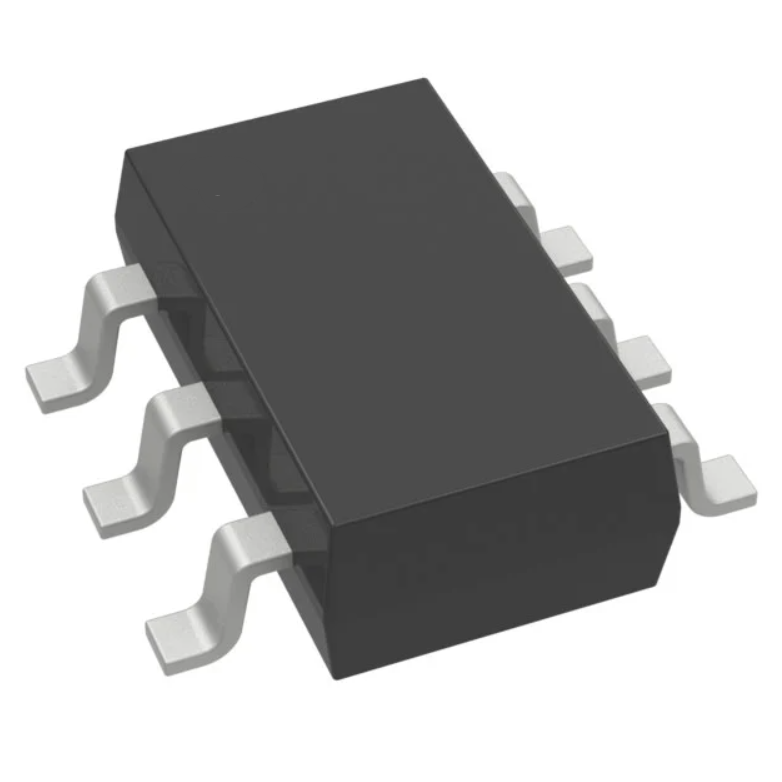
What is the TP4057?
The TP 4057 is a compact linear charger for a single lithium-ion battery. It uses constant-current/constant-voltage (CC/CV) charging and comes in a small SOT-23-6 package, making it suitable for portable electronics, USB devices, and adapter-powered products.
An internal MOSFET and reverse-charging protection circuit reduce the need for external components. Charging current is set with an external resistor, while the charging voltage is fixed at approximately 4.24 V.
The TP4057 includes thermal regulation, automatically reducing charging current if the device becomes too hot. Charging ends when the current drops to about one-tenth of the programmed level after the battery reaches its final voltage.
Additional features include automatic recharge, battery temperature monitoring, undervoltage lockout, and two status outputs for charging and completion indicators. When input power is removed, the charger enters a low-power sleep mode, reducing battery drain to below 1 µA.
Its compact design makes the TP 4057 suitable for 18650 batteries, Bluetooth products, digital cameras, and other single-cell lithium-ion applications.
TP4057 Pinout
The TP 4057 pinout consists of six pins for power input, battery connection, charging-current programming, and charging-status indication.
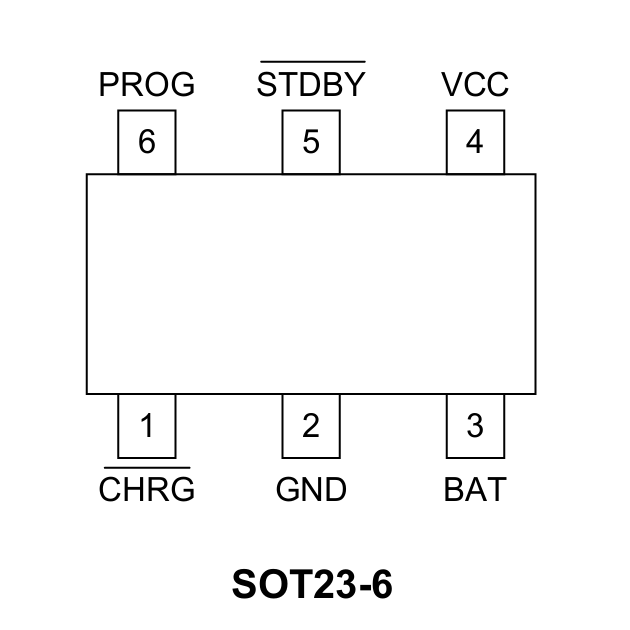
Pin Number | Pin Name | Description |
1 | CHRG | Charging status indicator output |
2 | GND | Ground |
3 | BAT | Battery connection |
4 | VCC | Power supply input |
5 | STDBY | Charging-complete indicator output |
6 | PROG | Programmable charging-current setting pin |
VCC connects to the external power source, while GND provides the common ground connection.
BAT connects directly to the positive terminal of the single lithium-ion battery. Use the PROG pin with an external resistor to set the desired charging current.
CHRG indicates that the battery is being charged, while STDBY indicates that charging has been completed. These status outputs can connect to LEDs or monitored by a microcontroller.
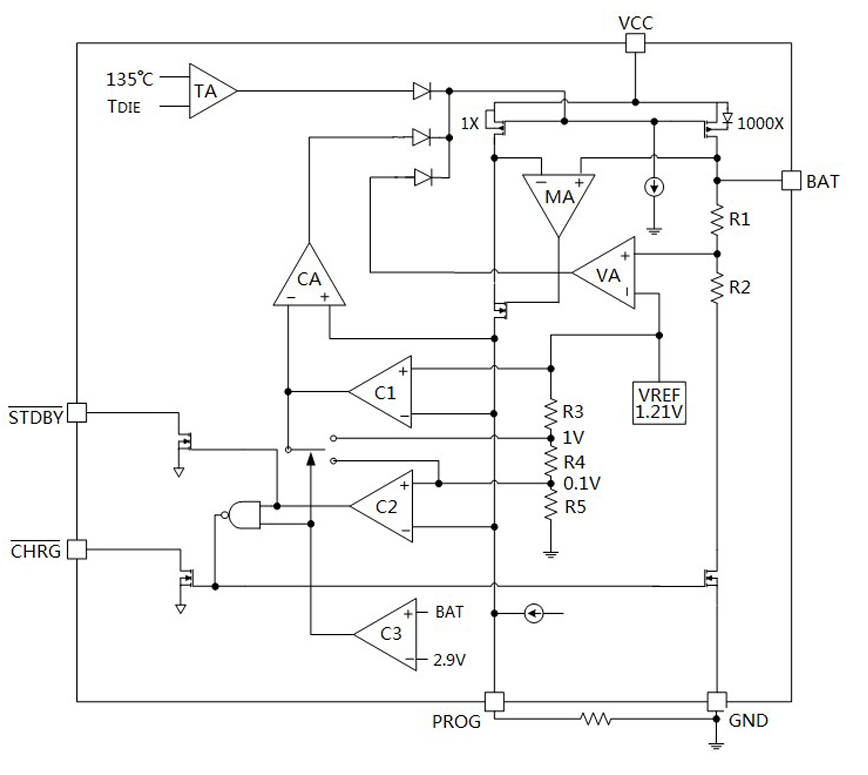
Structure Diagram
TP4057 Features
The circuit features make it suitable for compact single-cell battery charging applications:
· Programmable charging current up to 500 mA
· Constant-current/constant-voltage charging
· Single lithium-ion battery charger
· Compact SOT-23-6 package
· No external MOSFET required
· No external current-sense resistor required
· No external isolation diode required
· Thermal regulation for safer charging
· Charging voltage accuracy of approximately ±1%
· Automatic charging termination
· Automatic recharge
· C/10 charge termination
· Charging-status indication
· Battery temperature monitoring
· Undervoltage lockout
· 2.9 V trickle/precharge charging
· Soft-start current limiting
· Low standby current of approximately 25 µA
· Low battery leakage current when input power is removed
The charging IC uses thermal feedback to reduce the charging current when the chip approaches its temperature limit. This allows the charger to maintain a suitable charging rate without excessive thermal stress.
TP4057 Specifications
Table
Parameter | Value |
Battery Chemistry | Lithium-Ion |
Number of Cells | 1 |
Charging Method | Constant Current / Constant Voltage |
Charging Current | Programmable |
Maximum Charging Current | 500 mA |
Battery Voltage | 4.24 V |
Supply Voltage, Maximum | 6.5 V |
Programmable Functions | Current, Timer, Voltage |
Fault Protection | Over Temperature |
Interface | USB |
Operating Temperature | -40°C~85°C |
Mounting Type | Surface Mount |
Package/Case | SOT-23-6 |
The TP4057 specifications are intended for a single-cell lithium battery charging system. The exact charging current depends on the external programming resistor and the particular TP 4057 implementation.
TP4057 Application
Include many compact portable devices that require charging for a single lithium-ion battery.
Mobile Phones and Portable Electronics
Can used in small battery-powered electronics where USB or adapter power is available for charging.
MP3 and MP4 Players
Its compact size and integrated charging functions make the TP 4057 suitable for portable media players and similar low-power devices.
Digital Cameras
The circuit can be incorporated into compact camera power systems designed around a single lithium battery.
Bluetooth Devices
Bluetooth accessories and other wireless portable devices can use a single-cell lithium battery together with a TP 4057 charging circuit.
GPS Navigators
Portable GPS equipment can use the chip to provide a simple charging solution for its internal lithium battery.
DIY Battery Projects
The TP 4057 is also suitable for DIY lithium battery charging projects, especially when a small PCB footprint and simple circuit are preferred.
TP4057 Charging Principle
The charging chip follows a standard constant-current/constant-voltage charging process.
When connect a deeply discharged battery, the charger can begin with a low-current precharge stage. If the battery voltage is below approximately 2.9 V, the TP 4057 provides a low-current trickle charge to gradually raise the battery voltage.
After the battery reaches the appropriate voltage level, the charger enters the constant-current stage. The programmed charging current is maintained while the battery voltage gradually increases.
When the battery approaches the final charging voltage, the TP 4057 changes to constant-voltage charging. The battery voltage is regulated while the charging current gradually decreases.
When the charging current falls to approximately C/10, the TP4057 terminates the charging cycle. If the battery voltage later falls below the automatic-recharge threshold, the charging cycle can start again.
TP4057 Charging Board 18650 Module
The TP 4057 18650 charging module is designed for DIY single-cell lithium battery charging applications. It can use with common 3.7 V lithium batteries, including 18650 cells and lithium-polymer batteries, depending on the specific board design.
A typical charging board include additional battery protection circuitry. This protection can provide functions such as overcharge protection, over-discharge protection, and overcurrent protection.
The module can be used for:
· 18650 lithium battery charging
· DIY lithium battery projects
· Portable electronics
· Adding a charging port to existing equipment
· Single-cell lithium-polymer battery projects
· Small embedded power systems
When using an 18650 cell, make sure the battery chemistry, charging voltage, charging current, and protection circuit are compatible with the selected module.
TP4056 vs TP4057
A common comparison when selecting a single-cell lithium-ion battery charger.
Both devices use constant-current/constant-voltage charging and are intended for single lithium-ion batteries. However, they differ in package, charging-current capability, and some electrical specifications.
Feature | TP4056 | TP4057 |
Battery Cells | 1 | 1 |
Charging Method | CC/CV | CC/CV |
Maximum Charging Current | Up to 1 A | Up to 500 mA |
Typical Package | ESOP-8/EMSOP-8 | SOT-23-6 |
Charging Voltage | 4.2 V | Approximately 4.24 V |
Charging Current | Programmable | Programmable |
Thermal Regulation | Yes | Yes |
Automatic Recharge | Yes | Yes |
Battery Temperature Monitoring | Yes | Yes |
Charging Status | Yes | Yes |
Main Advantage | Higher charging current | Smaller package and compact design |
The TP4056 can provide a higher programmable charging current, making it suitable when faster charging is required and the thermal design can handle the resulting power dissipation.
The TP 4057 uses a smaller SOT-23-6 package and supports a lower maximum charging current, making it a good choice for compact and lower-power portable applications.
Another important difference is the charging-voltage specification. TP4056 commonly design around a 4.2 V final charging voltage, while the TP4057 specification provided here uses approximately 4.24 V. Therefore, the battery's required charging voltage should be checked before selecting either device.
Frequently Asked Questions [FAQ]
What is TP4057 used for?
TP4057 is used to charge a single lithium-ion or lithium-polymer battery using a constant-current/constant-voltage charging process. Commonly use in portable electronics, Bluetooth devices, GPS equipment, digital cameras, MP3/MP4 players, 18650 battery projects, and other compact battery-powered devices.
How can I charge my lithium-ion battery without a charger?
A lithium-ion battery should be charged with a proper lithium battery charging circuit rather than a simple power supply. A TP 4057 module can provide controlled CC/CV charging for a compatible single-cell lithium battery. Always verify the battery voltage, polarity, charging current, and protection requirements before connecting it.
How do I connect a TP4057 charging module to my device?
Connect the input power to VCC and GND, and connect the battery to BAT and GND according to the module markings. The PROG pin sets the charging current, while CHRG and STDBY provide charging-status signals. If the board has protection circuitry, follow its B+ and B- markings.
What is the difference between TP4056 and TP4057?
TP4056 and TP4057 are both single-cell lithium battery chargers, but TP4056 generally supports a higher charging current of up to 1 A, while TP 4057 supports up to 500 mA. TP 4057 also uses a smaller SOT-23-6 package, making it more suitable for compact portable applications.
Can TP4057 charge 4 batteries?
TP4057 is designed for a single lithium-ion cell and should not directly charge four independent cells. Four cells in series require a suitable multi-cell charger, while parallel cells require careful consideration of capacity, charging current, cell matching, and protection. Use a battery-management solution appropriate for the battery configuration.
How to wire a TP4057?
Connect the power input to VCC and GND, and connect the single-cell battery to BAT and GND. Use the PROG pin with its programming resistor to configure the charging current. CHRG and STDBY can use for charging indicators. Always verify the module's polarity and wiring labels before powering the circuit.
Conclusion
TP4057 is a compact single-cell lithium-ion battery charger that combines constant-current and constant-voltage charging in a small SOT-23-6 package. Its programmable charging current, thermal regulation, automatic recharge, charging-status outputs, and low-power behavior make it useful for portable electronics and DIY battery projects.
Compared with the TP4056, the TP4057 offers a smaller package and lower maximum charging current, making it particularly suitable for applications where PCB space and moderate charging current are important. When selecting a TP4057 charging module, always check the actual board's charging voltage, charging current, protection functions, and battery compatibility before use.
Read More:
1. TP4056 Charging Module Pinout, Working, and Applications
HOT NEWS
TP4056 Charging Module Pinout, Working, and Applications
TP4056 Charging Module Pinout, Working, and Applications
2026-01-23
LR41 Battery Guide: Specifications, Equivalents, and Uses
LR41 Battery Specifications, Equivalents, and Uses
2025-12-14
Understanding A 0603 Resistor
0603 resistor,dimensions,marking code, values
2025-05-29
MT3608 Boost Converter - An In-Depth Guide
MT3608 Boost Converter
2025-09-04
The 0402 Resistor: A Comprehensive Guide
0402 Resistor
2025-05-06
Complete Guide to the 220 Ohm Resistor
220 Ohm Resistor
2025-07-28
What Is A 1206 Resistor?
1206 resistor dimensions,footprint,value
2025-06-05
Guide To The XL6009 Boost Converter
XL6009 Boost Converter
2025-09-05
120 Ohm Resistor- Specifications, Applications, and Features
2025-05-12
Everything You Need To Know About ARE1309 Relay

2025-04-23