




 BOM
BOM Cart
Cart Product Catalog
The TP5100 battery charging module is a compact switching charger designed for rechargeable lithium batteries. It supports both single-cell 4.2V and two-cell 8.4V lithium battery packs, with a programmable charging current of up to 2A. Its switching architecture provides higher efficiency and lower heat generation than conventional linear charging circuits.
This guide explains the TP5100 module specifications, charging principle, pinout, features, applications, alternatives, and the differences between TP5100 and TP4056.
4. Where and How to Use TP5100?
5. TP5100 Equivalents & Alternatives
10. Frequently Asked Questions
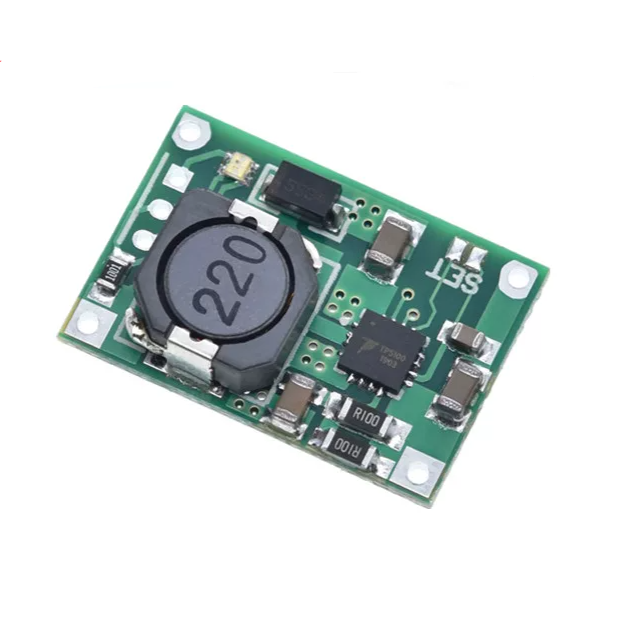
What is TP5100?
The TP5100 is a switching step-down lithium battery charging management IC designed for single-cell 4.2V or two-cell 8.4V lithium-ion battery charging. It uses a compact QFN16 package and requires relatively few external components, making it suitable for small battery-powered products.
The TP 5100 operates from a 5V to 18V input supply, although a practical input range of approximately 5V to 12V commonly prefer for module applications. The charging process includes trickle pre-charge, constant-current (CC), and constant-voltage (CV) stages.
Can adjust both the pre-charge current and constant charging current using external resistors. The maximum charging current is approximately 2A.
Unlike linear chargers such as the TP4056, the TP 5100 uses a 400kHz switching architecture. This allows smaller passive components and helps reduce heat generation during high-current charging.
The IC integrates a power MOSFET and reverse-current protection, so an external reverse-current Schottky diode is generally unnecessary. It also incorporates input overcurrent protection, undervoltage protection, thermal protection, battery temperature monitoring, and battery reverse-connection protection.
TP5100 Power Supply Module Specifications
Parameter | Specification |
Input Voltage | 5–18V DC |
Recommended Input | 5–12V DC |
Battery Configuration | 1S or 2S lithium battery |
Full-Charge Voltage | 4.2V / 8.4V |
Maximum Charging Current | 2A |
Switching Frequency | 400kHz |
Charging Method | Trickle, Constant Current, Constant Voltage |
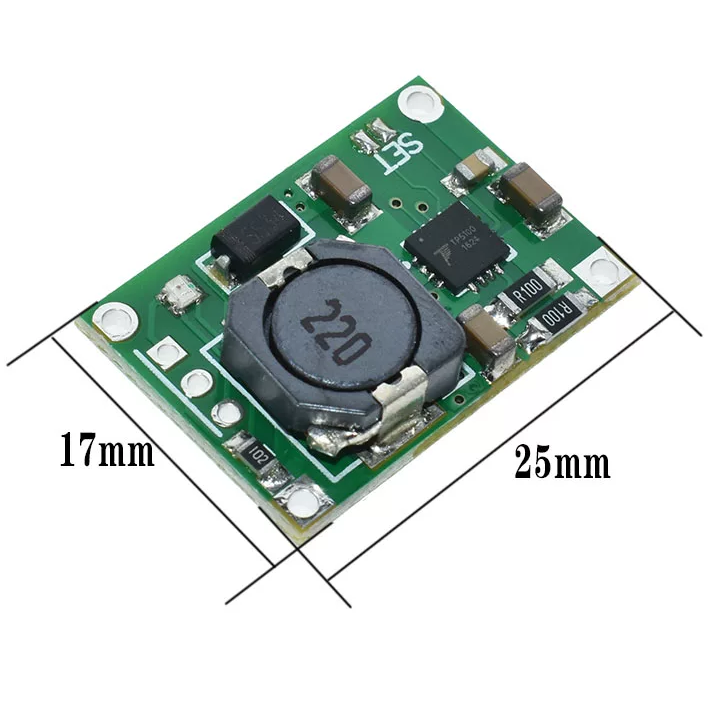
Module Dimensions | 25 × 17 × 5mm |
Status Indicator | Red/blue LED |
Charger Type | Switching step-down |
For a single-cell battery, the module is configured for a 4.2V charging voltage. For two cells connected in series, it is configured for 8.4V.
The charging indicator is typically red during charging and blue when charging is complete or when the charger is in standby.
When changing the voltage configuration, should power off the module first. If install a switch for selecting the charging mode, disconnect the input power before changing the setting.
Can also use the module as a constant-current driver for white LEDs. In the single-cell configuration it can drive one suitable LED, while the two-cell configuration can be used for two LEDs in series, provided the voltage and current requirements are appropriate.
TP5100 Power Supply Module Dimensions
TP5100 Charging Module Working Principle
The TP 5100 uses a switching buck-converter architecture to efficiently convert the input voltage into the voltage required for the battery. Its charging process includes three stages: trickle pre-charge, constant-current (CC), and constant-voltage (CV).
During pre-charge, a small current safely raises a deeply discharged battery voltage. The charger then provides constant current until the battery approaches its target voltage, followed by constant-voltage charging until the current gradually decreases and charging complete.
With a 400kHz switching frequency, the TP 5100 provides efficient charging while reducing heat generation compared with linear chargers.
Where and How to Use TP5100?
The TP 5100 is suitable for projects that require a compact rechargeable lithium battery charger and where lower heat generation is desirable.
Typical uses include portable electronics, battery-powered instruments, DIY power supplies, handheld devices, communication equipment, MP3/MP4 players, tablets, RC models, and power tools.
For a single lithium-ion or lithium-polymer cell, configure the module for 4.2V charging and connect the battery to BAT+ and BAT−.
For a two-cell series battery pack, configure the module for 8.4V charging. The cells should appropriately match and the battery pack should have suitable protection and balancing arrangements where required.
The TP 5100 is a charger, not a general-purpose battery protection circuit. When building a multi-cell battery pack, should consider appropriate battery-management and balancing protection.
TP5100 Equivalents & Alternatives
TP4560
Can consider the TP4560 as an alternative in some lithium battery charging applications. However, should check its electrical characteristics, charging voltage, current capability, and module configuration carefully before replacing a TP 5100.
TP5000
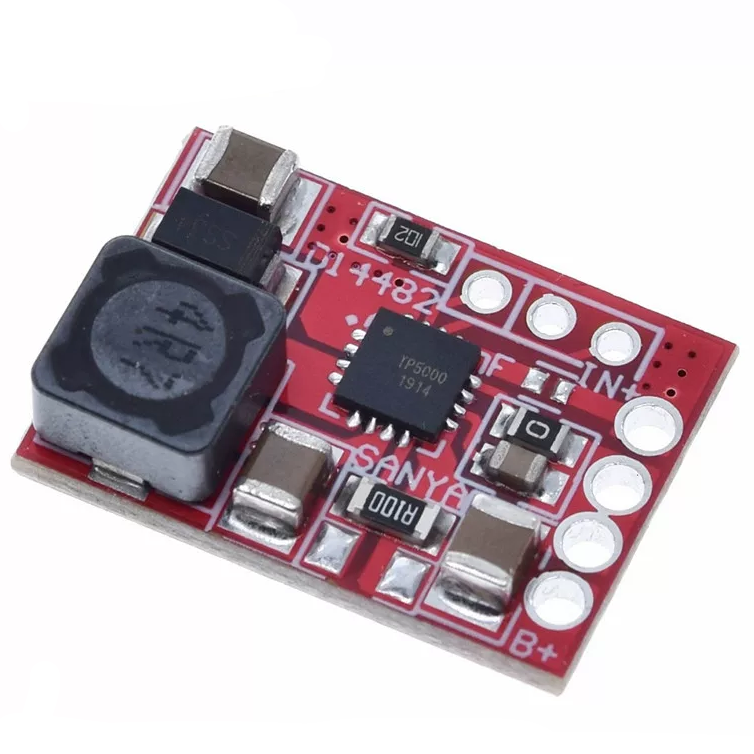
The TP5000 is another switching lithium battery charger designed for rechargeable batteries. It can support lithium-ion and lithium-polymer batteries as well as certain lithium iron phosphate (LiFePO4) charging configurations.
A typical TP5000 module provides approximately 1A charging current, with the charging voltage selectable for different battery chemistries. Its switching architecture provides better efficiency and lower heat generation than a linear charging circuit.
Compared with the TP 5100, the TP5000 is generally better suited to single-cell charging applications, while the TP 5100 is particularly useful when require 4.2V/8.4V single-cell or two-cell charging.
TP5100 Battery Charger Module Pinout
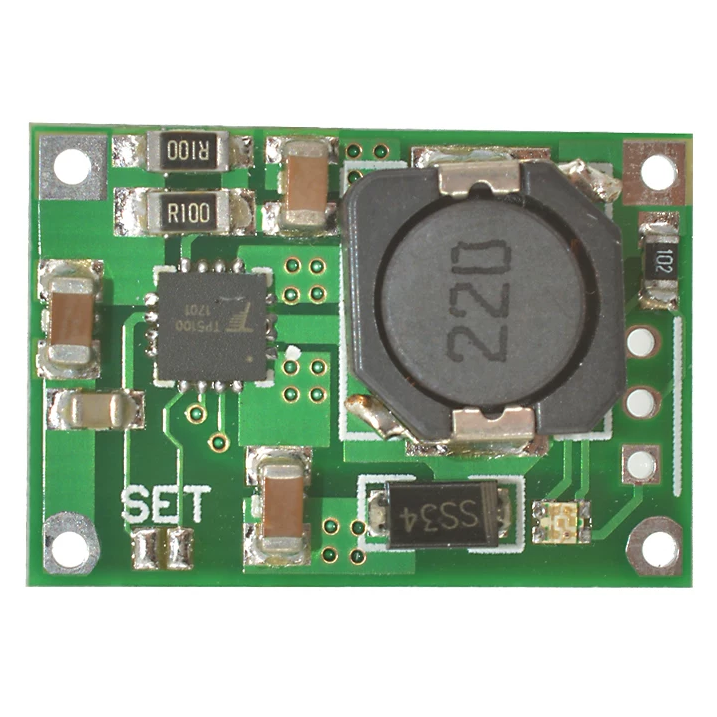
The TP5100 module generally has four main power connections.
Pin | Function |
IN− | Power input negative / GND |
IN+ | Power input positive, 5–18V DC |
BAT− | Lithium battery negative |
BAT+ | Lithium battery positive |
IN+ and IN− connect to the external DC power supply.
BAT+ and BAT− connect to the rechargeable battery or battery pack.
The input polarity and battery polarity must observe carefully. Although the TP 5100 includes protection features, incorrect wiring should always avoid.
TP5100 Features
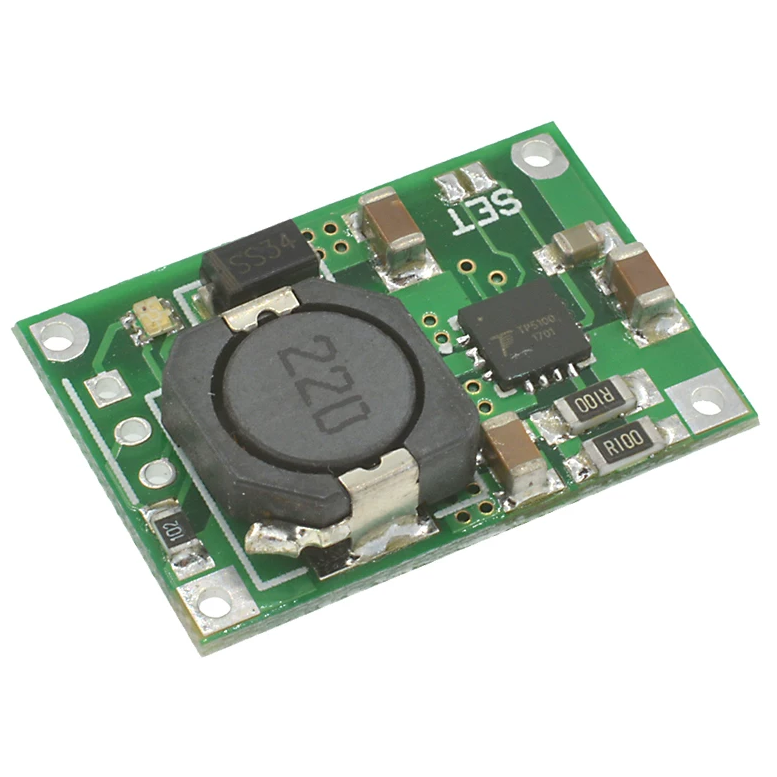
The TP 5100 provides several features that make it useful for compact battery-charging applications.
Single-Cell and Two-Cell Charging
The module can be configured for single-cell 4.2V or two-cell 8.4V lithium battery charging, giving it more flexibility than chargers designed only for one battery cell.
Programmable Charging Current
Can externally program the charging current from approximately 0.1A to 2A. This allows to adapt the charger to batteries with different capacity and recommended charging rates.
Switching Charger Architecture
The TP 5100 uses an approximately 400kHz switching frequency. Because it is a switching charger rather than a linear charger, it can achieve better efficiency and generate less heat during charging.
Integrated MOSFET
The power MOSFET is integrated into the IC, reducing the number of external components and helping keep the module compact.
Multiple Protection Functions
The TP 5100 incorporates protection functions including input overcurrent, undervoltage, thermal, battery temperature monitoring, short-circuit protection, and battery reverse-connection protection.
Charging Status Indication
The module uses LED indicators to show charging status. On common boards, the red LED indicates charging, while the blue LED indicates full charge or standby.
Reverse-Current Protection
The integrated reverse-current protection reduces the need for an external Schottky diode at the charger output.
Compact Design
The TP5100 IC uses a compact QFN16 package, while typical modules measure approximately 25 × 17 × 5mm, making them suitable for space-constrained projects.
Applications
Can used in many rechargeable battery systems where require a compact and efficient charging solution.
Common applications include:
Portable Devices: Battery-powered electronic devices can use the TP 5100 to recharge their internal lithium battery.
DIY Battery Packs: It can integrate into custom lithium-ion battery projects using one or two cells in the appropriate configuration.
RC and Hobby Electronics: The compact size and switching operation make it suitable for some hobby and model applications.
Power Tools: Battery-powered tools can use switching charging circuits when the battery configuration and charging requirements are properly matched.
Communication Equipment: Portable radios, intercoms, and other battery-operated communication equipment can benefit from compact charging electronics.
LED Drivers: The TP 5100 can also configure for constant-current LED applications when the voltage and current requirements are compatible with the charger configuration.
TP4056 vs TP5100
The TP4056 and TP 5100 are both popular lithium battery charging solutions, but they design around different charging architectures and battery configurations.
The TP4056 is a linear single-cell lithium-ion battery charger. Typical TP4056 modules use a Micro-USB input, accept approximately 4.5–5.5V, and provide a 4.2V full-charge voltage with a commonly configured charging current of around 1A.
The TP5100, on the other hand, is a switching charger that can support single-cell 4.2V or two-cell 8.4V charging and can provide up to approximately 2A of charging current.
Feature | TP4056 | TP5100 |
Charger Type | Linear | Switching |
Typical Battery | 1S Li-ion/LiPo | 1S or 2S Li-ion |
Full-Charge Voltage | 4.2V | 4.2V / 8.4V |
Typical Module Current | 1A | Up to 2A |
Input Voltage | 4.5–5.5V | 5–18V |
Switching Frequency | N/A | 400kHz |
Heat Generation | Higher at large voltage drop | Generally lower |
Reverse Protection | Depends on module | Integrated functions |
Typical Interface | Micro-USB | Power terminals |
The TP4056 is a simple choice when you need to charge one 3.7V nominal lithium battery from a 5V supply.
The TP 5100 is more appropriate when you need higher charging current, a switching charger, lower heat generation, or support for a two-cell 8.4V battery pack.
TP5100 vs TP4056: Which Should You Choose?
Choose TP4056 for a simple, low-cost single-cell charging project where a 5V input and approximately 1A charging current are sufficient.
Choose TP 5100 when you need a switching charging solution, higher charging current, or the ability to charge a 2S lithium battery pack at 8.4V.
Neither module should be selected solely by output voltage. The battery chemistry, number of cells, recommended charging current, protection requirements, and charging termination characteristics must all consider.
Frequently Asked Questions [FAQ]
What is the price of a TP5100 charging module?
The price of a TP5100 charging module varies depending on the PCB design, component quality, seller, and order quantity. Basic modules are generally inexpensive around $0.4~$1.0, while versions with additional protection or connectors cost more. Always compare specifications rather than price alone.
What is the maximum charging current of the TP5100 module?
The TP 5100 can support a programmable charging current of up to approximately 2A. The actual safe charging current depends on the battery's specifications, PCB thermal performance, input voltage, and module configuration. Do not automatically charge every battery at 2A.
Can I charge a 3.7 V battery with a 4.2 V charger?
Yes. A typical single-cell lithium-ion or lithium-polymer battery has a nominal voltage of about 3.7V and a full-charge voltage of 4.2V. A charger configured for 4.2V is therefore appropriate for a compatible single-cell battery.
What is the use of the TP5100 charging module?
Use the TP 5100 module to charge rechargeable lithium batteries. It can configure for 4.2V single-cell or 8.4V two-cell charging and uses a switching architecture to provide efficient charging with reduced heat generation.
How many batteries can TP5100 charge?
Can configure TP5100 for either one lithium cell or two lithium cells connected in series. In 1S mode, the target charging voltage is 4.2V; in 2S mode, it is 8.4V. Two-cell packs require appropriate battery protection and balancing considerations.
What is TP4056 used for?
The TP4056 primarily use to charge single-cell 3.7V nominal lithium-ion or lithium-polymer batteries from a 5V supply. It is a linear charger and commonly appears on small charging modules with Micro-USB input and LED charging indicators.
How do I use the TP4056 charging module?
Connect a suitable 5V supply to the module's input and connect a compatible single-cell lithium battery to B+ and B−. Confirm polarity before powering the board. The battery's recommended charging current should be compatible with the module configuration.
Does TP4056 have protection?
The TP4056 IC itself is a charger, while many commercial TP4056 modules add a separate protection circuit, commonly based on a battery-protection IC and MOSFETs. Therefore, not every TP4056 board has the same protection functions. Check the actual module circuit before use.
Can I use TP4056 to charge LiPo?
Yes. A standard single-cell 3.7V nominal LiPo battery with a 4.2V full-charge voltage can generally charge using a properly configured TP4056 module. The charging current should match the battery manufacturer's specified charging rate.
What is the difference between TP5100 and TP4056?
The main difference is their charging architecture and supported battery configuration. TP4056 is a linear 1S 4.2V charger, while TP5100 is a switching charger supporting 1S 4.2V or 2S 8.4V and charging current up to approximately 2A.
Conclusion
The TP5100 battery charger module is a compact and efficient switching charger for single-cell 4.2V and two-cell 8.4V lithium batteries. With up to 2A programmable charging current, 400kHz switching operation, integrated MOSFET, and multiple protection functions, it provides a practical solution for portable electronics, DIY battery packs, and other rechargeable applications.
Read More:
1. TP4056 Charging Module Pinout, Working, and Applications
2. LR41 Battery Guide: Specifications, Equivalents, and Uses
3. Mini MP1584 DC-DC 3A Buck Converter Module: Complete Guide
HOT NEWS
TP4056 Charging Module Pinout, Working, and Applications
TP4056 Charging Module Pinout, Working, and Applications
2026-01-23
LR41 Battery Guide: Specifications, Equivalents, and Uses
LR41 Battery Specifications, Equivalents, and Uses
2025-12-14
Understanding A 0603 Resistor
0603 resistor,dimensions,marking code, values
2025-05-29
Understanding The CD4051 Analog Multiplexer
CD4051 analog multiplexer
2025-06-30
MT3608 Boost Converter - An In-Depth Guide
MT3608 Boost Converter
2025-09-04
Complete Guide to the 220 Ohm Resistor
220 Ohm Resistor
2025-07-28
The 0402 Resistor: A Comprehensive Guide
0402 Resistor
2025-05-06
Guide To The XL6009 Boost Converter
XL6009 Boost Converter
2025-09-05
Mini MP1584 DC-DC 3A Buck Converter Module: Complete Guide
Mini MP1584 DC-DC 3A Buck Converter Module: Complete Guide
2026-03-26
What Is A 1206 Resistor?
1206 resistor dimensions,footprint,value
2025-06-05